Children who always drew the same house - a triangle roof, a chimney with curling smoke, a path to the front door, and a sun in the corner - even when their actual house looked nothing like it, often become adults who carry an interior blueprint for safety that was never based on a real place, because the child who kept drawing a house that didn't exist wasn't making art but building the only architecture that felt like home
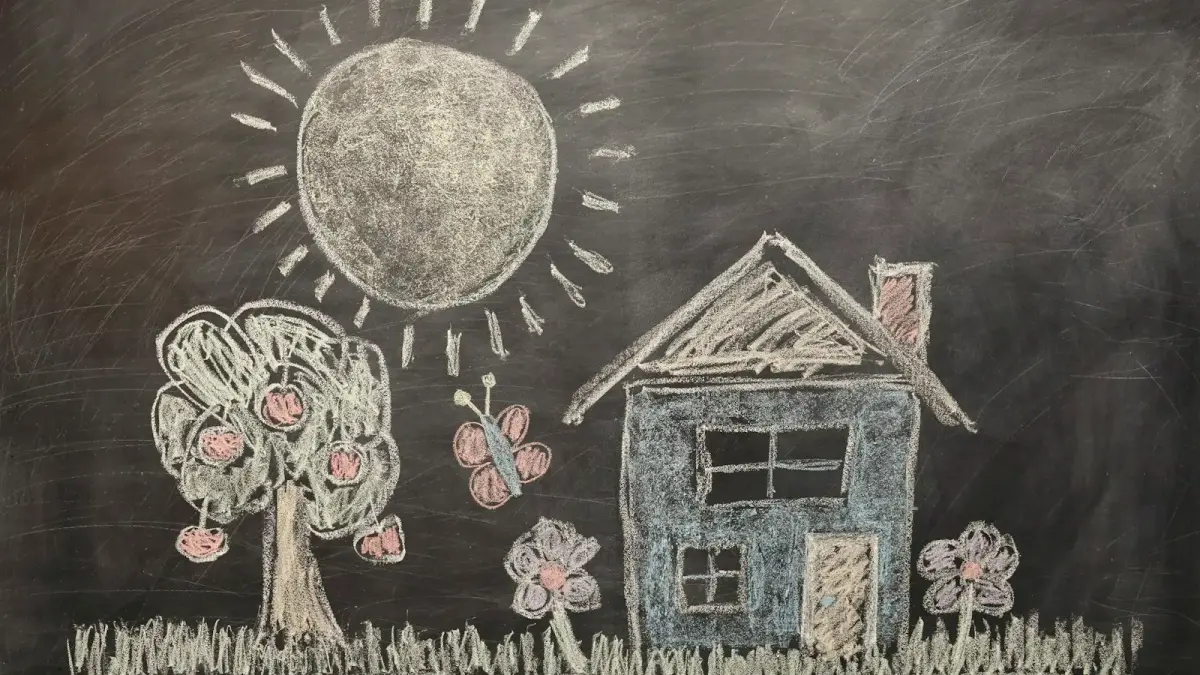
I found one of my old drawings in a box at my mother’s house last spring. I was maybe six or seven when I made it. There it was - a triangle roof, two square windows with curtains, a red door, a winding path through green grass, and a fat yellow sun beaming down from the upper right corner. Smoke curled from a chimney in a perfect lazy spiral.
We lived in a third-floor apartment in a brick building with no yard, no path, no chimney, and certainly no curling smoke. The windows were rectangular and didn’t have curtains until I was nine. There was no front door that belonged to just us - only a shared entrance that smelled like other people’s cooking.
I stared at that drawing for a long time. Not because it was charming, though it was. Because I recognized the feeling it was trying to hold. That little house on the page was not a memory. It was a wish. And I am only now beginning to understand how much of my adult life has been spent trying to walk up that crayon path and step inside.
The house every child draws
If you grew up in the Western world between 1950 and 2010, you almost certainly drew this house. The triangle roof. The symmetrical windows. The central door. The chimney. The sun. The path.
It didn’t matter if you lived in a ranch-style home or a duplex or a housing project or a mobile home. The house children draw is almost never the house children live in. Developmental psychologists have known this for decades, and what it reveals is both more tender and more significant than most people realize.
The House-Tree-Person test, developed by John Buck in 1948 and later expanded by Robert Burns and S. Harvard Kaufman, has been used by clinical psychologists for generations as a projective assessment tool. When children draw houses, they are not sketching their environment. They are externalizing their internal model of safety, containment, and belonging.
The triangle roof is stability. The windows are openness to the world. The door is accessibility - the belief that you can enter and leave freely. The chimney with its smoke says someone is inside, keeping things warm. The sun says the world outside is bright and not threatening.
That drawing is not architecture. It is emotional autobiography.
When the drawing and the reality don’t match
Here is where it gets interesting - and where it starts to hurt a little.
Children whose homes are stable and warm still draw the idealized house. But children whose homes are chaotic, unpredictable, or emotionally cold draw it with a kind of urgency that clinicians can actually detect. The lines are pressed harder. The house is drawn larger. The details are more elaborate - more flowers in the garden, more smoke from the chimney, more sun in the sky.
A 2019 study published in the journal Frontiers in Psychology found that children’s drawings of houses reliably reflected their perception of family warmth and cohesion, not the physical characteristics of where they lived. Children who reported feeling safe at home drew houses with open doors and large windows. Children who felt unsafe drew houses with smaller doors, missing windows, or heavy shading around the structure - as if building walls even on paper.
The child who draws the perfect house over and over, the one with the curling smoke and the sunny sky, when their actual home has none of those qualities - that child is doing something remarkable. They are constructing on paper what they cannot find in reality. They are building a psychological shelter with the only tools they have: a crayon and a blank page.
This is not escapism. This is survival architecture.
The blueprint that never gets erased
You might think children outgrow this. You might assume that once you understand your childhood home for what it was - messy, complicated, imperfect, maybe painful - you stop carrying around that imaginary house in your head.
You don’t.
Gaston Bachelard, the French philosopher, wrote in The Poetics of Space that the house is the original shelter of the imagination. He argued that every home we ever inhabit is experienced through the template of the first home we internalized - not the one we lived in, but the one we dreamed of. “The house we were born in is physically inscribed in us,” he wrote. But I think he was only half right. For many of us, the house that is most deeply inscribed is the one that never existed at all.
Environmental psychologists call this the “home schema” - an internal cognitive map of what safety, comfort, and belonging are supposed to feel like. It forms early, often before conscious memory, and it persists into adulthood with remarkable tenacity.
A 2021 study in the Journal of Research in Personality found that adults’ descriptions of their ideal living environment correlated more strongly with their childhood attachment style than with their actual childhood home. In other words, the house you dream of building says more about how loved you felt than about the house you grew up in.
If you grew up feeling secure, your internal blueprint tends to be flexible. Home can be many things - an apartment, a cabin, a noisy house full of people. The feeling of safety is portable.
But if you grew up feeling uncertain - if warmth was inconsistent, if the door didn’t always feel safe to walk through, if the people inside were unpredictable - your blueprint tends to be rigid and specific. You know exactly what home is supposed to look like. You have been drawing it your whole life.
The adults who are still building that house
You might recognize yourself in what I am about to describe.
You walk into a home goods store and something catches in your chest when you see a certain kind of lamp, a certain color of throw blanket, a certain arrangement of mugs on a shelf. It is not aesthetic preference. It is recognition. Something in you says: yes, this is what it was supposed to look like.
You light candles even though you live alone and nobody will see them. You arrange furniture so there is a clear path from the door to the couch because openness matters to you in a way you have never been able to explain. You plant flowers by your front door even though you rent and might move in a year.
You are building the house from the drawing.
John Bowlby, the father of attachment theory, described the concept of a “secure base” - the idea that healthy development requires a reliable home point from which a child can explore the world and return to safety. Children who had a secure base internalize it. Children who didn’t spend their lives trying to construct one externally.
This is why some adults are almost compulsive about their living spaces. It is not vanity or materialism. It is the developmental need for containment finally expressing itself with adult resources. The child who drew the house with two square windows and a triangle roof is now the adult who needs the kitchen to feel a certain way before they can relax. The chimney smoke has become the scented candle. The sunny corner has become the reading nook by the window.
The path to the front door has become the way you arrange your shoes by the entrance, neat and paired, because order at the threshold means the world makes sense for one more day.
Why the sun was always in the corner
There is a detail in the classic children’s house drawing that I think about more than any other. The sun.
It is always there. Upper right or upper left corner. Bright yellow with radiating lines. Sometimes it has a face. It watches over the house like a benevolent eye.
Children almost never draw rain falling on their ideal house. They almost never draw nighttime. The house exists in permanent daylight, permanent warmth, permanent visibility. Nothing is hidden. Nothing is approaching from the dark.
A 2018 study published in Psychological Science examined how early experiences of environmental predictability shaped adult tolerance for ambiguity. The researchers found that children who grew up in unpredictable environments - where routines were inconsistent, where parental mood shifted without warning - developed a stronger need for environmental control as adults. They preferred well-lit spaces. They disliked clutter. They wanted to see the door from wherever they sat.
The sun in the corner of the drawing was never decorative. It was a child’s way of saying: in this house, nothing comes without warning. In this house, you can see everything. In this house, there is enough light.
The house was never the point
What moves me most about this - what I keep returning to in my own work and my own life - is that the child who drew that house was never really drawing a building.
They were drawing a feeling.
Warmth. Containment. Symmetry. Light. A place where the door opens easily and the smoke curling from the chimney means someone is inside who is glad you came home. A path that leads somewhere certain. A sun that does not set.
The fact that this house didn’t exist - that it was invented from whole cloth by a small person with a box of crayons - does not make it less real. It makes it more real. Because the child was not copying what they saw. They were articulating what they needed. And that need was so clear, so precise, so universally felt, that children across cultures and decades and circumstances all drew essentially the same house.
If you are someone who still carries that blueprint - if you still feel a pang when you see a house with a triangle roof and a winding path and smoke rising from the chimney - I want you to know something.
You are not being nostalgic for a place that existed. You are being faithful to a feeling that always deserved to exist. The child who drew that house was not confused about where they lived. They knew exactly where they lived. They also knew, with a clarity that most adults have forgotten, what home was supposed to feel like.
And they were right.
You were right. You were always right about what you needed. The fact that you had to draw it because you couldn’t find it does not make you naive. It makes you someone who understood safety before anyone taught you the word.
That drawing was never just a drawing. It was the first house you ever built. And somewhere inside you, the light is still on.