Children who always made their bed perfectly before school - not because anyone asked, but because a child who could not control the chaos downstairs found that a made bed was the one square of the world that stayed exactly the way they left it - often become adults who clean when they are anxious and build routines so airtight that any deviation feels like free fall
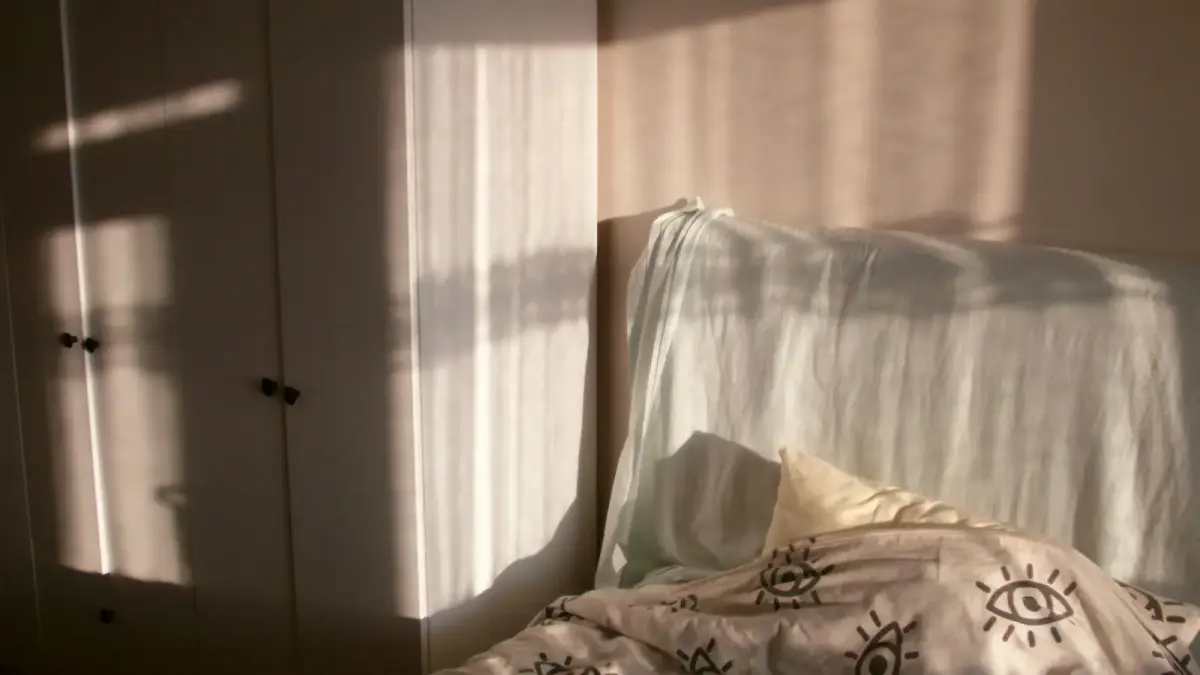
I was seven the first time I understood that a pillowcase could hold the whole weight of a day.
Not literally, of course. But I remember standing in my room before the sun was fully up, smoothing the wrinkles out of my comforter with both palms, tucking the edges under the mattress the way I had seen someone do on television. Downstairs, the kitchen was already loud. Cabinets closing too hard. Voices rising in that particular frequency that meant today was going to be one of those days.
I could not make the voices stop. I could not make the silence that followed any less frightening. But I could make my bed, and when I did, the room looked like a place where a person who had things figured out might live.
If you were that child - the one who lined up shoes, who wiped down counters nobody asked you to wipe, who needed your backpack zipped in a certain order before you could walk out the door - I want you to know something. That was not a quirk. That was not being “type A” or “a little OCD” or whatever casual label adults pinned on you. That was you, at an age when you barely had language for what you were feeling, building the only architecture of safety available to you.
And it probably followed you into adulthood in ways you are only now beginning to recognize.
The bed was never about the bed
Children are remarkable engineers of emotional survival. When the environment around them becomes unpredictable - when a parent’s mood shifts without warning, when the house runs on rules that change by the hour, when love feels conditional on performance - a child cannot change the system. They are too small, too dependent, too fundamentally powerless.
But they can change their corner of it.
A 2015 study published in the Journal of Personality and Social Psychology found that people who experience a loss of control in one domain instinctively seek to reassert control in another. The researchers called this “compensatory control” - and they observed it across ages, cultures, and contexts. When the big things feel ungovernable, we reach for the small things we can govern.
For a child in a chaotic home, the bed becomes the first canvas. It is the first place where effort produces a predictable result. You smooth the sheet, you place the pillow, and it stays. Nobody comes in and unmakes it with a slammed door or a shouted accusation. It holds its shape until you return.
That is an extraordinary thing for a child who has learned that almost nothing else does.
The ritual before the ritual
Here is what most people never understand about the child who kept their room immaculate: it was not about cleanliness. It was about rehearsal.
Every morning, before the chaos of the household could reach you, you had already completed something. You had already succeeded at one task. The bed was proof that your hands could produce order, that your effort meant something, that the world - at least this three-by-six-foot rectangle of it - responded to your intentions.
This is what developmental psychologists call “self-efficacy in micro-domains.” Dr. Albert Bandura’s foundational research on self-efficacy showed that belief in our ability to influence outcomes is not built from grand achievements. It is built from small, repeated experiences of competence. The child making their bed was not being fussy. They were constructing, stitch by stitch, a sense of agency that the rest of the house was systematically dismantling.
And the ritual expanded. Maybe it was the way you organized your desk. The way you folded your clothes into perfect squares. The way you needed the kitchen wiped down before you could sit and do homework. Each act was another brick in a wall between you and the feeling that everything was about to fall apart.
You were not rigid. You were building.
What it looks like now
If you were that child, you probably recognize yourself in some of these patterns as an adult.
1. You clean when you are anxious
Something goes wrong at work, and before you have processed a single emotion about it, the apartment is spotless. You cannot sit with the feeling until the counters are clear. People might joke about it - “stress cleaning” - as though it is a charming personality quirk. It is not a quirk. It is the oldest strategy you have, and it still works.
2. You cannot think in a messy room
Clutter does not just bother you aesthetically. It feels like noise. Visual disorder creates a kind of internal static that makes it genuinely hard to focus, to plan, to feel present. A 2011 study from the Princeton Neuroscience Institute confirmed this is not imagined - researchers found that visual clutter competes for neural representation, reducing working memory and increasing cortisol. Your brain is not being dramatic. It learned, correctly, that external disorder signals internal danger.
3. Your routines are airtight
Morning routine. Evening routine. The way you prep meals for the week, the order you check your emails, the specific path you walk through the house before bed. People call it discipline. You know it is something else. You know that if one piece slips - if the routine breaks, if something unexpected wedges itself into the sequence - the feeling that floods in is not inconvenience. It is something closer to vertigo.
4. You over-prepare for everything
You arrive early. You pack for contingencies. You have a backup plan for the backup plan. Not because you are particularly cautious by nature, but because the child in you learned that surprises were rarely good ones. Preparedness is the adult version of making the bed. It is you smoothing the wrinkles out of tomorrow before they have a chance to form.
5. You struggle to rest without earning it
Sitting still feels dangerous. Doing nothing feels negligent. You have to “finish everything” before you can relax, but the list never actually ends, so relaxation keeps getting pushed to a someday that never arrives. This is the legacy of a childhood where stillness meant you were available to be pulled into someone else’s storm. Busyness was not productivity. It was a shield.
6. Disruption hits you harder than it should
A canceled plan. A change in schedule. A friend who shows up twenty minutes late. These things register in your body as something much larger than the moment warrants. Because for you, disruption was never just disruption. Disruption meant the ground was shifting. It meant someone was angry, or leaving, or about to make the evening unrecognizable. Your nervous system learned to treat small changes as early warnings, and it never fully unlearned that.
The word nobody used
The word is hypervigilance. And if you grew up in a home where you had to monitor the emotional temperature of every room before you entered it, you know exactly what it feels like even if you have never heard the term.
Hypervigilance is the brain’s way of saying: I will never be caught off guard again. It scans for threats constantly - in tone of voice, in facial expressions, in the angle of a closed door. And it extends to physical space. A messy counter is not just a messy counter. It is data. It means someone was careless, or rushed, or upset, and the mess is evidence that something may have gone wrong while you were not watching.
This is why order feels like oxygen to you. It is not preference. It is your nervous system’s way of confirming that the environment is safe enough to inhabit.
The reframe you deserve
I want to be very direct about something. If you have spent years feeling embarrassed about your need for order - if partners have called you controlling, if friends have rolled their eyes at your routines, if you have quietly wondered whether something is wrong with you - I need you to hear this.
You built a survival system out of pillowcases and shoe racks and wiped-down counters. You did it when you were too young to drive, too young to vote, too young to leave. You did it with the only materials available to you. And it worked.
Gabor Mate has written extensively about how the adaptations we develop in childhood are not pathologies - they are intelligent responses to impossible environments. The child who makes their bed perfectly is not exhibiting early signs of a disorder. They are exhibiting early signs of resourcefulness, creativity, and an extraordinary will to find solid ground in a landscape that offered none.
Your need for order is not your damage showing. It is your brilliance showing. It is the part of you that refused to be consumed by chaos and instead built a small, portable version of the world you wished you lived in.
Where it can go from here
The adaptation that saved you as a child can sometimes limit you as an adult. And holding both of those truths at once is the real work.
You can honor the child who needed the bed made while also gently expanding your tolerance for the unexpected. You can keep your routines while also practicing the experience of things going sideways and surviving it. You can clean when you are anxious and also sit, just for five minutes, in a room that is not perfect and notice that you are still breathing, still here, still okay.
This is not about fixing yourself. There is nothing broken. This is about updating the software - recognizing that the threat level has changed, that you are no longer seven years old in a house where the weather shifted without warning. You are an adult now. You have a door you can close. You have a life you built with the same hands that once smoothed those sheets.
And that life - with its labeled containers and Sunday meal prep and the particular way you need the dishwasher loaded - is not evidence of damage.
It is evidence of a child who figured out, long before anyone taught them, that they were worth protecting. And then spent the rest of their life proving it, one made bed at a time.