Children who always pretended to be asleep when their parents checked on them at night - who closed their eyes and controlled their breathing the moment footsteps appeared in the hallway, who could perform unconsciousness so convincingly that no one ever thought to question it - often become adults who cannot let anyone see them in a state they did not choose, because a child who learned that being caught awake meant questions they were not ready to answer decided the safest version of being seen is one you have had time to rehearse
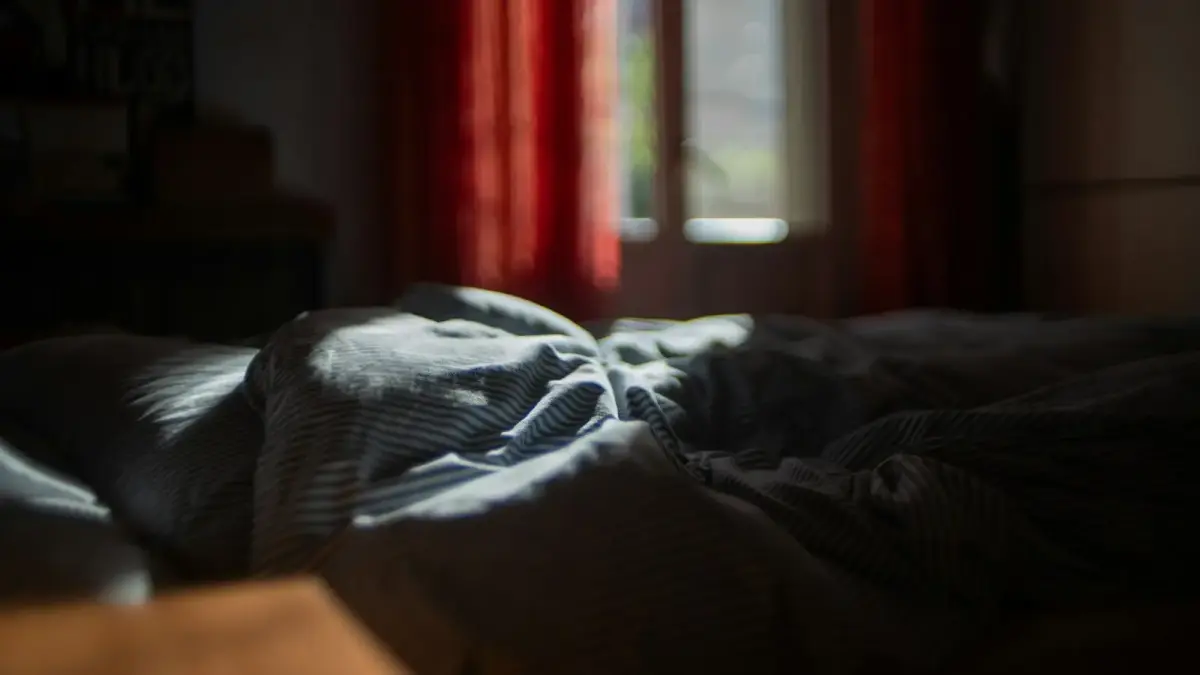
I was seven years old the first time I realized I could fool my mother into thinking I was asleep.
She opened the door slowly, the way she always did - just a crack, just enough to let a sliver of hallway light fall across the foot of my bed. I had heard her coming from three rooms away. The creak of the kitchen chair. The soft padding of socks on carpet. The particular rhythm of her footsteps when she was checking rather than passing through.
By the time the door moved, I was already gone. Eyes shut. Breathing slow. Body arranged in a position that looked like someone who had drifted off mid-thought rather than someone who had been lying awake cataloguing every sound in the house for the last two hours.
She stood there for a moment. I could feel her looking. And then the door closed, and I was alone again, and something in me understood - without words, without even a conscious thought - that I had just passed a test I would spend the rest of my life taking.
If you were that child, you already know what I am talking about. And if you are now an adult who cannot let anyone see you cry, who composes yourself before answering an unexpected phone call, who has never once let a partner witness you in the first raw minutes of grief or panic or confusion - this is where it started. In a dark bedroom, with your eyes closed, performing a version of yourself that felt safer than the real one.
The bedroom as the first stage
Most people think of pretending to sleep as a small thing. A childhood quirk. Something all kids do once or twice.
But for some children, it was not occasional. It was nightly. It was a system.
You learned the timing. You knew how long it took for a parent to walk from the living room to your door. You knew which floorboards announced their approach. You calibrated your breathing to match what sleep actually sounds like - slower, deeper, with that slight heaviness in the exhale that you had studied in yourself on the nights you genuinely fell asleep first and woke to the sound of someone entering.
A 2019 study published in the Journal of Child Psychology and Psychiatry found that children who develop heightened monitoring of parental behavior - tracking footsteps, listening for tone shifts, reading the atmosphere of a room before entering it - often do so in response to environments where a parent’s emotional state was unpredictable. The child learns to gather information before being seen, because being seen before you are ready carries a cost.
That cost was different for every household. For some children, being caught awake meant irritation. For others, it meant a conversation they were not equipped to have. For others still, it meant absorbing a parent’s anxiety, sadness, or need - becoming a container for feelings that did not belong to them.
The specific reason mattered less than the pattern it created. A child who learns that the moment of being discovered is a moment of vulnerability will build an entire personality around never being discovered unprepared.
What the performance actually taught you
Here is what nobody explains about those nights. You were not just pretending to be asleep. You were learning something far more sophisticated.
You were learning that there is a version of you that exists for other people, and a version of you that exists when no one is watching. And you were learning that the safest thing to do is make sure other people only ever encounter the first one.
This is not the same as lying. A child who lies knows they are deceiving someone. A child who performs sleep has internalized something deeper - the idea that your unguarded self is a liability. That the you who exists at 11 PM with your eyes open and your thoughts racing is someone who should not be witnessed.
Dr. Donald Winnicott, the British psychoanalyst, wrote extensively about what he called the “false self” - a protective identity that children construct when they sense that their authentic reactions are unwelcome or unsafe. The false self is not a mask in the dramatic sense. It is more like a reflex. You stop choosing to perform and start simply being the performance, so seamlessly that you forget there is anything underneath.
For the child in the dark bedroom, the false self was born in the three seconds between hearing footsteps and closing your eyes. In those three seconds, you made a decision that would echo for decades: I will not be caught being myself.
The adult version looks like competence
The thing about growing up this way is that it does not make you seem damaged. It makes you seem incredibly capable.
You are the person who never falls apart at work. You are the friend everyone calls in a crisis because you are calm, steady, already composed by the time you pick up the phone. You are the partner who processes their grief privately and emerges with a measured take on what happened, how you feel, and what you need - a summary so clean it sounds like you skipped the messy part entirely.
You did not skip it. You just did it alone, in the dark, the way you have always done everything that matters.
A 2021 study in Personality and Individual Differences found that individuals with high emotional concealment - the tendency to suppress or hide emotional responses from others - often score highly on measures of perceived social competence. Other people experience them as steady, reliable, and emotionally mature. What the study also found is that the same individuals report significantly higher rates of loneliness and emotional exhaustion.
Because here is the cost of being unfailingly composed: nobody worries about you. Nobody checks on you the way you check on yourself. Nobody thinks to ask how you are doing because you have made it so thoroughly clear, through decades of flawless performance, that you are fine.
And you cannot tell them you are not fine without first dismantling the entire identity you built to keep yourself safe.
The door check that never ended
Think about what you do now as an adult. Not the dramatic things - the small ones.
You hear your partner’s key in the lock and you quickly arrange your face. You wipe your eyes and steady your voice before calling back the friend who just left a voicemail. You sit in the car for three minutes after receiving bad news, not because you need the time but because you need to arrive inside the house already processed. Already handled. Already the version of you that other people are allowed to see.
Someone knocks on your door unexpectedly and your first reaction is not curiosity or warmth. It is a flash of something closer to alarm. Because for a fraction of a second, you are seven years old again and someone is about to open the door and you are not ready.
You are always, always getting ready. Your entire life is the three seconds before the door opens.
This is what developmental psychologists call hypervigilant self-monitoring - the continuous, often unconscious scanning of your own emotional state to ensure it is presentable before anyone encounters it. Dr. Judith Herman, in her work on complex trauma responses, describes how children who grow up managing the emotional climate of their household develop a “radar” that never fully turns off. Even in safe environments, even with people who would welcome their unguarded selves, they cannot stop preparing.
Why vulnerability feels like a system failure
If you grew up this way, you have probably had the experience of someone telling you they want to see the “real” you. A partner, a therapist, a close friend. They say it gently. They mean it kindly.
And something in you recoils. Not because you do not trust them. But because the real you - the awake-at-midnight, thoughts-racing, unprocessed, un-composed you - has never been safe to show anyone. You have no muscle memory for it. You have decades of muscle memory for the opposite.
Letting someone see you before you are ready feels like the emotional equivalent of being caught naked. It is not that you are hiding something shameful. It is that the act of being seen without preparation triggers a response so old and so deep that your body does not distinguish between a loving partner sitting on the edge of the bed and a parent opening the door at 11 PM.
A 2023 study in Frontiers in Psychology examined adults who reported chronic difficulty with emotional vulnerability in close relationships. The researchers found a significant correlation between this difficulty and childhood environments where emotional expression was met with dismissal, discomfort, or role reversal - where the child was expected to manage the parent’s response to the child’s feelings rather than simply having them.
This is the piece that makes it click. You did not learn to hide because your feelings were too much. You learned to hide because your feelings became someone else’s problem the moment they were visible. And a child who watches their sadness become their mother’s anxiety, or their fear become their father’s frustration, learns very quickly that the kindest thing to do - for everyone - is to feel things alone.
The rehearsal that never stops
Here is something you might recognize but have never said out loud.
You rehearse conversations before you have them. Not casually - thoroughly. You anticipate questions. You prepare answers. You map out the emotional trajectory of a discussion before it begins so that nothing catches you off guard, so that no one sees you fumble or search for words or - worst of all - feel something in real time that you have not yet decided how to present.
You compose texts and then rewrite them. You draft emails and sit with them. Not because you are a perfectionist in the usual sense, but because releasing any communication before you have controlled every variable feels reckless.
You practice. You have always practiced. The sleeping was practice. The steady voice was practice. The calm face in the bathroom mirror before you walked out to face whatever was happening in the living room - that was practice too.
And the exhausting part is that no one knows how much work it takes. They see the finished product - the composure, the steadiness, the person who always seems to have it together - and they assume it is effortless. They assume this is just who you are.
It is who you built. There is a difference.
What the child actually needed
The child in the dark bedroom did not need to be caught. That is an important distinction.
They did not need a parent to fling the door open and say “I know you are awake.” That would have been terrifying. That would have confirmed every fear - that vigilance was necessary, that being caught was dangerous, that the performance had to be even better next time.
What the child needed was an environment where being awake was allowed. Where a parent could open the door and find them sitting up, eyes open, and the response was not a question or a correction but a simple presence. A glass of water left on the nightstand. A hand on the blanket. A “you don’t have to sleep yet, I just wanted to check on you” that carried no weight, no agenda, no implicit demand to perform wellness.
What the child needed was to learn that being seen in an unfinished state was not a problem to be managed.
Learning to leave the door open
If you are reading this and feeling that specific tightness in your chest - the one that comes from being described too accurately - I want to tell you something you probably already know intellectually but have never felt in your body.
You are allowed to be seen mid-thought. Mid-feeling. Mid-falling-apart.
You are allowed to answer the door with red eyes. You are allowed to pick up the phone before you have composed your voice. You are allowed to sit next to someone you love and say “I don’t know how I feel yet” without following it with a tidy explanation.
The people who love you are not your parents in the hallway. They are not checking on you to see if you are performing correctly. Most of them - the good ones, the ones worth keeping - are checking on you because they want to know you. The real, awake, unfinished version of you.
You do not have to close your eyes anymore.
You spent your whole childhood perfecting the art of being found exactly as expected. The bravest thing you will ever do is let someone find you exactly as you are.
Not rehearsed. Not ready. Just awake, in the dark, finally willing to be seen that way.