Children who always walked quietly through the house - who learned by six which floorboards creaked and which were safe, who could move from bedroom to bathroom in complete darkness without making a sound, who treated every hallway like a negotiation between their body and a building that might betray their position - often become adults who walk softly everywhere they go, who move through hotels and offices and their own homes with a lightness that people mistake for grace but is actually the architecture of a childhood where being heard meant being found
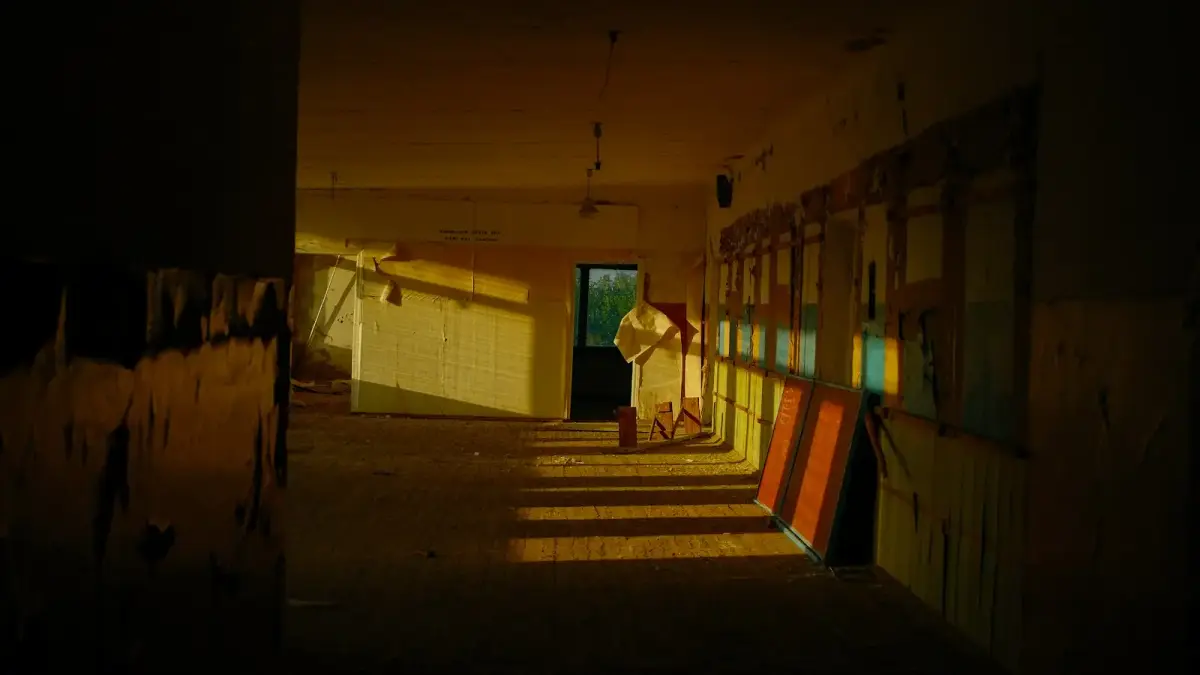
I still remember the third step from the top of the staircase in the house I grew up in. It groaned if you placed your weight in the center, but if you pressed your foot against the left edge - right where the wood met the wall - it stayed silent. I was maybe seven when I figured that out. I didn’t think of it as a skill at the time. It was just the way you moved through a house where the wrong sound at the wrong moment could change the entire temperature of an evening.
I mapped that staircase the way other children mapped their neighborhoods on bikes. Every step had a personality. Every floorboard in the hallway had a threshold of pressure it would tolerate before it spoke. I learned all of them by heart, the way you learn the combination to a lock - except the thing I was trying to unlock was safe passage.
Decades later, I still walk quietly. In hotels, in grocery stores, in my own apartment where nobody is listening and nobody cares. My feet know something my conscious mind has long moved past, and they refuse to forget it.
If any of this sounds familiar to you, what follows might explain why.
1. The Floorboard Map: How a Child’s Brain Learns Architecture as Survival
Children who grow up in unpredictable households develop an extraordinary spatial awareness. Not the kind that wins awards in geometry class - the kind that keeps you invisible.
By age five or six, these children have memorized the acoustic signature of every surface in their home. The hallway runner that muffles footsteps. The kitchen tile that’s cold but silent. The bedroom door that swings freely until exactly forty-five degrees, where the hinge catches and whines.
A 2018 study published in Development and Psychopathology found that children raised in high-threat environments show enhanced perceptual sensitivity to environmental cues - their brains literally rewire to detect and respond to sensory information that other children’s brains learn to filter out. This isn’t a flaw. It’s adaptation operating exactly as designed. The child’s nervous system identified a problem - sound attracts danger - and engineered a solution with the only materials available: attention, memory, and the body itself.
You didn’t know you were building a map. You just knew that the stretch of hardwood between your bedroom and the bathroom had three safe zones and two betrayal points, and that if you stepped carefully enough, you could cross it like a ghost.
2. The Door Handle Technique: Turning Silence Into a Physical Practice
There’s a particular way that quietly-raised children learn to open doors. You don’t just turn the handle and push. You grip the handle first, then rotate it fully before you move the door. You hold the latch in the retracted position so the door swings without clicking. When you close it behind you, you reverse the process - hold the handle, ease the door into the frame, then release the latch slowly until it seats itself without a sound.
This is not something anyone teaches you. There is no lesson, no instruction manual. You learn it through trial and error at three in the morning when you need a glass of water and the house feels like it’s holding its breath.
The technique becomes automatic. It writes itself into your muscle memory so deeply that decades later, you still close every door this way. Bathroom doors in restaurants. Your car door in the parking garage. The door to your own bedroom in a home where you are the adult and there is nothing to be afraid of.
Your hands remember what your mind has tried to release. And every silent door closure is a tiny performance of a skill you wish you’d never needed to develop.
3. The Staircase Math: Weight Distribution as Childhood Calculus
Stairs were the final exam. Every other surface in the house offered some workaround - a rug, a shortcut, a path along the wall where the boards were nailed tighter. But stairs funneled you into a narrow channel of unavoidable wood, and each step had its own voice.
Quietly-raised children learn a kind of intuitive physics. They discover that spreading weight across the ball of the foot produces less sound than a heel strike. That the edges of stairs creak less than the centers. That speed matters - too slow and you put prolonged pressure on a single point, too fast and the rhythm of footfalls becomes its own announcement.
Research by Dr. Martin Teicher at Harvard Medical School has documented how early adversity shapes the developing brain’s stress-response architecture. The neural pathways that govern motor control, threat detection, and environmental scanning become interconnected in ways they don’t in children who grow up feeling safe. The child doesn’t just learn to walk quietly. Their entire nervous system reorganizes around the principle that the body must be managed, monitored, and controlled at all times.
You carried that staircase math into adulthood. You are the person who instinctively walks on the outer edge of steps in old buildings. The person who tests an unfamiliar staircase with one careful foot before committing your weight. Not because you’re afraid. Because your body still runs the calculations without asking your permission.
4. The Breathing Room: Learning to Shrink Your Acoustic Footprint
It wasn’t just footsteps. The truly quiet children learned to manage every sound their body produced.
Breathing through your mouth because nasal breathing was too loud in a silent hallway. Timing your coughs to coincide with the television’s louder moments. Learning how to cry without making noise - not silently, exactly, but on a frequency so low it wouldn’t carry through walls.
A 2021 study in Frontiers in Psychology examined the long-term physiological effects of childhood hypervigilance and found that adults who grew up in threatening environments often maintain suppressed respiratory patterns - shallower breathing, lower vocal volume, and reduced spontaneous vocalization compared to controls. The body learned to take up less acoustic space, and it never received the signal that the emergency was over.
You might notice this in yourself as the person who speaks softly in every setting. The one whose colleagues say “you’re so calm” when really you’re just quiet in a way that was never about calm. The person who has been told to “speak up” so many times that the phrase itself produces a small bloom of shame, because you know the volume isn’t a choice. It’s a setting that got locked into place before you had the language to understand why.
5. The Surprise Arrival: When People Never Hear You Coming
Here’s where the childhood pattern shows up most visibly in adult life: you startle people constantly. Not on purpose. Never on purpose. But you walk into rooms and people jump. You appear beside a colleague’s desk and they clutch their chest. You come around a corner in your own home and your partner gasps.
“You move like a cat,” people say. Or, “I didn’t even hear you.” They mean it as a compliment. They think it’s charming or funny or slightly mysterious. They don’t know that every time they flinch at your presence, something inside you flinches too - because the whole point of learning to move silently was to avoid exactly this kind of reaction. You learned to be undetectable, and now you’re so good at it that your very existence in a room registers as an intrusion.
This pattern can be genuinely disorienting. You start to doubt your own right to be in spaces. You over-announce yourself - knocking on open doors, clearing your throat before entering kitchens, calling out “just me” when you walk into your own living room. You’ve built a lifetime of compensatory behaviors to manage a silence you can’t turn off.
6. The Inability to Stomp: When the Body Refuses to Be Loud
There’s a telling moment that reveals this pattern for what it is: anger.
Most people, when they’re furious, get louder. They slam doors. They stomp. Their bodies expand to fill the emotional space. But if you were a quiet child - if silence was your operating system - anger doesn’t make you loud. It makes you quieter. More controlled. More precise in your movements.
You might notice that you physically cannot stomp your feet, even in private. That slamming a door feels so transgressive it floods you with adrenaline. That raising your voice, even in justified frustration, triggers something that feels less like anger and more like terror.
This is not a personality trait. This is a nervous system that learned, at a very young age, that volume equals danger. And that equation doesn’t reverse just because you’ve grown up, moved out, and built a life where no one is listening at the other end of the hallway.
7. The Hotel Hallway: Carrying Quiet Into Spaces That Don’t Require It
You can spot a quietly-raised adult in any hotel corridor in the world. They’re the ones padding down the hallway at midnight with their shoes in their hand. The ones who ease their room key into the lock like they’re defusing something. The ones who run the bathroom faucet at a trickle because the pipes might wake a stranger on the other side of a wall they’ll never see.
Nobody asked them to be this considerate. Nobody in that hotel will notice or care. But the quiet has become constitutional. It’s not a behavior they perform - it’s the medium they move through. Sound, for them, has never been neutral. It has always been consequential, always been a variable that needed managing, always carried the weight of potential fallout.
And so they manage it everywhere. In airports. In the break room at work. In their partner’s apartment on a Sunday morning, tiptoeing to the kitchen to make coffee as though the building itself might object to their presence.
8. The Soft Voice Extension: When Silence Becomes Identity
The quiet doesn’t stay in your feet. It migrates. It becomes your speaking voice, your laugh, the way you set a glass down on a table. It becomes the way you eat - no clinking silverware, no chewing that anyone could hear. It becomes the care with which you close a laptop, end a phone call, place your keys on the counter.
People describe you as gentle. Thoughtful. Considerate. And you are all of those things. But underneath the gentleness is a blueprint that was drawn in a child’s hand, in the dark, in a house where being perceived was a risk.
The work of healing isn’t learning to be loud. It’s learning that quiet can be a choice instead of a mandate. It’s noticing the moments when your body automatically dims itself and asking, gently - do I want to be quiet right now, or am I just running the old program?
You don’t have to stomp to prove you’ve healed. You don’t have to slam doors or raise your voice or announce yourself in rooms. But you deserve to know that the silence you carry isn’t a personality trait. It’s a testimony. It’s the record of a child who figured out how to move through a dangerous world using nothing but attention and the soles of their feet.
And if no one has told you this before - that quiet you carry, the one that surprises people and makes you feel like a ghost in your own life - it’s not a flaw. It’s proof that you survived something that required extraordinary intelligence, extraordinary sensitivity, and an extraordinary willingness to bear the weight of an entire household’s emotional weather in your small, careful body.
You learned the floorboard map. You mastered the door handle technique. You calculated the staircase math.
And you made it out.