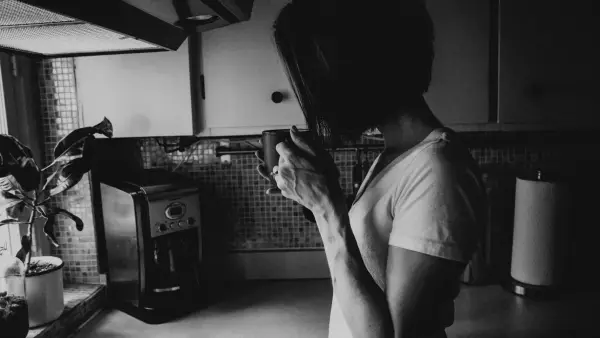
Children who always colored inside the lines - who pressed gently with every crayon, who never let a single stroke cross the border, who took twice as long as every other child because precision was the only language that earned approval - often become adults who cannot start anything without a plan, because a child who learned that the border between acceptable and unacceptable was exactly one crayon-width wide never stopped believing that control and safety were the same thing

I found a coloring book in a box in my mother’s garage last spring. It was mine, from kindergarten. Every single page was filled in with painstaking precision - soft, even strokes that never once wandered past the printed black border. I remember holding it and feeling something I didn’t expect.
Pride. And then, right behind it, a wave of sadness so sharp it startled me.
Because I also found my daughter’s coloring book from the same age. Hers was chaos. Purple trees. Orange skies. Crayon marks that exploded past every border like the lines were suggestions she had politely declined. She had finished each page in minutes. Mine had probably taken me an hour.
I stood there in my mother’s dusty garage holding both books, and I understood something I had been circling for thirty years. My daughter colored like a child who felt safe enough to make a mess. I colored like a child who believed the mess was the danger.
That realization has unraveled more about my adult life than any therapy session. Because the thing about coloring inside the lines is that nobody tells you it’s a life philosophy. It just becomes one. Quietly. Completely. Until you’re forty-three years old and you cannot start cooking dinner without a recipe, cannot begin a work project without a detailed outline, cannot take a road trip without mapping every single stop in advance.
Here are the ways that careful little coloring-book child shows up in your grown-up life - and why recognizing them might be the first step toward letting a few strokes wander.
1. You cannot deviate from a recipe
You follow recipes like they are legal documents. A pinch means a pinch. When it says “season to taste,” you feel a small flutter of panic because that is not an instruction - that is an abandonment.
You have never once looked at a recipe and thought, “I’ll just wing it.” The idea of substituting an ingredient without Googling whether it will work feels reckless. Cooking without measurements feels like driving without a map.
This is not about food. This is about the deep, bone-level belief that improvisation is a form of risk. A 2016 study published in the Journal of Personality and Social Psychology by Gordon Flett and Paul Hewitt found that socially prescribed perfectionism - the kind driven by the belief that others demand perfection from you - often originates in childhood environments where approval was conditional and mistakes were met with visible disappointment. The recipe is the coloring book. The borders are still there. You just traded crayons for measuring cups.
2. You always need a plan before you begin
You do not start things. You prepare to start things. There is a difference, and you have lived inside that difference your entire life.
Before you begin a project at work, you outline it. Before you outline it, you research. Before you research, you make a list of what to research. The planning becomes its own activity - sometimes more consuming than the project itself.
The reason is simple and painful: if you plan thoroughly enough, you cannot be caught off guard. And if you cannot be caught off guard, you cannot fail in a way that anyone can see. The child who took twice as long at the coloring table wasn’t slow. She was building a buffer between herself and criticism. The plan is the adult version of that buffer - a way to make sure that every stroke lands exactly where it should before you ever pick up the crayon.
3. Open-ended situations make you quietly desperate
“Just see where the day takes you.” Few sentences in the English language produce more anxiety in your body.
You need parameters. You need to know what time things start and end, what the dress code is, where you’ll park, whether there will be food. When a friend says, “Let’s just hang out this weekend,” you nod and smile while internally constructing a seventeen-step contingency plan.
Arie Kruglanski’s research on the need for cognitive closure helps explain this. His work, published across decades of study in the Journal of Personality and Social Psychology, describes people with a high need for closure as those who experience ambiguity as genuinely distressing. They crave definitive answers and predictable frameworks. Open-endedness is not freedom to them. It is freefall. And the child who colored inside the lines learned very early that structure was the opposite of danger.
4. Spontaneity feels like a threat dressed up as fun
Your friends think you are a planner. They use words like “organized” and “reliable.” They do not understand that what they are describing is not a personality trait. It is a survival strategy wearing a cardigan.
When someone suggests a last-minute trip, a sudden change of restaurant, an unplanned detour, you feel your whole body tighten. Not because the new plan is bad - but because the old plan was safe, and safety is not something you give up easily when you spent your childhood earning it one careful crayon stroke at a time.
You have said “maybe next time” to more adventures than you can count. Not because you didn’t want to go. But because going would have meant trusting the unplanned moment, and the unplanned moment is where your childhood taught you that mistakes lived.
5. You check and recheck your work until the checking becomes the work
You have read an email fourteen times before sending it. You have reviewed a presentation so many times that you could deliver it in your sleep, and you still lie awake the night before convinced you missed something.
This is not conscientiousness. This is a child sitting at a table, holding a crayon up to the light, checking whether any color has bled past the printed line. The checking is not about quality. It is about protection. If you check enough times, no one can find the flaw before you do. And if no one finds the flaw, no one has a reason to withdraw the approval you have been performing for since you were five years old.
Flett and Hewitt’s extensive work on perfectionism dimensions describes this pattern as self-oriented perfectionism - the relentless internal standard that nothing you produce is ever quite finished, quite polished, quite safe enough to release into the world where other people might see it and judge.
6. “Good enough” sounds like giving up
Someone once told you that done is better than perfect. You nodded. You understood it intellectually. And then you went home and spent three more hours adjusting something that was already finished.
The psychoanalyst Donald Winnicott wrote about the concept of the “good enough mother” - the idea that perfection in caregiving is neither possible nor desirable, and that adequate, imperfect love is what actually allows a child to develop resilience. But you were not raised in a house that believed in good enough. You were raised in a house where good enough was the territory between the crayon line and the border - the gap where criticism lived.
So you cannot hear “good enough” as permission. You hear it as a warning. You hear it as the moment just before someone looks at your coloring page and says, “You went outside the line right here.”
7. You choose the safe option even when the exciting one is calling your name
You took the stable job instead of the creative one. You married the person who made sense instead of the one who made your chest ache. You picked the neighborhood with good schools and low crime rates and never once admitted, even to yourself, that you sometimes dream about living somewhere with no plan at all.
This is not cowardice. This is the coloring book. The safe option has visible borders. It has a clear picture printed on the page. You know what it is supposed to look like when it’s finished. The exciting option is a blank page, and a blank page is the most terrifying thing in the world to a person who learned that the only acceptable art is the kind that stays inside someone else’s lines.
8. You apologize for things that don’t require an apology
You say sorry when your house is slightly untidy. You apologize for crying. You preface every creative act with a disclaimer - “It’s not very good” or “I just threw this together” - because you learned early that the only thing worse than imperfection is imperfection that you seemed to be okay with.
The apology is a preemptive strike. If you name the flaw before anyone else does, you control the narrative. You get to be the one who notices, who corrects, who demonstrates that you know the border was crossed and you feel appropriately bad about it. The child who colored inside the lines didn’t just want praise. She wanted to make sure no one ever had a reason to look at her work and find it lacking.
9. You feel both anxiety and envy when you watch someone make a beautiful mess
This is the one that broke me open.
I watch my daughter paint. She uses her hands. She mixes colors that should not work together and somehow they do. She does not ask me if it’s good. She does not check the borders because she does not see borders. She just creates - freely, wildly, without the invisible audience that has watched over my shoulder for as long as I can remember.
And I feel two things at once. The first is anxiety - a tightening in my chest that whispers, someone should teach her to be more careful. The second is envy so deep it makes my eyes sting. Because she has something I have spent my whole life trying to earn back. She has the freedom to make something imperfect and believe it is still worth making.
I am not going to tell you to throw away your plans and start coloring outside the lines. That would be dishonest, and honestly, it would terrify me as much as it would terrify you.
But I want you to know something. The child who colored so carefully was not broken. She was brilliant. She read the room before she could read a book. She understood, at four or five years old, what the adults around her needed to see, and she produced it. That is not a flaw. That is a kind of emotional intelligence that most people never develop.
The problem is not that you learned to stay inside the lines. The problem is that you never learned there was anything else. You never got the permission - from a parent, a teacher, a world that rewards compliance - to discover what your art looks like when nobody is grading it.
You are not rigid. You are not boring. You are not “too type-A” or “too controlling” or whatever word people have used to describe the architecture of your survival.
You are a person who built an entire life inside borders that someone else drew. And the most radical thing you may ever do is pick up a crayon - metaphorically or literally - and let one single stroke wander past the edge.
Not because the picture will be better.
Because you will finally know that it can be yours.