Children Who Always Knew Which Grocery Store Aisle Their Mother Would Cry In - the Cleaning Products Where Nobody Lingered - Often Become Adults Who Can Recognize Grief in a Public Place Before Anyone Else in the Room Notices It
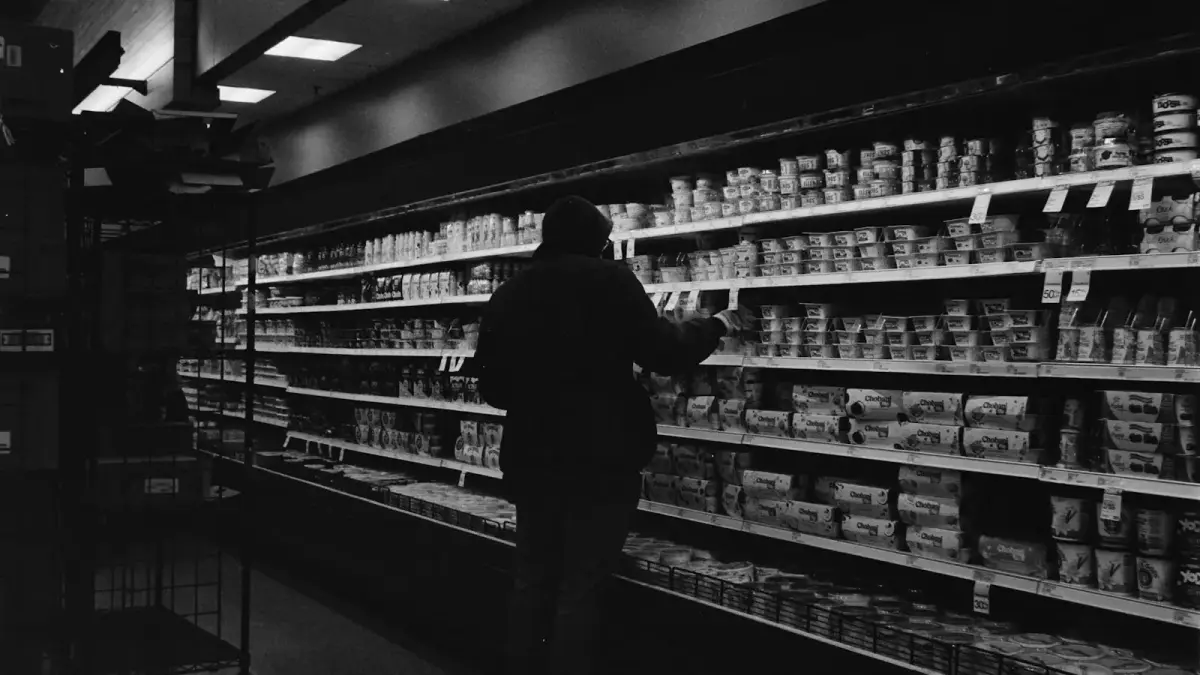
I was eight years old the first time I realized my mother had a route through the grocery store that had nothing to do with efficiency and everything to do with where she could fall apart without being seen.
She always started in produce. Produce was a performance aisle. Other mothers were there, squeezing avocados, comparing lettuce. She smiled in produce. She asked me about school in produce. In produce, she was fine.
But somewhere between the cereal and the cleaning supplies, the route would shift. She’d steer the cart toward the back of the store - paper towels, trash bags, the chemical smell of bleach and floor cleaner - and her pace would slow. Her hand would drift from the cart to the shelf, and she’d stand there reading the label on a bottle of dish soap like it contained instructions for how to keep going. I learned to stand very still during those moments. I learned that the cleaning products aisle was where she went to be invisible, because nobody lingers near the mop heads and the drain cleaner. Nobody makes eye contact there.
I didn’t know the word “grief” yet. But I had already mapped its geography.
1. The grocery store was never just a grocery store
For some children, a public errand is a covert emotional operation. You aren’t picking out cereal. You’re scanning your parent’s face in the rearview mirror during the drive over, reading the tension in their grip on the steering wheel, and calculating whether this will be a good trip or a quiet one.
A 2014 study published in the journal Child Development found that children in emotionally unpredictable households develop accelerated facial recognition skills - they learn to read micro-expressions faster and more accurately than their peers. The researchers framed this as a form of “biological adaptation to threat.” But what it actually looks like, from the inside, is a child who knows their mother is about to cry before she does.
The grocery store, with its fluorescent lights and public-facing architecture, becomes a testing ground. There are aisles where grief can hide and aisles where it cannot. A child who has made this map does not forget it.
2. Some aisles were for performance, and some were for falling apart
Every grocery store has a social geography that most people never notice. Produce is near the entrance, bright and open. The deli counter has employees who make small talk. Checkout requires conversation, eye contact, the performance of normalcy.
But the back aisles - cleaning supplies, paper goods, the freezer section where the hum of the compressors covers the sound of a shaky breath - those are the aisles where a person can disappear for ninety seconds and no one will wonder why.
As a child, I learned this geography not from a textbook but from watching my mother navigate it. I knew that if she turned left at the end of aisle six instead of right, we were heading toward the paper towels, and the paper towels meant she needed a minute. I would pretend to be interested in the packaging of napkins. I became an expert at looking like I wasn’t watching.
3. The child was not shopping - the child was conducting surveillance
This is the part that’s hardest to explain to people who didn’t grow up this way. You were not a child being dragged along on an errand. You were an intelligence analyst embedded in a domestic operation, and your entire nervous system was oriented toward one question: Is she okay right now, and if not, how bad is it going to get?
You tracked micro-expressions the way air traffic controllers track radar. A tightened jaw in the frozen foods section. A too-long pause in front of the greeting cards. The specific way she said “we don’t need that” when you reached for something - was that a normal no, or was that the voice that meant the ground was shifting?
A 2019 study in Psychological Science documented what researchers called “threat-related attentional bias” in children from high-stress homes. These children could identify a fearful expression on a face sixty milliseconds faster than their peers. Sixty milliseconds. That is not empathy as a soft skill. That is empathy as a surveillance architecture.
4. You learned that sorrow has a preferred hiding place
Here is what most people don’t understand about grief in public: it doesn’t happen randomly. People who are breaking down in a grocery store or a department store or a parking lot are not doing it in the middle of the crowd. They find corners. They find aisles where the traffic is low. They turn their faces toward shelves and pretend to read labels.
You learned this at eight because you watched it happen in real time, over and over. You learned that a person crying in public will almost always orient their body toward something - a wall, a shelf, a car window - because turning away from the open space is the last act of control a person has when everything else is falling apart.
And so now, at forty-seven, when you walk into a room and something pulls your attention to the person standing a little too still by the window, or the woman in the office kitchen who is holding her coffee mug with both hands and staring at the wall, you don’t know how you know. But you know.
5. The “performance aisles” trained you to recognize masks
It wasn’t just the grief aisles that taught you something. The performance aisles - produce, checkout, anywhere other people might see - taught you something equally powerful. They taught you what it looks like when a person is pretending to be fine.
Your mother’s voice changed in the performance aisles. It became a half-step brighter. Her posture straightened. She made jokes to the cashier. And because you had just watched her cry silently in aisle nine, you knew exactly how much effort that brightness cost.
This is why you can walk into a dinner party and within ten minutes identify who is performing and who is actually present. It isn’t intuition. It is a pattern-recognition system that was calibrated in childhood by thousands of hours of data collection. You know what it looks like when a smile doesn’t reach the eyes because you spent years watching smiles that didn’t reach the eyes and calculating what that meant for your evening.
6. This kind of empathy was never a gift - it was an assignment
People will tell you that you’re “so empathetic” or “so perceptive” like it’s a compliment. Like you won a personality lottery. They don’t understand that this skill was not chosen. It was assigned.
Research published in the Journal of Personality and Social Psychology in 2016 distinguished between what the authors called “empathic accuracy” - the ability to correctly identify what another person is feeling - and “empathic concern” - the motivation to respond with care. Children who grew up monitoring a parent’s emotional state scored unusually high on empathic accuracy but often struggled with empathic concern, because the system wasn’t built for compassion. It was built for prediction. The goal was never to help the person who was hurting. The goal was to know what was coming so you could prepare.
This is the difference that nobody talks about. The child in the grocery store wasn’t learning empathy. The child was learning threat assessment.
7. The surveillance system never received a decommission order
You are no longer eight. Your mother’s grief is no longer your assignment. But the system you built - the one that scans every room, reads every face, tracks every shift in vocal tone and body language - is still running.
It runs at restaurants when the couple at the next table goes quiet in a specific way. It runs at work when your colleague’s email sign-off changes from warm to clipped. It runs at family gatherings when someone laughs a half-beat too late.
You cannot turn it off because it was never designed to be turned off. It was designed to run continuously, in the background, like an old program that boots up every time you start the machine. There is no off switch because the child who built it didn’t know adults are supposed to have off switches.
8. You are not “too sensitive” - you are precisely calibrated
If you recognize yourself in any of this, I want you to hear something clearly. You are not overly sensitive. You are not “too much.” You are not imagining things when you notice what nobody else notices.
You are running a perceptual system that was built under extraordinary conditions. A child who needed to map the emotional topography of a grocery store in order to feel safe developed a level of perceptual acuity that most adults will never achieve. That is not a flaw. It is an adaptation.
The exhaustion you feel at the end of a day spent around other people - that is not weakness. That is the cost of running a surveillance system at full capacity in environments that no longer require it. Your nervous system is doing exactly what it was trained to do. It just never got the memo that the mission is over.
You learned the layout of grief before you learned long division. You mapped your mother’s emotional geography in a fluorescent-lit grocery store while other children were asking for cookies. And now you carry that map everywhere, unfolded and active, reading rooms and faces and silences with a precision that startles even you sometimes.
That is not a burden you chose. But it is a capacity you built, and it is real, and it is yours. The child who stood very still in the cleaning products aisle, pretending to read the label on a bottle of dish soap, was doing something remarkable. They were paying the kind of attention that most people never learn to pay.
You still pay it. Every room you walk into. Every face you scan without meaning to. Every time you notice the woman standing too long in aisle twelve and feel something tighten in your chest - that is the eight-year-old, still watching, still mapping, still keeping everyone safe the only way they knew how.
You were never too sensitive. You were exactly sensitive enough.