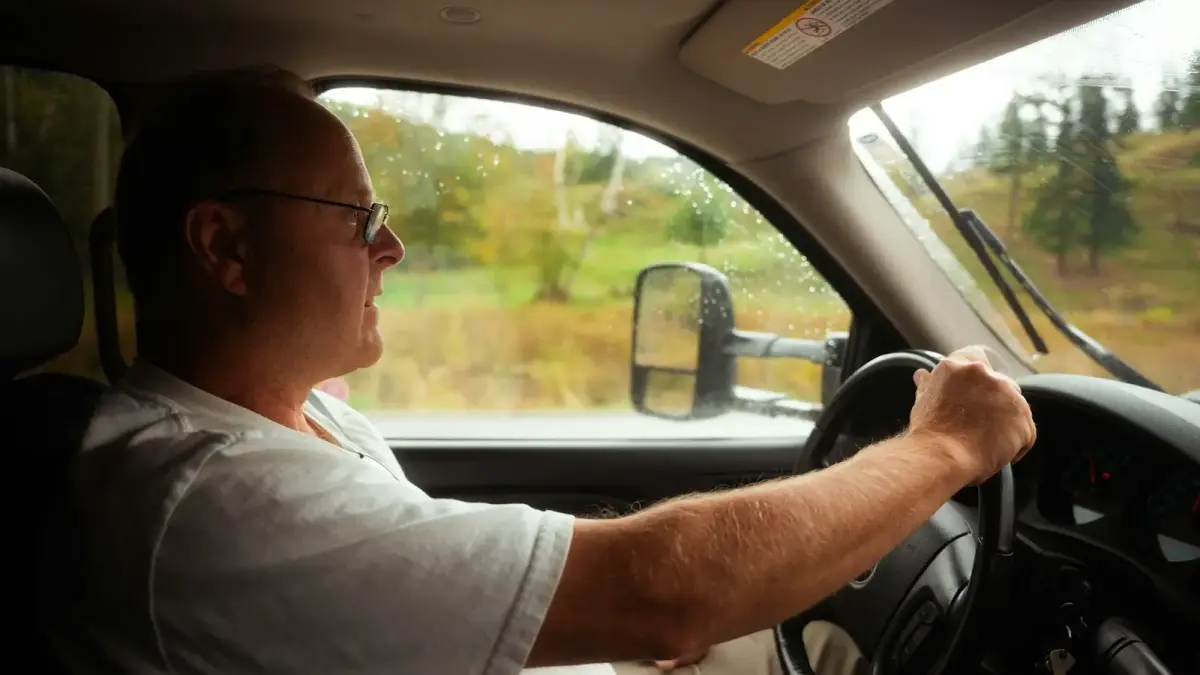
He's 62 and reads every sign aloud when he drives - exit numbers, restaurant names, gas prices, church marquees - because his father did the same thing for forty years, and a boy who watched a man who left school at fifteen read the entire visible world out loud understood without being told that literacy was not a skill his father took for granted but proof of purchase on an education the world decided he did not deserve to finish
The Mouth That Never Stops Narrating
I was eleven years old in the back seat of my father’s Buick when I first noticed he was doing it.
“Texaco. Three forty-nine a gallon.” A pause. “First Baptist Church - Wednesday Night Supper, All Welcome.” Another pause. “Exit 14, Danville, next right.”
He wasn’t talking to anyone. My mother was asleep in the passenger seat. My sister had her headphones on. I was the only one listening, and I don’t think he knew that. He was just reading. Everything. Every sign the road put in front of him, he spoke aloud like a man in conversation with the landscape.
I didn’t think it was strange. I thought that’s what driving was. You moved through the world and you named it.
It took me fifty years to understand why.
A Habit With No Obvious Origin
My daughter asked me about it last spring. We were driving to her place outside Charlotte, and I’d been doing what I always do - reading the road.
“Cracker Barrel, next exit.” “Speed limit forty-five.” “Carolina Family Dentistry, now accepting new patients.”
She laughed. Not cruelly. More like someone who had been saving a question for a very long time.
“Dad, why do you read everything out loud?”
I opened my mouth. Nothing useful came out. I said something about keeping alert, about staying engaged with the road. She nodded the way people nod when they know you’re making something up in real time.
The honest answer - the one I didn’t have language for until I sat with it for weeks afterward - is that I do it because my father did it. And my father did it because reading was not something he could afford to treat as ordinary.
The Boy Who Left School at Fifteen
My dad dropped out in 1959. Tenth grade. His father had a bad back and the family needed someone on the floor at the mill in Gastonia. That was it. No ceremony. No guidance counselor intervention. One Monday he was in school and the next Monday he wasn’t.
He never talked about it with bitterness. That’s the thing people from comfortable backgrounds don’t always understand about working-class silence. It isn’t suppression. It’s acceptance so complete it doesn’t register as loss anymore. He didn’t mourn his education because mourning implied he’d ever had the luxury of expecting one.
But he read everything.
Not books, usually. He wasn’t a book man. But the newspaper, front to back. The labels on cans. The instructions that came with anything mechanical. The historical markers at every rest stop we ever pulled into on family trips, standing there in the sun reading every word while we shifted from foot to foot wanting to get back in the car.
And signs. Every sign the world offered, he read aloud.
Literacy as Something Earned
I’ve been thinking about what it means when a man who left school at fifteen treats the printed word with a kind of reverence that people who finished school never develop.
A 2018 study published in the Journal of Research in Personality found that first-generation learners - people who were the first in their families to access higher education - carried what researchers called “educational vigilance” throughout their lives. A heightened awareness of learning opportunities. A tendency to treat knowledge as scarce and therefore precious. The study noted that this vigilance often became unconscious, expressing itself in small, persistent habits rather than grand intellectual pursuits.
My father’s sign-reading was exactly that. Educational vigilance made audible.
He wasn’t struggling with the words. I want to be clear about that. My dad was sharp. He could do math in his head that would send most people reaching for a calculator. He wrote in clean, careful cursive. His spelling was better than mine, and I finished college.
He read signs aloud not because reading was hard but because it was holy. Because a boy who got pulled out of school to work understood at a cellular level that the ability to decode the written world was not a given. It was proof that he had learned something before they took the chance away.
The Inheritance Nobody Names
Here’s what nobody tells you about growing up working class: you inherit behaviors without inheriting the reasons behind them.
I graduated high school. I went to community college, then state university. I have never worried, not for a single day in my adult life, that I might not be able to read a road sign. Literacy is as natural to me as breathing.
And yet I read every sign aloud.
“Bojangles, next left.” “Historical marker ahead.” “Bridge freezes before road surface.”
I do it in the car alone. I do it with passengers who did not ask for a guided tour of every business along Highway 74. I do it and I don’t notice I’m doing it until someone asks me why.
Sociologist Annette Lareau wrote extensively about how social class shapes parenting practices and how those practices create patterns that echo across generations. Her research, published across several landmark works including in the American Sociological Review, showed that working-class families tend to organize life around what she called “the accomplishment of natural growth” - a framework where children absorb their parents’ orientations toward the world through observation rather than explicit instruction.
I was never told to respect literacy. I was never told that reading was precious. I watched a man treat the printed word like it mattered, and I absorbed the posture without understanding the economics behind it.
The Church Marquee He Read Three Times
There’s a memory I keep returning to. We were driving through Shelby on a Saturday, my father and I, some errand I don’t remember. A church on the left had one of those black letter boards with the removable white letters.
“The ground is level at the foot of the cross,” my father read aloud.
We drove past. He was quiet for a moment.
“That’s good,” he said. “The ground is level at the foot of the cross. That’s a good one.”
Then about a quarter mile later, almost to himself: “The ground is level at the foot of the cross.”
Three times. He read it, he evaluated it, he repeated it. Like a man tasting something and wanting to remember the flavor.
I was maybe thirteen. I didn’t think anything of it at the time. Now I’m sixty-two and I understand that I was watching a man who’d been denied the full education he deserved practicing the only form of scholarship available to him. The roadside. The bulletin board. The gas station marquee. He turned the ordinary printed world into his classroom, and he never stopped attending.
The Price Tag Nobody Sees
People who grew up with education as a given - who went to school because of course you go to school, who read books because of course there are books - sometimes mistake working-class habits for quaintness. The father who reads signs aloud. The mother who saves every piece of mail. The grandfather who watches Jeopardy every single night and whispers the answers, keeping score against himself.
These aren’t charming eccentricities. They’re scars of access.
A 2021 study in Psychological Science examined what researchers called “resource scarcity mindsets” and found that people who experienced educational scarcity - limited access to schooling, books, or learning environments - developed lasting cognitive patterns of attention toward informational resources. Even decades after the scarcity ended, the heightened attention remained. The brain, having once learned that knowledge was rare, never fully recalibrated to abundance.
My father’s brain never recalibrated. He read signs aloud at sixty-five the same way he’d read them at twenty-five. The scarcity was gone but the reverence was permanent.
And my brain, having watched his, adopted the same reverence without ever experiencing the scarcity. I inherited the prayer without knowing the god it was addressed to.
What My Daughter Doesn’t Know Yet
After my daughter asked me that question - “Dad, why do you read everything out loud?” - I spent a long time thinking about what to tell her.
I could explain the economics. That her grandfather’s family needed a paycheck more than they needed a tenth-grader. That the textile mills of North Carolina in the late 1950s ran on the labor of boys who should have been in classrooms. That an entire generation of men in our family measured their worth by what they could produce with their hands, not their minds, because the world had made that measurement for them before they were old enough to object.
I could tell her that when her grandfather read “Texaco, $3.49” aloud to an empty car, he wasn’t providing information. He was performing proof. Proof that he could. Proof that the boy who left school at fifteen had still learned to read the world.
I could tell her that when I do the same thing - when I read “Speed limit 55” or “Welcome to Virginia” or “Waffle House, open 24 hours” to no one in particular - I’m continuing a ritual I don’t fully own. That I’m the echo of a man’s quiet insistence that literacy mattered, spoken into a world that told him his mattered less.
But I think what I’ll actually tell her is simpler.
I’ll say: “Your grandfather read everything out loud. So I read everything out loud. And if you ever catch yourself doing it someday, you’ll know where it came from.”
The Road Keeps Talking
I drove home from my daughter’s place that evening. Two hours on I-85, alone in the car. The sun was going down and the signs were lighting up, white text on green, exit numbers glowing.
“Exit 42, Thomasville, one mile.”
“Pilot Travel Center, diesel, $3.89.”
“Speed limit seventy.”
I said every one of them aloud. Not because anyone needed to hear it. Not because I was trying to stay alert. Because my father taught me, without ever teaching me, that the printed word is a gift not everyone gets to unwrap.
Some inheritances show up in trust funds and property deeds. Others show up in the way a man moves his mouth in a moving car, reading the world aloud to no one, honoring a father who honored every word he encountered because he knew what it cost to learn them.
I’m sixty-two. I have read more signs aloud than I could ever count. I will read more tomorrow. And the day after.
And every single one of them is a small, quiet thank-you to a man who left school at fifteen and never stopped reading.