He's 64 and just realized that the way he always moves to the outside of the sidewalk when walking with anyone - the quiet shuffle to position himself between the person beside him and the road, the hand that drifts to guide someone to the inside without saying a word - is the exact positioning his father held every single walk they ever took together, and the man who thought he was being protective was really performing the only choreography of devotion his father ever taught him
I was walking my granddaughter to the ice cream shop last Tuesday when she said something that stopped me mid-stride. “Pop-Pop, how come you always walk on the outside?” She’s seven. She notices everything.
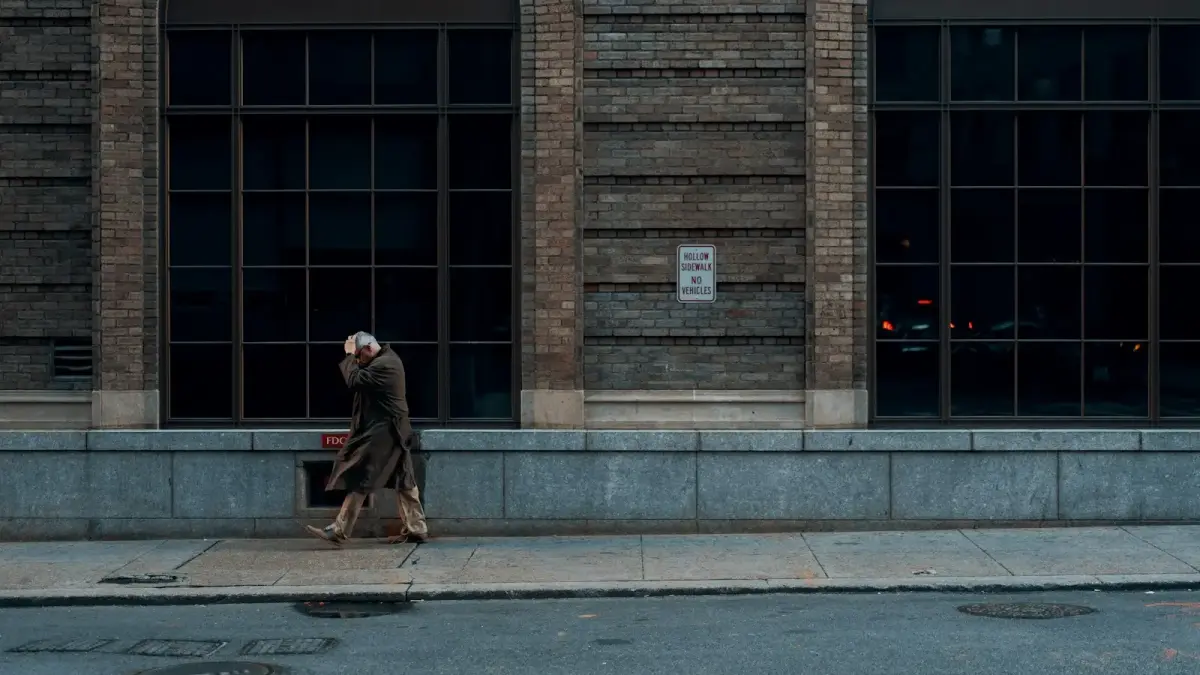
I looked down at my feet. I was on the street side, positioned between her and two lanes of traffic, my left hand resting lightly on her shoulder. I hadn’t thought about it. I hadn’t chosen it. My body had simply arranged itself there the way it always does - the way it has for forty years with my wife, my daughter, my friends, anyone I’ve ever walked beside and cared about.
“Because that’s where the cars are,” I told her. And that was true. But it wasn’t the real answer.
The real answer didn’t hit me until later that night, sitting in the kitchen after everyone had gone to bed. I was thinking about my father. About the thousands of walks we took together through our neighborhood in Akron. And I realized - with the kind of clarity that makes your chest go tight - that I was standing exactly where he always stood. Every single walk. Every single time. The street side. The outside. The position between me and whatever was coming.
He never told me to do it. I never decided to learn it. But my body has been speaking his language for four decades, and I only just now heard it.
The Shuffle
There’s a specific movement that anyone who does this will recognize instantly.
You’re walking with someone. You come to a corner, or you switch sides of the street, or a new person joins you, and suddenly you realize you’re on the wrong side. You’re on the inside. The person you love is closer to the road.
And you do the shuffle.
It’s not dramatic. It’s barely visible. You slow your pace for half a second, drift behind the other person, and reappear on their other side. Your hand might touch the small of their back as you pass. You might say nothing at all. The whole maneuver takes two seconds, and most people on the receiving end never even register it happened.
But it did happen. Your body made a calculation your conscious mind never ran. It assessed the spatial relationship between the person beside you and the nearest source of danger, found it unacceptable, and corrected it.
I’ve been doing the shuffle my entire adult life. When my wife and I were dating, I did it without knowing why. When my daughter was small and we walked to school together, I did it before she could take her second step off the porch. When a buddy and I grab lunch downtown, I do it, and neither of us acknowledges it.
I thought it was instinct. I thought it was just something men did. But it’s not instinct. It’s inheritance.
A Language Written in Distance
Edward Hall, the anthropologist who coined the term “proxemics” in the 1960s, spent his career studying something most of us never think about - the distances we keep from each other, and what those distances say.
Hall argued that humans communicate enormous amounts of information through spatial positioning alone. How close you stand. Which side you choose. Whether you angle toward someone or away. These aren’t random. They’re a vocabulary, and we learn it the same way we learn spoken language - by watching the people who raise us.
A 2019 study in the Journal of Nonverbal Behavior found that children as young as four begin replicating the spatial patterns of their primary caregivers. The distances they keep, the sides they prefer, the positioning they default to - all of it mirrors what they’ve observed. The researchers called it “proxemic inheritance,” and they noted that it was remarkably durable. The spatial habits people learned in childhood persisted well into adulthood, often without the person being aware of them at all.
My father was not a talker. He was born in 1932, raised by a man who was born in 1904, which means the emotional vocabulary available to him was roughly the size of a postcard. He said “I love you” maybe five times in my entire childhood, and each time it sounded like it cost him something physical to get the words out.
But he walked on the street side. Every single time. Rain, sun, Tuesday afternoon, Sunday morning. If I drifted to the outside, his hand would appear on my shoulder - not gripping, just resting there - and he’d guide me back to the inside with a pressure so gentle I could have ignored it. I never did.
What the Body Remembers
Here’s what I’ve come to understand at sixty-four: my father couldn’t say what he felt, so he positioned it instead.
He couldn’t tell me I mattered to him, so he put his body between mine and the oncoming world. He couldn’t explain that he worried about me, so he stood where the worry lived - on the edge, facing the danger, absorbing whatever might come.
And I absorbed all of it. Not the words he didn’t say, but the geometry. The spatial arrangement of his devotion.
Research on embodied cognition - the idea that our bodies carry knowledge our minds haven’t processed - backs this up in ways that would have made my father uncomfortable, because it means admitting that shuffling to the outside of a sidewalk is an act of love. A 2021 study published in Psychological Science found that men, particularly men over fifty, were significantly more likely to express care through physical positioning and protective spatial behavior than through verbal affirmation. The researchers noted that this wasn’t a deficit in emotional capacity. It was a different channel entirely.
My father was fluent in that channel. He was, in fact, eloquent. I just didn’t have the translation until now.
Forty Years of Choreography
When I think about the sheer number of times I’ve done the shuffle, the math gets overwhelming.
Walking my wife to the car after our first real date, stepping around her so smoothly she thought I was opening the door. I was. But I was also making sure I was between her and the parking lot traffic.
Walking my daughter to kindergarten every morning for a year, always on her left, always closest to the road. She used to hold my hand and skip, and I’d adjust my stride so she wouldn’t lose her rhythm. I never once thought about why I was on that side.
Walking with my mother after my father died, taking his exact position beside her on streets they’d walked together for fifty years. She looked up at me once and said, “You walk just like your dad.” I thought she meant my pace. She meant my placement.
Walking my granddaughter to get ice cream last Tuesday, standing exactly where my father stood when I was her age, doing the same shuffle, placing the same gentle hand, holding the same position between the person I love and whatever is coming down the road.
Four generations of this choreography. My grandfather probably did it for my father. My father did it for me. I do it for everyone I love. And none of us ever said a word about it.
The Choreography of Men Who Can’t Say It
I want to be careful here, because I’m not celebrating emotional silence. I wish my father had told me he loved me more. I wish I’d heard the words enough that they didn’t surprise me every time. I’ve tried to be different with my own daughter, my own grandkids. I say it. I say it a lot.
But I also do the shuffle. I also position myself on the outside. And I now understand that these two things aren’t in competition. The words and the positioning are both real. They’re both love. One isn’t better than the other - they’re just different dialects of the same desperate language that says, “You matter to me, and I will stand between you and whatever is coming.”
Daniel Goleman’s work on emotional intelligence reminds us that nonverbal behavior accounts for the vast majority of emotional communication between people. We like to think love lives in declarations. In the big moments. In the words we choose. But so much of it lives in the body - in which side of the sidewalk you choose, in the hand that drifts to someone’s back without being asked, in the two-second shuffle that nobody notices and everybody feels.
My father taught me this. He taught it to my muscles and my bones and the part of my brain that calculates spatial relationships faster than I can form a sentence. He taught it without a single lesson, a single instruction, a single conversation.
He just stood where love stands. And my body memorized the coordinates.
The Part That Gets Me
My father has been gone for eleven years. Prostate cancer. He went the way he lived - without much commentary, without making a fuss, without asking anyone to rearrange their lives around his leaving.
But he’s still here. He’s here every time I step off a curb and realize I’m on the wrong side. He’s here in the shuffle. In the hand on the shoulder. In the geometry of protection that my body performs without consulting my brain.
He never taught me to throw a football, though he tried. He never taught me to fix an engine, though he knew how. The one thing he taught me perfectly - the one skill I mastered completely - was where to stand when you love someone.
I don’t know if my granddaughter will inherit the shuffle. Maybe she’ll develop her own version of it - her own spatial vocabulary for saying what words can’t always carry. But I know this: when she’s sixty-four, something will catch her off guard. Some small movement her body makes without thinking. And she’ll realize, with that chest-tightening clarity, that it came from someone who loved her.
That the body remembers what the heart couldn’t say.
That some people don’t tell you they love you. They just stand between you and the traffic, every single time, and hope you feel it.
I felt it, Dad. It just took me forty years to hear it.