There is a moment every parent dreads without knowing they are dreading it - the first time you hear your child say 'I'm sorry' for something that was never their fault, in the exact voice you used at their age, and you realize the apology has been traveling through your family for three generations, each woman teaching the next that the safest way to exist in a room was to preemptively forgive herself for being in it
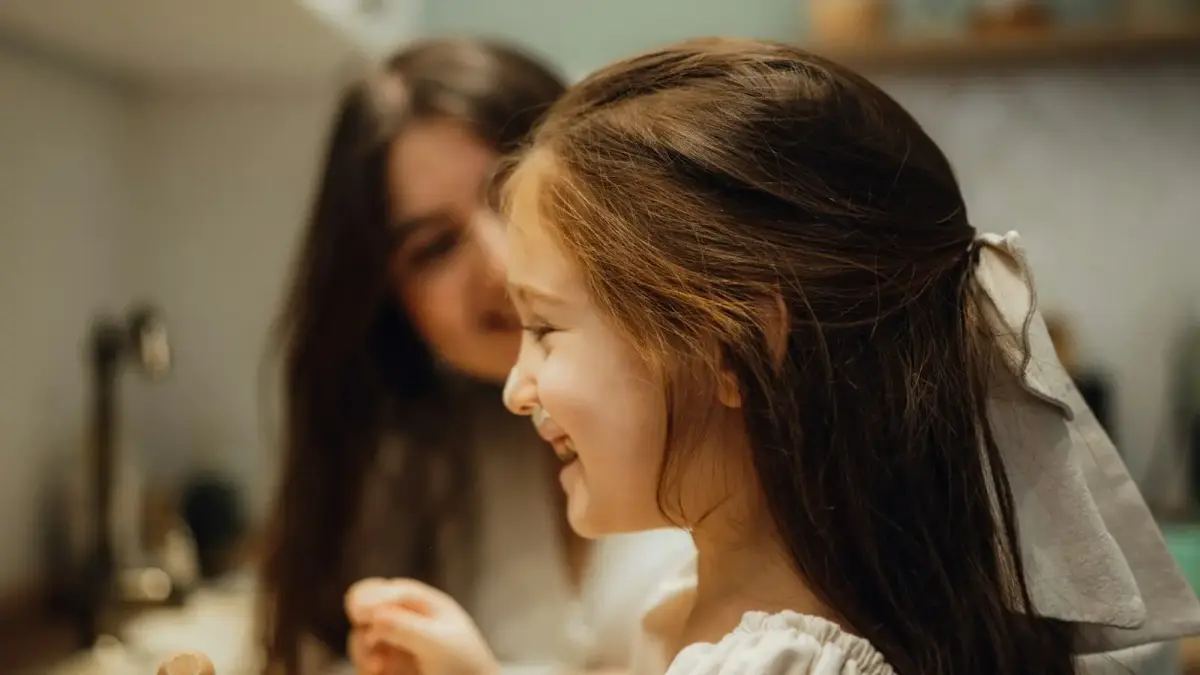
My daughter dropped a spoon last Tuesday.
It clattered off the counter, bounced once on the tile, and rolled under the kitchen table. She was seven, and it was a spoon, and before the sound had finished she looked up at me with wide eyes and said, “I’m sorry.”
Not the way a child says sorry when she’s broken a rule. Not sheepish, not testing a boundary.
She said it the way I used to say it - quickly, reflexively, with her shoulders already pulling inward, as if the sound of metal hitting the floor had announced something about her that needed to be corrected immediately.
I stood there holding a dish towel and felt my stomach drop.
Because I knew that apology. I had been saying it my entire life - to teachers, to boyfriends, to strangers in grocery store aisles when our carts came within three feet of each other.
I’m sorry. I’m sorry. I’m sorry for the space I take up, the noise I make, the inconvenience of being a person who exists in rooms where other people are also trying to exist.
She didn’t learn it from a book or a friend or a show. She learned it from watching me.
The apology that arrives before anything goes wrong
There is a particular kind of sorry that has nothing to do with wrongdoing.
It is not a response to a mistake. It is a preemptive offering - a small, verbal genuflection that says, “I know I’m here, and I know that might be a problem, and I want you to know I’m aware of it before you have to tell me.”
Children who apologize this way are not being polite. They are performing a survival strategy they absorbed before they had language for it.
A 2021 study published in Developmental Psychology found that children as young as four can internalize what researchers call “relational vigilance.” It describes a heightened sensitivity to the emotional temperature of a room and an instinct to regulate themselves downward before conflict arises.
The study noted this pattern was significantly more common in children whose primary caregivers displayed the same behavior. The apology is not invented. It is inherited.
My mother apologized the same way. For asking the waiter to correct an order. For being five minutes late to pick us up.
She moved through the world as if she owed it something for letting her in. I watched her do it for eighteen years before I left home carrying the exact same debt.
Watching a woman shrink
You don’t teach a child to over-apologize by telling her to apologize. You teach her by letting her watch you do it.
Every time I said “sorry” to a cashier for counting out change. Every time I apologized to my husband for being tired. Every time I prefaced a thought in a meeting with “this might be a dumb question, but.”
My daughter was in the room, or in the next room, or in the part of her brain that was always cataloging how a woman moves through the world.
Children don’t learn behavior from instructions. They learn it from observation - from the micro-adjustments they watch their mothers make a hundred times a day.
The lowered voice. The stepped-aside body. The “oh no, you go first” in a doorway that was wide enough for both of them.
A 2018 study in the Journal of Family Psychology found that daughters of mothers who frequently used unnecessary apologies were three times more likely to develop what researchers called “preemptive self-diminishment.” This is a pattern of minimizing your presence, opinions, and needs before anyone asks you to.
Three times more likely. Not because anyone told them to shrink, but because they watched someone they loved do it every day and assumed it was the price of being female in a room.
My mother watched her mother do it too. My grandmother apologized to her husband for the meal she’d spent two hours cooking, for the house being too warm, for the children being too loud, for the weather.
Always sorry. Always bracing. Always arriving in a room with her forgiveness already extended, just in case someone needed a reason to be irritated and she could absorb it before it landed on anyone else.
Three generations of women. Three lifetimes of “I’m sorry.” And the youngest one is seven years old and already knows the choreography.
What the apology is really saying
Here is the thing nobody tells you about excessive apologizing: it is not humility. It is not kindness. It is not good manners.
It is fear that has been polished until it looks like grace.
When a woman says “I’m sorry” for existing too loudly in a room, she is saying something much older than the words themselves. She is saying: I learned, very early, that my presence is a negotiation, that being in a room is something I need to earn.
Dr. Harriet Lerner, a clinical psychologist who has spent decades studying the psychology of apology, writes that women are socialized to apologize not as a form of accountability but as a form of emotional management. The excessive apology, she argues, is less about remorse and more about making other people comfortable with your presence.
When a seven-year-old does it - when a child who has barely begun to understand the world looks up after dropping a spoon and immediately says “I’m sorry” with that particular softness in her voice - she is not sorry about the spoon.
She is sorry about herself.
She is practicing the same negotiation her mother practiced, and her grandmother before that. She is learning that a woman’s first job in any room is to make sure no one regrets that she’s in it.
The stomach drop
The moment I heard my daughter apologize for a falling spoon, I did not feel sad. Sadness would have been manageable.
What I felt was recognition. The kind that starts in your stomach and moves upward until it reaches your throat and sits there, heavy and hot, refusing to be swallowed.
I recognized that apology because it lived in my body. I had been carrying it for forty-six years.
Hearing it come out of her mouth - in her small voice, with her small shoulders pulling inward - was like watching a home video I never agreed to film.
I think every mother who carries this pattern has a version of this moment. The first time the inheritance shows up in your child and you can’t pretend it came from anywhere else.
Maybe your son flinches when he hears a raised voice, and you remember flinching the same way. Maybe your daughter asks permission to feel something - “Is it okay if I’m upset about this?” - and you hear your own childhood self, checking whether emotions were allowed that day.
The stomach drop is not guilt. It is the sudden, nauseating clarity of seeing yourself as a link in a chain you never chose to be part of.
The inheritance nobody packed
No one sits a daughter down and says, “When you grow up, I want you to apologize for everything.” No one says, “I want you to shrink in doorways and preface your opinions and make yourself small enough that nobody ever has to accommodate you.”
No one says that. But the lesson gets delivered anyway - in a thousand small moments, over thousands of ordinary days, through the simple act of a child watching her mother move through the world as if she owed it something.
A 2023 study published in Frontiers in Psychology examined what researchers called “behavioral inheritance” - the transmission of nonverbal social strategies from parent to child without explicit instruction. They found that children who observed a parent consistently engaging in self-diminishing behaviors were significantly more likely to adopt those same behaviors.
Often without any conscious awareness that they had learned them.
My mother did not mean to teach me this. Her mother did not mean to teach her.
And I - standing in my kitchen, watching my daughter apologize for gravity - did not mean to teach my daughter. But I did. Not with my words, but with my body, my reflexes, every unnecessary “sorry” that fell out of my mouth while she was learning what it meant to be a woman.
The mother who notices
Here is what I want to say to every woman who has had this moment - who has heard her own childhood apology come out of her child’s mouth and felt the floor shift beneath her.
You are not the villain of this story.
The fact that you noticed - that you heard the apology and felt your stomach drop, that you recognized the pattern and felt something crack open inside your chest - means you are already doing something no one in the chain before you was able to do.
You are seeing it.
Your mother couldn’t see it because she was inside it. Your grandmother couldn’t see it because the world she lived in didn’t have language for it.
But you heard your daughter say “I’m sorry” for a spoon, and you didn’t nod and move on. You stopped. You felt it.
That awareness is not a small thing. It is, in fact, the entire thing.
The pattern doesn’t break when you become a perfect mother who never apologizes. That person doesn’t exist. The pattern breaks when you become a mother who notices.
Who hears the unnecessary “sorry” - her own or her child’s - and gently, without drama, says something different.
“You don’t need to apologize for that.”
Five words. Said softly, without judgment. Said to your daughter, or to yourself, or to the ghost of your mother who is standing in the kitchen with you whether you can see her or not.
What I said to my daughter
After she apologized for the spoon, I knelt down on the kitchen floor.
I picked it up and handed it back to her. And I said, “You didn’t do anything wrong. Spoons fall sometimes.”
She looked at me for a moment, uncertain, the way a child looks when you change the rules of a game she didn’t know she was playing.
Then she nodded.
I thought about my mother - about the woman who spent her whole life apologizing for rooms she had every right to be in. I thought about how she would have loved to hear someone say those words to her when she was seven.
I can’t go back and tell her that. The chain started before I was born, and it will take more than one conversation on a kitchen floor to undo it.
But I can say it now. I can say it every time my daughter’s shoulders start to pull inward and that familiar apology begins forming in her mouth.
You don’t have to be sorry for being in the room.
You never did.
None of us did.