There is a particular kind of man who always offers to carry the heavy things - the grocery bags from the car, the suitcase down the stairs, the box his wife could manage perfectly well on her own - not because he thinks she cannot do it but because a boy who was unable to carry the weight of what was happening inside his house found that physical weight was the only kind he was permitted to lift, and the man at sixty who reaches for every bag and box is not old-fashioned but still converting the unbearable lightness of emotional helplessness into something his arms can hold
The Parking Lot Ritual
I watched my father do it every Sunday for thirty years.
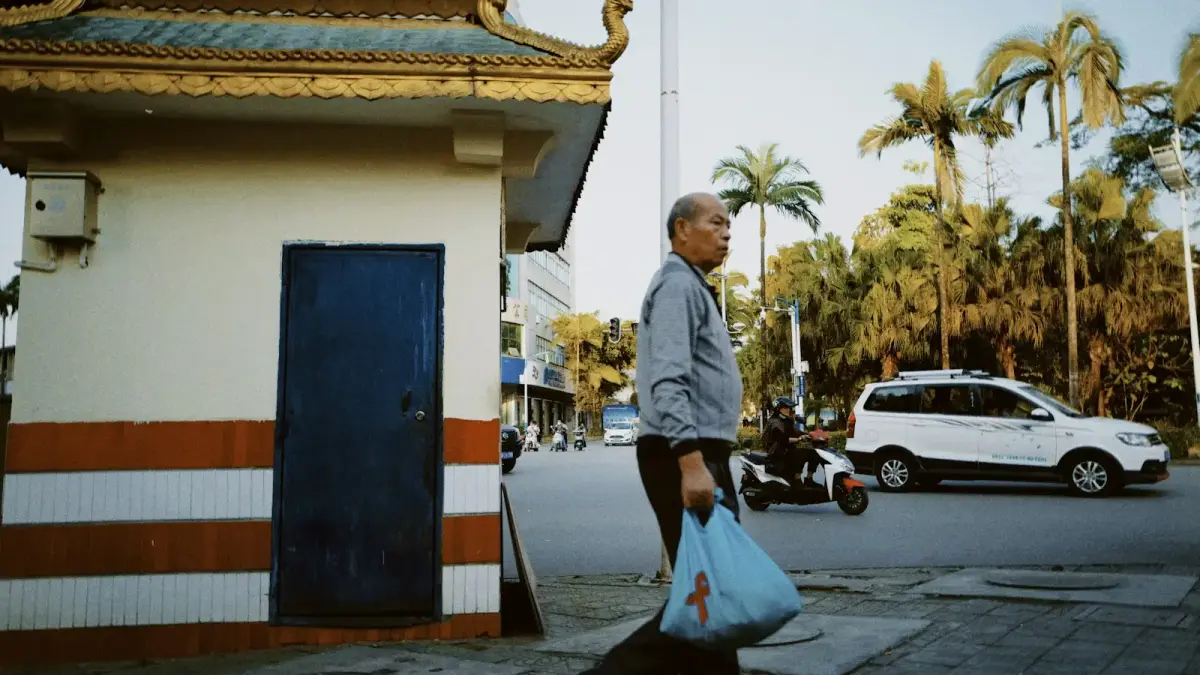
My mother would open the trunk after the weekly grocery run, reach for the closest bag, and before her fingers touched the plastic he was already there. Both arms out. A gentle shake of his head. “I’ve got it,” he’d say, the way other men might say “I love you” - quietly, without expecting anything back.
He would load six bags onto each arm, the handles cutting pale lines into his forearms, and make one trip where any reasonable person would make three. My mother would walk beside him carrying nothing but her purse and her keys, and if you saw them from across the parking lot you might think you were watching something quaint. A man from another generation performing an outdated courtesy.
You would be wrong about what you were seeing.
Because my father was not performing chivalry. He was performing the only competence he had ever been allowed to develop in the territory of love. And the weight of twelve grocery bags distributed across two aging arms was not a burden to him. It was a relief.
The Boy Who Could Not Fix the Sound
There is a version of this story that begins in almost every house where a certain kind of boy grew up.
The house had noise in it. Maybe it was fighting - the sharp, escalating kind that made the walls feel thinner than they were. Maybe it was silence, which is its own kind of violence when you are eight years old and can feel something enormous happening in rooms you are not allowed to enter. Maybe it was a parent crying in the kitchen at two in the morning, or a father leaving without explanation, or a mother who smiled in public and disappeared behind her bedroom door the moment the guests went home.
The boy could feel all of it. Children are not oblivious to the emotional weather of a household. A 2019 study published in the journal Developmental Psychology found that children as young as five demonstrate sophisticated awareness of family emotional climate, and that this awareness often far exceeds what parents believe their children perceive.
He felt it. He absorbed it. And he could do absolutely nothing about it.
He could not fix his parents’ marriage. He could not carry the sadness that filled the hallway like a draft. He could not hold the weight of his mother’s loneliness or his father’s rage or whatever unnamed thing made the house feel like it was always about to break. He was a child, and the emotional architecture of the family was collapsing, and his arms were too short to hold any of it up.
But then something happened.
Someone asked him to carry something.
The Discovery of Useful Weight
Maybe it was a bag of mulch from the garage. Maybe it was a box of Christmas ornaments from the attic. Maybe his mother said “Can you help me bring in the groceries?” and for the first time in his young life, he felt the specific and unmistakable sensation of being useful in a house where he had otherwise been helpless.
The bag was heavy. His arms strained. And it felt like purpose.
This is the moment that rewires a boy. Not dramatically, not in any way he could name at the time. But somewhere deep in the architecture of his developing self, a connection formed: I cannot carry what is wrong here, but I can carry this. This I can do.
Research on what psychologists call “instrumental helping behaviors” supports this pattern. A 2021 study in the Journal of Research in Personality found that boys who grow up in emotionally unstable households are significantly more likely to develop what the researchers described as “action-oriented caregiving strategies” - expressions of care routed through physical tasks rather than emotional articulation. These boys learn early that doing something with their hands is safer, more welcome, and more clearly valued than trying to do something with their words.
And so a template is set. Not consciously. Not with any awareness that it is happening. But the boy begins to understand that his body is his instrument of love, and that the world will accept his caring more readily when it arrives in the form of lifted objects, repaired faucets, mowed lawns, and shoveled driveways.
The emotional weight remains untouchable. But physical weight - that, he is permitted to carry.
Thirty Years of Grocery Bags
Fast forward three decades.
The boy is a man now. He is fifty-five, or sixty, or sixty-seven. His knees ache. His back has opinions about things it used to ignore. His doctor has mentioned something about his shoulder that he has chosen not to hear.
And he still reaches for every bag.
His wife says “I can get that.” He says “I’ve got it.” She says “You don’t have to carry everything.” He says “It’s fine, it’s not heavy.” And both of them are telling the truth and missing the point at the same time, because the conversation was never about the bag.
You have seen this man. You might be married to him. You might be his daughter, watching him insist on loading your moving boxes into the truck while you stand there with perfectly functional arms feeling somewhere between grateful and frustrated.
He is not doubting your capability. That is important to understand. He is not operating from some dusty manual of gender roles that tells him women are fragile. He has watched you manage a career, raise children, navigate crises he could barely name. He knows you are strong.
But his body has a memory that his mind does not fully control. And the memory says: when everything was falling apart, the one thing I could do was carry something heavy. The one time anyone looked at me with something other than worry or pity was when I walked through the door holding something that needed holding.
The grocery bag is not a grocery bag. It is a repetition of the first moment he ever felt like he mattered.
The Fluency He Was Given
Daniel Goleman, whose work on emotional intelligence reshaped how we think about the inner lives of men, has written extensively about how boys are socialized away from emotional vocabulary and toward instrumental expression. The message is not always cruel. Sometimes it is simply an absence - nobody teaching him the words, nobody modeling what it looks like to say “I’m scared” or “I need you” or “I don’t know how to help but I want to.”
Without those words, the body steps in.
He builds a deck because he cannot say “I want you to have something beautiful.” He fixes the leaking pipe at midnight because he cannot say “I am terrified of being useless to you.” He carries every bag from the car in one trip because he cannot say “This is the only language I know for telling you that I would hold every heavy thing in your life if my arms were long enough.”
A 2020 study published in Psychology of Men and Masculinities found that men who score high on measures of “restrictive emotionality” - the inability to identify or express emotional states - are significantly more likely to express care through physical acts of service. The researchers noted that this was not a deficit of caring but a rerouting of it. The love is present. It has simply been forced to find a different road.
And the road it finds is the one that leads to the trunk of the car on a Sunday afternoon, where twelve bags of groceries are waiting, and so is every unspoken thing he has ever felt.
What the Body Remembers
I think about my father’s arms sometimes.
How they looked when he carried things - not strained exactly, but committed. There was a set to his jaw, a specific posture that said I am doing something that matters right now. It was the same posture whether he was carrying groceries or moving furniture or helping a neighbor load a truck.
It was the posture of a man who had found the one arena where his caring was legible to other people.
My father grew up in a house where his own father was a good man who did not know how to be soft. Where his mother needed help that no child should have been asked to provide, and where the specific gravity of adult pain bent every room into a shape a boy could not navigate. He told me once - the only time we ever talked about it - that he remembered being nine years old and watching his mother carry a box of dishes down the basement stairs while crying, and that he had taken the box from her not because he was strong enough but because he did not know what else to do with his hands while someone he loved was hurting.
He was not strong enough. He was nine. The box was heavy and he almost dropped it.
But she stopped crying. She looked at him and she said thank you. And that was the day he learned what his body was for.
The Translation
Here is what I want you to understand about the man in your life who insists on carrying things.
He is not performing masculinity. He is performing the translation he learned before he had words for what needed translating. Somewhere in his history there is a house where big feelings lived and small boys could not touch them, and the only bridge between his love and the world was the physical act of lifting, moving, holding, and carrying.
It is not that he cannot learn other languages. Many of these men do, over time, with patience, with partners who gently insist that words are also a way of holding someone. The work of expanding that emotional vocabulary is real and valuable and worth doing.
But the carrying - the reaching for the bag before you can get to it, the way he takes the heavy box without being asked, the insistence on making the trip himself - that is not a habit to be corrected. It is a fluency. It is the first and sometimes the only way he learned to say I am here, I see you, I want to make your life lighter even if I cannot make it perfect.
The Bag You Are Already Holding
The next time he reaches for the bag you are already holding, let him take it.
Not because you cannot carry it. You can. He knows you can. But he is not reaching for the bag. He is reaching for the feeling of being someone who can help when it matters. He is reaching back through forty or fifty years to the boy who stood in a hallway full of noise he could not quiet, and he is giving that boy the one thing he always needed - something heavy enough to hold, and someone willing to let him hold it.
It is not old-fashioned. It is not patronizing. It is a man’s body remembering the only prayer it was ever taught.
And the prayer goes like this: let me carry something. Let me be useful. Let me turn this love I cannot say into something you can see me holding.
Every bag. Every box. Every suitcase down the stairs.
He is not carrying groceries. He is carrying the only proof he knows how to offer that he was here, and that he tried, and that his love - however clumsy its packaging - was real.
Let him carry it.