There is a particular kind of man who always tests the first stair, the first rung, the first step of anything his children are about to climb - a playground ladder, a wooden dock at the lake house, a set of bleachers at a Saturday morning soccer game - who puts his full weight on it once, quietly, before he waves them forward. Not because he is overprotective or anxious, but because a boy who once stepped onto something that gave way beneath him decided his own children would never be the first to test whether the world beneath their feet was solid.
I watched my father do it for years before I understood what I was seeing.
Every porch step at a rental cabin. Every dock at every lake we ever visited on summer vacation. The metal bleachers at my sister’s softball games. He would step on them first - not dramatically, not with any announcement - just a quiet press of his full weight onto whatever surface we were about to trust with our small bodies. Then he would nod. Then we would climb.
I thought it was just something fathers did. The way they check tire pressure or test the water temperature before you jump in. I filed it under the same category as holding the door or carrying the heaviest bag. It was simply what men did when they loved small people.
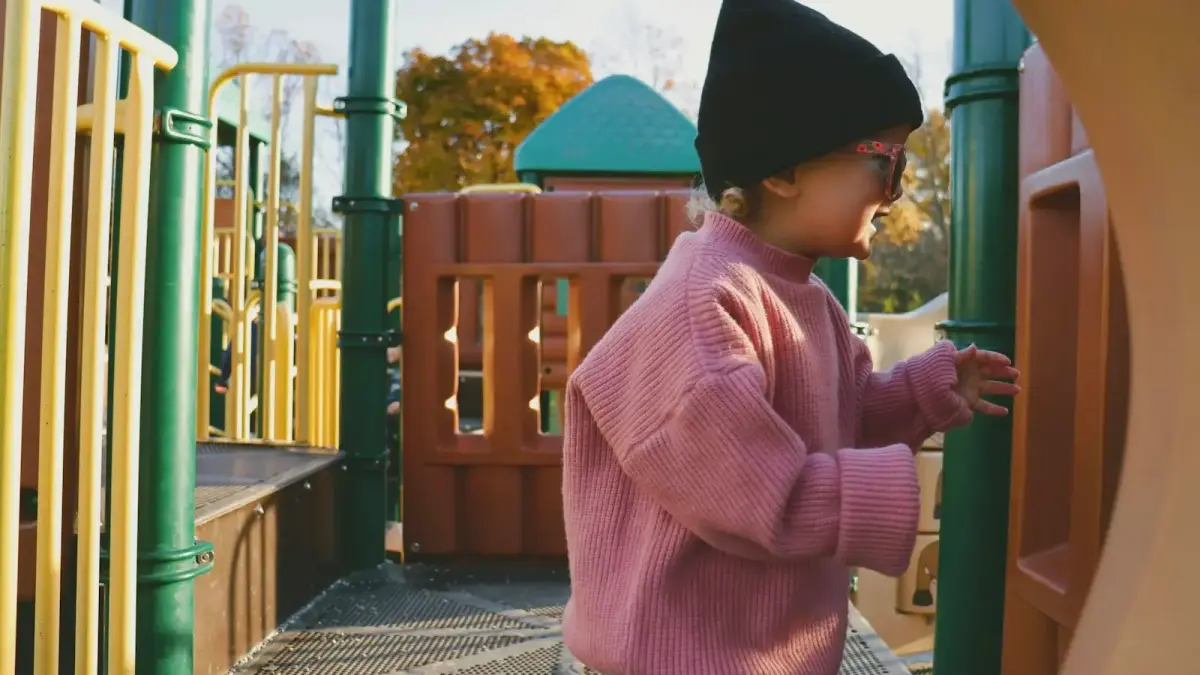
It was not until I became a father myself - and caught myself doing the exact same thing at a playground in a town I had never visited before, pressing my boot heel into the first wooden step of a climbing structure while my daughter waited behind me - that I understood. This was not a habit. This was a scar that had learned to dress itself as love.
The Rung That Came Loose
Somewhere in the history of every man who tests the stairs, there is a moment the ground failed.
For some, it was literal. A rotted porch board that splintered under a boy’s sneaker. A railing that pulled clean from its post when he leaned into it. A set of steps at a public pool that shifted and sent him sideways into concrete.
For others, it was something less physical but no less structural. A promise that collapsed. A person who was supposed to be solid but wasn’t. A home that looked stable from the outside but creaked in places no one talked about.
The specifics vary. The lesson does not. Something that was supposed to hold you did not hold you. And you hit the ground. And when you looked up, there was no one standing where someone should have been standing.
A 2019 study published in the Journal of Personality and Social Psychology found that men who experienced early instances of environmental unpredictability - situations where their physical or emotional world proved unreliable - developed heightened vigilance patterns that persisted decades into adulthood. Not anxiety in the clinical sense. Something quieter. A permanent orientation toward scanning for structural weakness in any environment their loved ones are about to enter.
The researchers called it “anticipatory protective cognition.” The men I know just call it being careful.
A Language Without Words
Here is what I have come to understand about this kind of fatherhood: it is an entire emotional vocabulary compressed into physical gestures.
The man who tests the stair does not say, “I am afraid for you because the world once proved itself unreliable to me, and I have spent every year since then making sure the people I love never learn that lesson the way I did.” He does not have those words. Many men of a certain generation were never given those words.
Instead, he presses his weight onto a wooden step. He grips a railing and pulls. He walks across a dock first, slowly, listening for the creak that means the wood has gone soft.
Daniel Goleman’s work on emotional intelligence has long argued that the capacity to feel deeply and the capacity to articulate those feelings are entirely separate skills. You can possess one without the other. And millions of men do. They feel everything. They say almost nothing. But if you watch their hands, their feet, the way they position their bodies between their children and the nearest edge, you can read every word they never learned to speak.
My father checked every hotel room deadbolt twice. He parked under streetlights. He walked on the traffic side of the sidewalk when we were small enough to walk beside him. I never heard him say he loved us in a way that sounded like it came from his chest instead of his throat. But I never once stepped onto something that had not already been tested.
The Inheritance No One Talks About
What is remarkable about this kind of protection is that it is almost invisible.
The children rarely notice. That is the point. A father who tests the first stair does not want his children to know he is testing it. He does not want them to inherit his vigilance. He does not want them to look at every new surface with suspicion. The entire project is to let them climb freely, to let them believe that the world is solid, to give them the experience of a ground that holds.
This is the quiet paradox. The man tests every step precisely so that his children never have to.
Research from the Frontiers in Psychology journal in 2021 found that children of protectively vigilant fathers - fathers who engaged in background safety behaviors without communicating anxiety - actually showed higher confidence in physical exploration than children of either anxious or disengaged fathers. The children did not become more cautious. They became braver. Because they had never experienced the fall.
That finding stopped me cold when I first read it. Because it means the project is working. These fathers are building something they never had - a felt sense of structural reliability - and they are building it so seamlessly that their children do not even know it was constructed. They think the world just works. They think steps just hold.
They have no idea someone walked them first.
What He Remembers That You Don’t
There is usually one specific memory.
Not a category of memories. One. A single moment when the floor gave way, the rail came loose, the branch snapped, the adult who was supposed to be watching was not watching. And it was not the injury that imprinted. It was the aloneness of the injury. The discovery, at six or eight or ten, that you could fall and no one would come.
That memory does not fade. It sharpens. It sits in the body like a splinter that worked its way deep enough that it cannot be removed, only lived around. And so the body adapts. It develops a system. Test the surface. Confirm the hold. Then and only then, wave the small ones forward.
I asked my father about it once, years after I had started doing it myself. He was quiet for a long time. Then he told me about his grandfather’s back porch in West Virginia, a step that had been soft for two summers that no one fixed. He went through it when he was seven. Cut his shin to the bone on a rusted nail underneath. Sat on the ground bleeding, calling for someone who took a long time to come.
He said he doesn’t think about it consciously. He said his foot just goes to the step first. Like a reflex. Like breathing.
I understood exactly what he meant.
The Weight They Carry So You Don’t Have To
Susan Cain once wrote about the hidden labor of quiet people - the enormous internal processing that happens beneath a calm surface. Protectively vigilant fathers carry a version of that same invisible weight. They are running a continuous background calculation that never fully powers down.
Is that railing secure. Is that dock sound. Is that ladder anchored. Is that bleacher row stable. Is that tree branch thick enough. Is that ice thick enough. Is that floor dry enough. Is that edge far enough.
This is not obsessive. It is practiced. It is so practiced that it no longer requires conscious thought. The foot goes first. The hand grips first. The body interprets the structural feedback in a fraction of a second, and either proceeds or redirects.
And here is what I want you to know if you recognize this man. If you are married to him, raised by him, or if you are him.
This is not damage that failed to heal. This is damage that chose a direction. The fall did not make him fragile. It made him into the floor. The absence of someone who checked made him into the person who always checks. The fact that no one tested the porch for a seven-year-old boy in West Virginia became the reason every porch gets tested now.
That is not brokenness. That is a wound that taught itself to build.
Every Tested Step
My daughter is nine now. She runs up stairs without thinking. She leaps onto docks. She climbs playground equipment with the reckless confidence of a person who has never once felt the ground give way beneath her.
She has no idea that I walk every new structure first. She has no idea that my foot pressing a board is a conversation between my body and a memory she will never carry. She does not know that the reason she trusts surfaces is because someone has been quietly verifying them for her entire life.
And that is the whole point.
Somewhere, right now, in a park or at a lake or at a school gym, a man is stepping onto the first bleacher row. His kids are behind him, impatient, wanting to climb. He presses down. He holds. He feels the metal accept his weight without protest. He nods them forward.
He will never tell them what he is doing. He will never explain the boy he used to be, sitting on the ground beside a broken step, waiting for help that was slow to come. He will never narrate the quiet arithmetic happening between his foot and the surface beneath it.
But every tested step is a sentence in the only love letter he knows how to write. Every pressed board is a promise that the ground will hold. Every railing gripped before a small hand reaches for it is a prayer in the only language this kind of father has ever spoken fluently.
And his children will grow up believing the world is solid.
Which is, of course, exactly what he has been building for them all along.