The room you keep choosing to be in alone
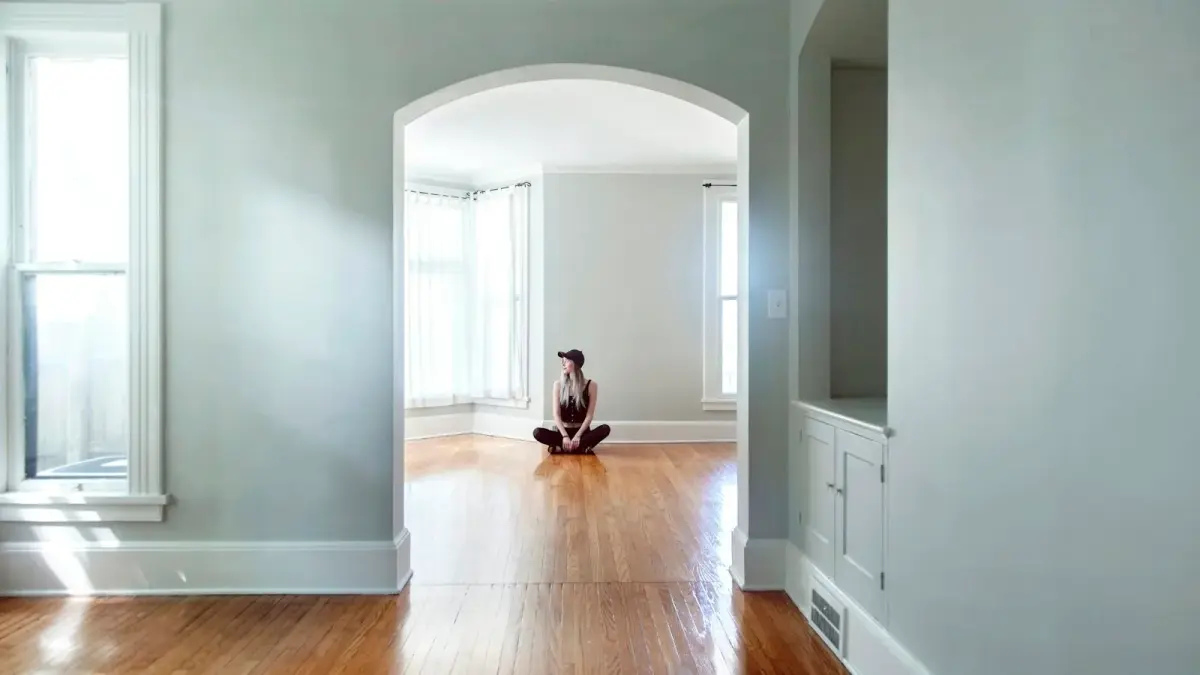
You canceled plans last Saturday. Not because anything was wrong. Not because you were sick, or sad, or overwhelmed - though you told your friend you were “a little run down” because that felt easier than the truth.
The truth was simpler and stranger: you just wanted to be alone.
You wanted the apartment to yourself. You wanted the couch, the quiet, the particular kind of stillness that only arrives when no one is expecting anything from you. And when you finally sat down with your tea and a book you’ve been meaning to finish for three months, something in your chest loosened. Not because the world was too much. But because this - this specific silence - was exactly enough.
And then, almost immediately, the guilt arrived. The voice that says: You should want to be around people. You’re becoming one of those people. What’s wrong with you?
I hear that voice from my clients more than almost any other. And I need to tell you something about it. That voice is wrong. Not slightly off. Fundamentally, structurally wrong. What it frames as a deficiency is actually one of the clearest indicators of something most people spend decades struggling to develop.
The thing no one calls by its real name
There’s a difference between isolation and solitude that our culture has almost completely collapsed. Isolation is withdrawal driven by pain. It’s avoidance. It’s a shutting down. Solitude is something else entirely - it’s a turning toward yourself with the same intentionality you’d bring to any meaningful relationship.
But we don’t talk about it that way. We talk about “loners” and “homebodies” and people who “keep to themselves,” and every one of those phrases carries a faint whiff of pathology. As if choosing to be alone is a warning sign rather than a conscious act.
The psychologist Abraham Maslow identified this decades ago. In his study of what he called “self-actualizing” people - individuals operating at the highest levels of psychological health - he noted that they consistently showed a strong preference for solitude. Not as a retreat from life, but as a foundation for engaging with it more fully. They didn’t avoid connection. They were selective about it. They had an unusual comfort with their own company that freed them from the need to fill every silence with another person’s presence.
Maslow didn’t describe these people as antisocial. He described them as having reached a level of inner security that most people never achieve.
Why the need for aloneness grows as you grow
Here’s something I’ve noticed across twenty years of clinical work, and it’s so consistent I’d almost call it a law: the more emotionally mature a person becomes, the more they crave solitude.
Not because they love people less. Because they understand themselves more.
When you’re younger, other people serve a function that goes beyond companionship. They help you figure out who you are. You use their reactions as mirrors. You test your identity against their approval or disapproval. You need the group because, on some level, you don’t yet fully exist without it.
But somewhere in your thirties or forties or fifties - and for some of us, even later - something shifts. You stop needing the mirror. Not because you’ve become narcissistic, but because you’ve finally built an internal sense of self that holds steady without external reinforcement. You know what you think. You know what you value. You know what kind of evening actually restores you versus what kind depletes you while pretending to be fun.
And once you know those things - really know them, in your body and not just your mind - the relentless social calendar starts to feel less like connection and more like noise.
That’s not withdrawal. That’s clarity.
What the research actually tells us
The cultural narrative says that more social contact is always better. That extroversion is the healthy default. That people who prefer their own company are either depressed, avoidant, or missing out. The research says something considerably more nuanced.
A study published in the British Journal of Psychology by Satoshi Kanazawa and Norman Li examined the relationship between social interaction, population density, and life satisfaction. What they found was striking: for people of higher intelligence, more frequent social interaction was actually associated with lower life satisfaction. The authors framed this through what they called the “savanna theory of happiness,” but the practical takeaway was simpler - some brains are wired to do their best processing, and their best living, with more space and fewer interruptions.
Separately, research by Christopher Long and James Averill at the University of Massachusetts found that the capacity to enjoy solitude - what they termed “the experience of solitude” - was positively correlated with self-awareness, creativity, and emotional regulation. People who could be alone without becoming lonely weren’t lacking something. They had developed something. A kind of internal richness that made their own company genuinely nourishing rather than merely tolerable.
This isn’t about introverts versus extroverts, though there’s overlap. It’s about a specific emotional skill: the ability to sit with yourself without reaching for a distraction, a screen, another person’s energy to borrow. That skill doesn’t come from avoidance. It comes from the slow, patient, often unglamorous work of becoming someone you can actually stand to be alone with.
The part no one wants to say out loud
Here’s the uncomfortable truth beneath all of this. Most social interaction, for most adults, is performative. Not dishonest exactly - but edited. You perform a version of yourself that is slightly more agreeable, slightly more interested, slightly more energetic than you actually feel. And the effort of that performance, repeated across dozens of interactions every week, is quietly enormous.
The people who choose solitude aren’t refusing connection. Many of them are the most deeply connected people in the room when they choose to be there. What they’re refusing is the performance. The small talk that goes nowhere. The dinner party where everyone is three drinks in and talking at each other. The group chat that pings forty times with content that could have been silence.
They’re not antisocial. They’re anti-pretend.
And that distinction matters, because the willingness to disengage from performative socializing requires something that is genuinely difficult: it requires being okay with other people’s disappointment. It requires tolerating the possibility that someone will think you’re distant, or cold, or “not as fun as you used to be.” It requires placing your own internal experience above someone else’s expectation of your presence.
That is not selfishness. That is a boundary. And healthy boundaries are not the hallmark of people who can’t handle relationships. They’re the hallmark of people who have finally learned to handle themselves.
What solitude actually gives you
I want to be specific here, because vague claims about “recharging” don’t capture what’s really happening when a mature person chooses to be alone.
Solitude gives you access to your own unedited thoughts. Not the thoughts you’d share in conversation, which are always shaped by the listener. The real ones. The slow, strange, sometimes uncomfortable ones that only surface when no one is watching and no response is required.
It gives you the ability to process emotional experiences fully. Most people carry half-digested feelings around for years because they never sit still long enough to complete the processing. The argument with your sister that you “got over” but didn’t. The career disappointment you “moved past” but still flinch from. Solitude is where that processing happens - not through dramatic catharsis, but through the quiet, almost imperceptible work of letting a feeling exist without rushing to resolve it.
And perhaps most importantly, solitude gives you a relationship with yourself that doesn’t depend on anyone else’s participation. That relationship is the foundation of everything. It determines what you’ll tolerate in a partnership. It determines whether you stay in a job out of fear or leave it out of clarity. It determines whether you spend your remaining years performing a life or living one.
The room is not a cage
If you are someone who keeps choosing to be alone - in the evenings, on weekends, in those small pockets of time that other people fill with plans - I want you to consider the possibility that you are not doing something wrong.
You are doing something that requires a kind of courage most people don’t recognize, because it looks quiet from the outside. It looks passive. It looks like nothing is happening.
But inside that room, inside that silence, something is happening. You are tolerating your own company. You are declining the performance. You are choosing depth over volume, presence over distraction, self-knowledge over social approval.
The room you keep choosing to be in alone is not evidence of something missing. It’s evidence of something found. A self sturdy enough to sit with. A mind that no longer needs the crowd to know what it thinks. A life that has made room - real, physical, deliberate room - for the person living it.
That’s not antisocial. That’s not broken. That’s not even unusual, though it can feel that way when everyone around you seems to need what you’ve quietly outgrown.
That’s maturity. The kind that doesn’t announce itself. The kind that just closes the door softly, sits down, and finally breathes.