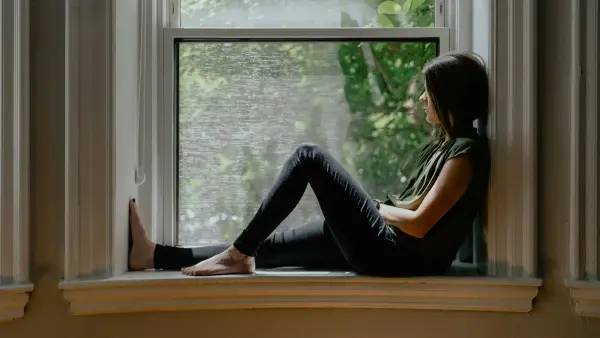
She's 58 and does everything herself - cuts her own hair, changes her own tires, fixed the leaking faucet from a YouTube tutorial at 1 a.m. - and the fierce independence that everyone admires is not strength, it is a fortress built by a woman who asked for help once at twenty-three and the cost of that help was so high she decided on the spot that needing anyone was the most expensive thing she could ever do
The Bookshelf at 11 p.m.
She was on the floor of her living room at eleven o’clock on a Thursday night, an Allen wrench in one hand and an instruction sheet in Swedish spread across her knees. The bookshelf had arrived in a flat pack that weighed more than she expected. She had carried it up the stairs herself, one step at a time, resting it against the railing between floors because her arms were shaking.
Nobody had offered to help. She hadn’t told anyone it was coming.
By midnight, the shelf was standing. A little crooked on the left side, but standing. She sat on the floor beside it and drank a glass of water and felt something she’d felt a hundred times before - a particular mix of pride and exhaustion that she’d learned to call satisfaction. It wasn’t exactly satisfaction. It was closer to relief. The relief of not owing anyone anything for the help.
If you know this woman - if you are this woman - then I need to tell you something that people who admire your self-sufficiency will never say. Because they don’t see what I see. They see capability. I see a fortress. And I know what the fortress is protecting, because I’ve built one of my own.
The Day the Math Changed
There is usually a specific moment. Not a gradual learning, not a slow fade - a single, precise event where the math changed forever.
For the woman I’m thinking of, it happened at twenty-three. She was in a relationship that looked fine from the outside. He was attentive when things were easy. He was generous when it cost him nothing. And then she hit a moment where she genuinely needed him - her car broke down two hundred miles from home during a weekend when everything felt like it was collapsing, her hours had been cut at work, and she was behind on rent and too proud to tell anyone but him.
She called. He came.
And for the next eighteen months, she paid for that phone call. Not in money - in leverage. Every disagreement circled back to that weekend. Every time she pushed back on something, he’d remind her how he’d dropped everything, driven two hundred miles, paid for the repair. The help wasn’t given. It was lent. And the interest rate was control.
She left that relationship at twenty-five. But she took the lesson with her, packed it down tight into a part of herself she’d never unpack in front of anyone again: needing someone gives them power over you. Asking for help is writing someone a blank check on your dignity. The only safe way to move through the world is to never need anything you can’t provide for yourself.
And so she learned. She learned plumbing from YouTube. She learned basic car maintenance from a library book. She learned to carry her own groceries in one trip, to change a flat tire in a parking lot, to drive herself to the emergency room with a fever of 103 because calling someone would mean she owed someone, and owing someone was the most dangerous thing she knew how to do.
The Architecture of Never Owing
By fifty-eight, the system is seamless. She has a toolkit under the bathroom sink that would make a contractor pause. She has a drawer of picture-hanging hardware sorted by wall type. She knows which YouTube channels have the best plumbing tutorials and which ones waste ten minutes before getting to the point.
People say things to her. They say “you’re incredible.” They say “I don’t know how you do it all.” They say “I wish I were that independent.”
She smiles when they say this. She has learned the smile. It is the smile of a woman who is being praised for a wound and has stopped trying to explain the difference.
Because here is what independence looks like from inside the fortress: it looks like lying in bed with a pulled muscle in your back and getting up anyway because the dishes won’t do themselves and calling someone to come sit with you while you rest would require a vulnerability your body physically will not allow. It looks like spending three hours learning to fix a garbage disposal rather than spending thirty seconds asking a neighbor. It looks like a woman at an urgent care clinic filling out her own emergency contact line with her own name because there is no one she trusts enough to be the person who gets the call.
A 2020 study published in the Journal of Personality and Social Psychology examined what researchers called “compulsive self-reliance” - a pattern most common in individuals with dismissive-avoidant attachment styles. The researchers found that these individuals didn’t simply prefer doing things alone. Their nervous systems had been conditioned to treat dependence as threat. Asking for help activated the same stress pathways as physical danger. The brain had learned, through experience, that needing someone and being safe were mutually exclusive states.
Her brain treats asking for help the way most people treat a hand on a hot stove. Not as uncomfortable. As dangerous.
The Loneliest Compliment in the Language
There’s a specific kind of praise that women like this receive, and it is the loneliest compliment in the English language.
“You don’t need anyone.”
People say it with admiration. They mean it as respect. And she hears it the way it actually sounds, which is: nobody is coming. You’ve built yourself into something so competent, so capable, so entirely self-contained, that the world has agreed you are fine on your own. And now you are on your own. Permanently. Because nobody rescues someone who doesn’t look like they need rescuing.
Brene Brown has described this as the paradox of armor. The very thing that protects you from being hurt - in this case, total self-sufficiency - is the thing that prevents you from being reached. The fortress keeps the danger out. But it also keeps out the person who might have sat on the floor with you at eleven o’clock on a Thursday night, handing you Allen wrenches and making you laugh about the Swedish instructions.
She didn’t lose that person. She never let that person exist. Because letting them in would have meant handing them the same blank check she handed someone at twenty-three, and she already knows what happens when that check gets cashed.
A 2019 study in Psychological Science found that adults who developed self-reliance as a defense mechanism after a trust violation were significantly more likely to experience chronic loneliness even when surrounded by people who cared about them. The isolation wasn’t circumstantial. It was architectural. They had built lives that made closeness structurally impossible, not because they didn’t want it, but because wanting it and being safe felt like opposing needs.
She wants it. She wants it at 2 a.m. when the apartment is quiet and the faucet she fixed is dripping again. She wants it on Sunday mornings when she drinks coffee alone and watches couples walk past the window. She wants it in the waiting room of the dentist’s office when she writes her own name on the emergency contact line and her pen pauses, just for a second, over the blank.
She wants it. She just can’t afford it. That’s what twenty-three taught her.
The Body Keeps the Ledger
It shows up in her body before it shows up anywhere else.
Her shoulders carry tension she doesn’t register anymore. Her jaw clenches when someone says “let me help you with that.” There’s a physical flinch - sometimes microscopic, sometimes visible - when a situation requires her to rely on another person for anything.
John Bowlby, whose attachment theory reshaped how we understand human connection, described a pattern he called “compulsive self-reliance” - a strategy where the individual maintains closeness with others only to the point where dependency might begin, then pulls back. He noted that this pattern is not a lack of desire for connection. It is a highly organized strategy for managing the terror that connection brings.
When someone insists on helping - carries her groceries, fixes something she didn’t ask them to fix, pays for her dinner - she feels something that looks like gratitude from the outside but feels like panic from the inside. Because help is not free. She learned that. Help is a loan with interest rates that compound in the dark.
She’s not cold. She’s not a loner by nature. She is a woman who built a system so effective at preventing one specific kind of pain that it accidentally prevents the closeness that might heal it.
The Fortress and the Girl Inside It
I’m not going to tell her to start asking for help. That advice is everywhere and it misses the point entirely. You don’t tell someone to open the gates of a fortress without first acknowledging why the fortress was built.
The fortress was a brilliant idea. It was designed by someone very young and very smart who was protecting something very real.
The girl who made that decision at twenty-three wasn’t being rigid. She was being rational. Given what she knew - given what help had cost her, given the power she’d lost, given the debt she’d carried like a stone in her chest - the most logical thing in the world was to build a life where she’d never be in that position again.
And she did. And it worked. And now she’s fifty-eight and the fortress is still standing, still immaculate, still protecting her from a threat that may or may not still exist in the form it once did.
Maybe the first step isn’t opening the gates. Maybe it isn’t even unlocking them. Maybe it’s just admitting the wall is there. Saying it quietly, to yourself, in your own living room at 11 p.m. with the Allen wrench still in your hand and the crooked bookshelf standing in front of you like evidence of everything you’ve had to become: I built this. I built all of this. And it kept me safe. And I am so tired of building.
Not tired enough to tear it down. Not yet. Maybe not ever. But tired enough to notice it. Tired enough to name it as something other than strength. Tired enough to wonder, for the first time in thirty-five years, what it might feel like to let someone hand you a wrench instead of finding it yourself.
You don’t owe anyone anything. You never did. The original debt was a lie told by someone who wanted you smaller. And the woman who refused to be small - who learned every skill, fixed every leak, drove herself to every emergency room - she is not a project that needs fixing.
She is a person who kept herself alive with the tools she had. And if she decides, someday, to let someone stand beside her while she works - not to take over, not to rescue, just to be there, just to hand her things and stay - that won’t be weakness.
That will be the bravest thing she’s ever done. And she has already done some very brave things.