She's 59 and just realized the reason her arm still shoots across the passenger seat every time she brakes too hard - even when the seat is empty, even when the only thing beside her is a handbag that does not need saving - is because her mother's arm did the same thing for eighteen years, and a daughter who spent her childhood being held back by a reflex faster than any seatbelt learned that love is the thing your body does before your brain has time to decide whether anyone still needs protecting
The arm moved before I did
It happened on a Tuesday in October, somewhere on a highway I’ve driven a thousand times.
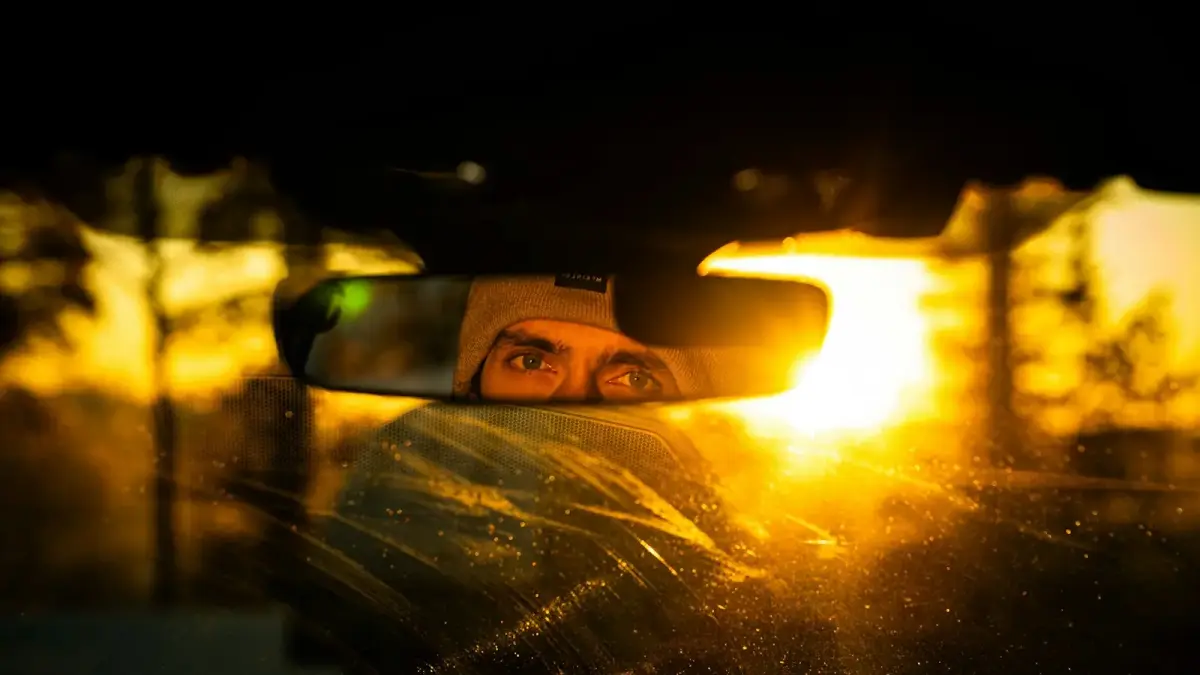
A truck ahead of me tapped its brakes. Nothing dramatic. Just a flash of red light that made me press my own brake pedal a little harder than usual. And my right arm - without invitation, without thought, without any participation from the part of me that makes decisions - flew across the passenger seat and landed palm-flat against the air where a chest would be.
There was no chest. There was a leather handbag with a broken zipper and a half-empty water bottle.
I held the bag back like it was a child who might go through the windshield. My fingers were spread wide, bracing. My shoulder was tense. My whole body had committed to saving something that did not need saving.
And then I sat there with my arm extended into empty space, and I heard my mother’s voice from thirty-five years ago, saying what she always said after doing the exact same thing: “Sorry, honey. Reflex.”
That word - reflex - cracked something open. Because I suddenly understood that this wasn’t my reflex. It was hers. I had been performing her gesture my entire adult life, and I had never once asked where it came from.
The arm that was always there first
If you rode in the passenger seat of my mother’s car between 1970 and 1988, you knew the arm.
You knew it the way you knew the smell of her car - coffee and hand lotion and the vinyl of seats that got too hot in summer. It was part of the landscape. She braked, the arm came out. Every single time.
It didn’t matter how minor the stop was. A yellow light. A pedestrian at a crosswalk. A squirrel that had already made it to the other side. The arm fired. Palm flat, fingers spread, pressing against your collarbone with a firmness that said: I have you.
She never looked at you when she did it. Her eyes stayed on the road. The arm operated on its own authority, independent of her attention, like a second nervous system dedicated entirely to the person sitting beside her.
I used to find it embarrassing. I was fifteen, sixteen, wearing a seatbelt, fully capable of surviving a gentle stop at a red light without being physically held in place by my mother’s forearm. I’d push her arm away. She’d laugh. Next red light, the arm would be back.
She couldn’t stop it. I don’t think she even felt herself doing it most of the time.
It was faster than language. Faster than thought. It was her body saying something that her mouth never had to.
Your body remembers what your mind forgets
There’s a term in psychology for this - embodied cognition. It’s the idea that your body doesn’t just carry out instructions from your brain. Your body thinks. Your body remembers. Your body makes decisions your conscious mind never signed off on.
A 2021 study published in Psychological Science found that motor patterns learned through repeated observation during childhood can persist in the body for decades, even when the person has no conscious memory of learning them. The researchers called these “embodied inheritances” - physical behaviors passed not through genetics, but through years of watching, absorbing, and unconsciously rehearsing someone else’s movements.
I find this staggering. Not because the science is surprising, but because it means my mother’s arm - the one that reached across my chest ten thousand times before I was old enough to drive - wrote itself into my muscles. Into the neurons that fire when I see brake lights. Into the automatic sequence that says: something ahead is stopping, someone beside me might get hurt, reach.
My brain never decided to adopt this gesture. My body just took it. The way a river takes the shape of the land it passes through.
Daniel Goleman’s work on emotional intelligence has always emphasized that our deepest emotional knowledge lives below the threshold of awareness. We feel things in our bodies before we understand them in our minds. But this goes further than feeling. This is doing. This is a motor action - arm out, palm flat, shoulder braced - that my body performs with perfect fidelity to the original, every time, without being asked.
I didn’t learn the mom arm. I inherited it. The way you inherit a laugh, or a way of standing with your arms crossed, or the specific tilt of your head when someone says something you don’t believe.
The physics of protection
Here’s what happens in the body when the arm fires.
The chest tightens first. Not your arm - your chest. There’s a contraction right behind the sternum, a pulling sensation, as if something inside you is bracing for impact before impact is even possible.
Then the shoulder activates. The right shoulder, specifically - it rolls forward and down, dropping into a position that creates maximum reach. Your body is engineering the longest possible barrier between the dashboard and the person you’re trying to hold back.
Then the arm extends. Not slowly, not deliberately. It launches. The speed of it still surprises me. I’ve been doing this for over thirty years and every time it happens, my arm moves faster than I expect it to, as if it’s been waiting for the signal and is furious about any delay.
The hand opens. Palm flat. Fingers spread. This is not a fist. This is not a grab. It’s a wall. The hand becomes a surface, a shield, a thing designed to distribute force across the widest possible area. Your body knows, without anyone teaching it, that a flat palm absorbs a hit better than a closed grip.
And then there’s the moment after. The car has stopped. Nobody is hurt. Nobody was going to be hurt. And your arm is still there, pressed against empty air or a seatback or, in my case, a handbag, trembling slightly from the adrenaline of having protected nothing from nothing.
That trembling is the part that gets me. Because it means the body believed the danger was real. The body committed fully. The body does not do practice runs.
Mirror neurons and the love they carry
In the early 1990s, a team of Italian neuroscientists discovered something remarkable in the brains of macaque monkeys. Certain neurons fired not only when a monkey performed an action, but also when the monkey watched someone else perform the same action. They called these mirror neurons.
A 2010 study in Frontiers in Psychology extended this research to parent-child motor learning, showing that children who repeatedly observed a parent performing a specific protective gesture developed stronger and faster motor responses to the same trigger than children who didn’t. The observation didn’t just create a memory. It created a readiness in the body. A spring, loaded and waiting.
I sat in my mother’s passenger seat for eighteen years. Roughly five thousand car trips, conservatively. Five thousand times I watched her arm shoot across my chest. Five thousand times the mirror neurons in my developing brain fired in sync with her movement.
Five thousand rehearsals. Five thousand repetitions of a gesture I never consciously practiced.
Of course the arm fires when I brake. My body has been preparing for this moment since I was three years old, buckled into a car seat, watching a woman who loved me throw her arm across my chest every time the world required slowing down.
The empty passenger seat
The hardest part of this realization isn’t the reflex itself. It’s what the reflex reveals about absence.
My mother died eleven years ago. She was seventy-two. She stopped driving about two years before that, when her vision made it unsafe. I remember the last time I rode in her car, though I didn’t know it was the last time. I’m sure the arm came out at least once during that trip. I’m sure I didn’t notice.
Now I drive alone most days. The passenger seat is empty more often than it’s occupied. And still, every time I brake with any urgency, my arm fires. Into nothing. Toward no one.
You might think this would make me sad. And sometimes, briefly, it does - a flash of grief that moves through me like a weather system, quick and total and then gone. But mostly what I feel is something closer to awe.
Because the arm isn’t reaching for my mother. The arm IS my mother. It’s the part of her that my body kept. Not her face, which I have to look at photographs to remember clearly now. Not her voice, which I can sometimes hear in my head but can never quite hold onto. Her arm. Her reflex. Her specific, unstoppable, slightly embarrassing insistence on protecting someone who was already wearing a seatbelt.
That’s what survived. Not the things I try to remember, but the thing my body refuses to forget.
The thing about a reflex is that you can’t argue with it
I tried, once, to stop doing it. I was in my early forties and dating a man who teased me about the arm. He found it funny and then, over time, found it annoying. “I’m a grown man,” he said. “You don’t need to save me from a yellow light.”
I told myself I’d stop. I concentrated. I kept my right hand firmly on the steering wheel. I focused on braking smoothly, on anticipating stops so there’d be no sudden deceleration.
It lasted about a week.
Then a dog ran into the road on a residential street and I braked hard and my arm was across his chest before the car had even finished stopping. He looked at me. I looked at my arm. We both understood something about the limits of willpower.
Gabor Mate writes about how the body keeps the score of our earliest relational experiences. We store love in our nervous systems, he suggests, the same way we store trauma. The arm isn’t a habit I can break because it isn’t a habit. It’s a relational record. It’s the physical documentation of eighteen years of being the person somebody’s body instinctively moved to protect.
You can’t unlearn being loved like that. Your body won’t allow it.
Three generations of the same arm
Last Thanksgiving, my daughter was driving. She’s thirty-one. Her own daughter - my granddaughter, age four - was buckled into a car seat in the back. I was in the passenger seat.
We were on a two-lane road behind a tractor that stopped without warning. My daughter braked hard. And I watched her right arm shoot across my chest - palm flat, fingers spread, shoulder rolled forward - with such speed and precision that for a disorienting half-second, I thought I was watching my mother.
“Sorry,” she said, pulling her arm back, her eyes still on the road. “Reflex.”
I couldn’t speak for a moment. Not because of the near-stop. Because I was watching a woman perform a gesture she learned from watching me perform a gesture I learned from watching my mother perform a gesture she probably learned from watching hers.
Three generations of the same arm. The same palm. The same impossible, beautiful, unnecessary instinct to protect the person sitting beside you from a danger that a seatbelt is already handling.
Later, as we were unloading groceries, I told her. I told her about the arm, about my mother, about the empty passenger seat, about the fact that her body is carrying a reflex that started in a woman she barely remembers.
She stood in the driveway holding a bag of sweet potatoes and she cried. Not the dramatic kind. The quiet kind, where your chin trembles and you look away and pretend you’re fine.
“I thought it was just a driving thing,” she said.
It is a driving thing. It’s also the most honest record of love I’ve ever encountered. No one decided to pass it down. No one taught it. No one even noticed it happening. The body just took what it needed and kept it safe, the way a body does, the way a body has always done - reaching out, palm flat, fingers spread, holding back the person beside you from a world that has not yet proven whether it intends to stop.
Your arm knows something your mind hasn’t caught up to yet. It knows that the people who loved you first are still here - not in your memories, not in your photographs, not in the stories you tell at holidays. In your muscles. In the automatic, involuntary, deeply physical way you move through a world they taught your body to navigate.
That reflex isn’t a habit. It’s a inheritance. And every time it fires, across an empty seat or a startled passenger or a handbag that absolutely does not need saving, it is your body’s way of saying: I was loved by someone whose hands moved faster than fear. And I still carry that.