She's 63 and just realized she talks to her plants the same way her mother talked to the garden every morning before the house woke up - narrating each task, asking the rosemary what it needs, telling the basil it looks strong today - not because she believes they can hear her but because a girl who sat behind the kitchen curtain at dawn listening to the only honest conversation her mother ever had understood that a woman who could not say what she truly felt to anyone in the house had found the only audience that never judged, never interrupted, and never told her she was being too much
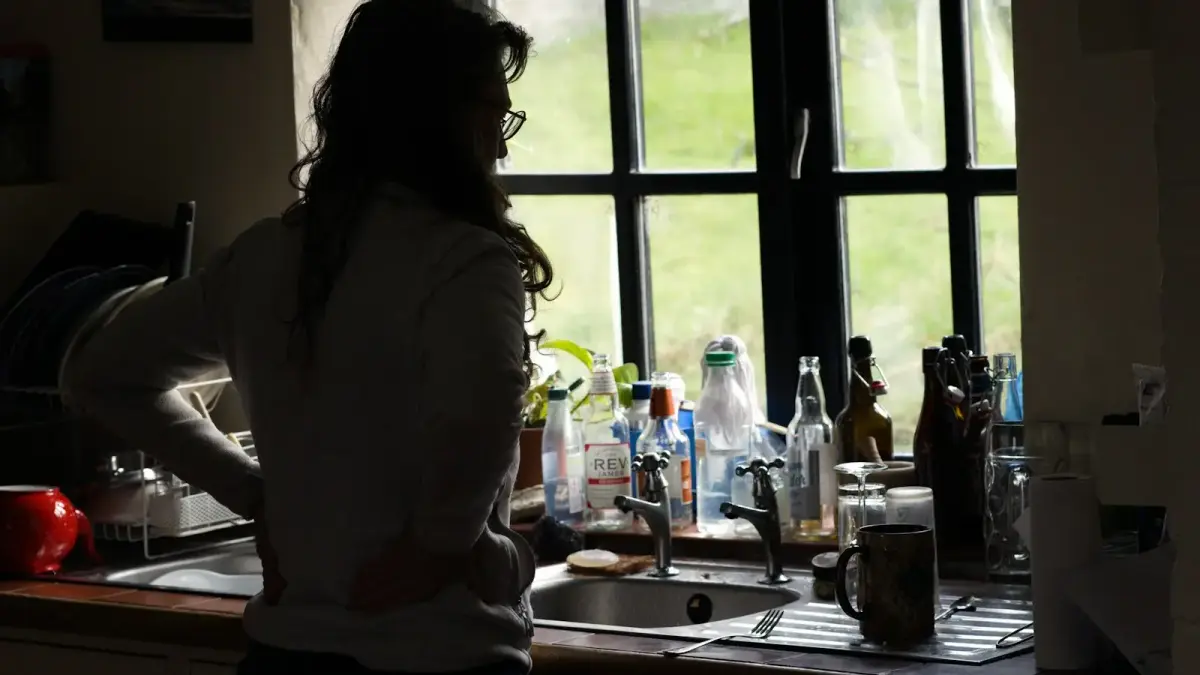
I was standing at the kitchen counter this morning, watering can in hand, and I heard myself say it.
“You look thirsty, sweetheart. Let me get you sorted.”
I was talking to the rosemary. The rosemary that sits in a clay pot on my windowsill and has never once answered me back.
I didn’t think anything of it at first. I’ve been doing this for years - decades, really. Narrating my way through the morning plant routine like a woman hosting a very quiet talk show for an audience of ferns and herbs. I ask the basil how it slept. I tell the spider plant it’s looking strong. I warn the fiddle leaf fig that I’m going to rotate it and that it shouldn’t be dramatic about the change.
My husband walked through once while I was mid-conversation with a pothos and raised an eyebrow. I laughed it off. Called it a quirk. One of those things you file under “eccentric but harmless.”
But this morning, something shifted. I heard my own voice - the cadence, the softness, the way I dropped into a register I don’t use with anyone else - and I went completely still.
Because I recognized it. Not from myself.
From her.
The Woman in the Garden at Dawn
My mother was up before anyone. Every single morning, summer or winter, she was outside by five-thirty, sometimes earlier, moving through the garden in her housecoat and slippers.
I know this because I used to watch her.
I was maybe seven or eight the first time. I couldn’t sleep, came downstairs for water, and noticed the back door was open. I didn’t go outside. I sat behind the kitchen curtain - this thin, floral thing that smelled like dish soap - and I pressed my face against the glass.
She was talking. Not to herself, exactly. To the tomatoes.
“You’re coming along nicely,” she said to a vine she’d staked the week before. “Just a little more sun and you’ll be perfect.”
She moved to the herbs. Asked the rosemary what it needed. Told the mint it was getting out of hand, but gently, the way you’d scold a child you secretly find charming.
She talked to those plants the way she never talked to us. Not unkindly - my mother wasn’t cruel. But inside the house, she was careful. Measured. She chose her words the way you’d choose steps across a frozen pond, testing each one before committing her weight.
In the garden, she didn’t test anything. She just spoke.
The Only Honest Conversation in the House
I went back to that curtain many mornings after. It became a kind of ritual - mine, not hers. She never knew I was listening.
And what I heard was a woman I didn’t recognize. A woman who laughed at a crooked sunflower. Who told the basil it looked strong today like she was giving it a compliment she meant with her whole chest. Who said things like, “I don’t know what I’m going to do about the fence,” and “I wish your father would just say what he means for once” - not to anyone in particular, but to the lavender, which absorbed it all without flinching.
She would narrate her tasks out loud. “Now I’m going to move you over here where you’ll get more afternoon light.” “This soil is too dry - let me fix that for you.” Small, practical sentences that were also, somehow, the most tender things I’d ever heard her say.
Inside the house, my mother communicated in logistics. Dinner at six. Don’t forget your lunch. Your father’s tired, keep the noise down. She wasn’t withholding love - I know that now. She was managing a household the way women of her generation were taught to: efficiently, without excess, certainly without making a scene of your own feelings.
But the garden was different. The garden was where excess lived. Where she could say too much, feel too much, be too much - and the only witnesses were things that grew.
What Gets Inherited Without a Word
A 2020 study published in the Journal of Research in Personality found that emotional expression styles are often transmitted between generations - not through explicit teaching but through observation and modeling. Children don’t learn how to handle emotions by being told. They learn by watching the adults around them navigate their own.
I never decided to talk to my plants. I never thought about it at all. It started sometime in my thirties, after my first daughter was born, when I had a few pots of herbs on the apartment balcony and a bone-deep exhaustion that made normal conversation feel like performance.
I’d go out there in the early morning, before the baby woke, and I’d just - talk. To the parsley. To the small, stubborn oregano that refused to thrive. I’d tell them what I was worried about. Not in any dramatic way. Just quietly, the way you’d confess something to a room you thought was empty.
It felt like relief. Not because anyone was listening. Because no one was.
I didn’t connect it to my mother for thirty years. Thirty years of morning conversations with plants, of narrating my way through watering and pruning and repotting, of using a voice so soft and unguarded that I’d be embarrassed if anyone actually heard it.
And then this morning, at sixty-three, standing in my kitchen with a watering can, I heard it. Her cadence in my mouth. Her softness in my throat. The exact rhythm she used when she told the tomatoes they were coming along nicely.
I hadn’t inherited her garden. I’d inherited her need for a safe place to be honest.
The Science of Speaking When No One Is Listening
There’s a reason talking to plants feels different from talking to people. And it’s not mystical. It’s structural.
Research on self-directed speech - what psychologists call private speech or self-talk - shows that narrating your actions out loud serves a powerful regulatory function. A 2022 study in Frontiers in Psychology found that people who engaged in self-directed narration during stressful tasks showed lower cortisol levels and reported feeling more in control than those who worked in silence.
But talking to plants is something slightly different from self-talk. It’s closer to what researchers call parasocial interaction - the phenomenon of communicating with an entity that cannot respond. We usually hear about this in the context of television characters or podcast hosts, but the mechanism is the same. You speak. Nothing comes back. And in that silence, something loosens.
When you talk to a plant, you’re not performing. There’s no feedback loop to manage. No face to read for disapproval. No tone to calibrate against someone else’s mood. You’re simply expressing - unedited, uninterrupted, unjudged.
For women of my mother’s generation, and honestly for many women of mine, that kind of freedom was rare. The house was a place where your words had consequences. Where saying the wrong thing could shift the temperature of an entire evening. Where “too much” was the worst thing a woman could be.
The garden asked for nothing. The garden absorbed everything. And a woman who couldn’t find a safe audience among the people she loved found one among the things she grew.
The Girl Behind the Curtain Grew Up
I think about that girl sometimes. The one sitting on the cold kitchen floor at dawn, pressing her face to the glass, listening to her mother have the only unguarded conversation of the day.
What did she learn?
She didn’t learn that her mother was unhappy. That’s too simple, and it isn’t quite true. She learned something more specific and more lasting. She learned that there is a version of you that only comes out when the stakes are zero. A version that is softer, funnier, more tender, more honest than the one you show to people who can react.
She learned that love sometimes looks like narrating your tasks to a rosemary bush. That emotional honesty doesn’t always happen in a therapist’s office or a heartfelt conversation at the dining room table. Sometimes it happens at five-thirty in the morning, alone, in a garden that smells like wet soil and basil, when you’re telling a tomato plant you believe in it.
A 2019 study from the Journal of Personality and Social Psychology examined how adults unconsciously replicate the emotional coping mechanisms they observed in their primary caregivers during childhood. The researchers found that these inherited patterns often go unrecognized for decades - not because they’re hidden, but because they feel so natural that they don’t register as learned behavior at all.
That’s exactly it. Talking to my plants never felt like something I picked up. It felt like something I was. A small, private part of my personality that belonged only to me.
Except it didn’t belong only to me. It belonged to her first.
The Audience That Requires Nothing
I called my sister last week. She’s sixty-one, lives in Oregon, has a garden that would make our mother weep with pride.
“Do you talk to your plants?” I asked.
She laughed. “Every morning.”
“What do you say?”
A pause. “I don’t know. I tell them how they’re doing. I ask the herbs if they need anything. I tell the roses they’re being dramatic.”
I could hear it in her voice. The same register. The same softness.
We were both quiet for a moment. Two women in their sixties, separated by two thousand miles, standing in their kitchens, realizing they’d been having the same conversation with the same invisible audience for most of their adult lives. A conversation their mother started in a garden before dawn, when she thought no one was listening.
But someone was always listening. A girl behind a curtain, absorbing not the words but the permission. The permission to need a place where you could speak without consequences. Where you could say what you actually felt without someone telling you to keep it down, calm down, not make such a fuss.
If you talk to your plants - if you narrate your morning to the herbs on your windowsill, if you compliment the fern and scold the ivy and tell the succulent you’re proud of it - you’re not being eccentric. You’re not being silly.
You’re honoring something ancient and necessary. The part of you that needs to speak without being heard. The part that learned, probably very young, probably from watching someone you loved, that the safest kind of honesty is the kind that asks nothing of its audience.
Your mother may have done it differently. Maybe it wasn’t plants. Maybe it was the car, alone on the highway, saying things she’d never say at dinner. Maybe it was the journal she kept in the nightstand. Maybe it was the way she hummed in the kitchen, not a song exactly, but a sound - a small, continuous proof that she was still in there, somewhere, behind all the managing and the measuring and the making sure everyone else was okay.
You inherited that need. Not as a flaw. As a form of emotional intelligence so quiet and so old that it doesn’t have a name.
The rosemary doesn’t need to hear you. But you need to say it. And knowing that - really knowing it, in your body, in the softness of your voice at dawn - is one of the truest things about you.