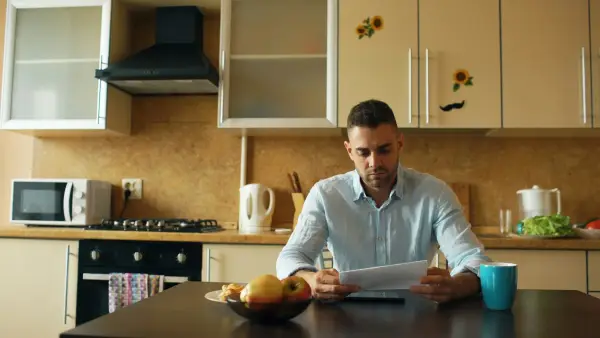
She's 64 and just realized the way she inspects every piece of fruit at the grocery store - turning the peach slowly in her palm, pressing the avocado with her thumb, holding the melon to her ear and tapping it twice with one knuckle - is the exact method her mother used in a household where a bruised pear or a mealy apple was not a mild inconvenience but money they genuinely could not afford to throw away, and now she does it in a kitchen that could absorb the loss ten times over but her hands never received the message that the stakes have changed
I watched my own hands last Thursday and didn’t recognize them as mine.
I was standing in the produce section of a grocery store I’ve been going to for eleven years, holding a cantaloupe up to my right ear, and I tapped it twice with my knuckle. Not once. Not three times. Twice. The exact same rhythm, the exact same pressure, the exact same tilt of the head to listen for the hollow sound that means it’s ripe. And something inside me came completely undone, because those were not my hands. Those were my mother’s hands, performing a ritual she taught me without ever saying a single word about it.
I’m 64 years old. I have a retirement account. I have a kitchen with a fruit bowl that sometimes holds fruit nobody eats before it goes soft. I throw things away. I can absorb a bad cantaloupe. But my body doesn’t know that. My body is still standing in a Piggly Wiggly in 1971, and the woman beside me is checking every piece of fruit like she’s defusing a bomb, because in our house, she was.
A bruised peach was not an inconvenience. It was a math problem. And my hands never stopped solving it.
The diagnostic system nobody taught you out loud
My mother had a method for every piece of produce, and I can recite the whole thing from muscle memory even now.
Peaches: you turn them slowly in your palm, running your thumb along the seam, feeling for any give that shouldn’t be there yet. Avocados: you press the stem end with your thumb - not the side, never the side, because the side lies. Melons: you hold them to your ear and tap twice, listening for a sound that’s hollow but not too hollow. Grapes: you lift the bunch and watch the bottom. If more than two fall, the bunch is past its prime.
She never sat me down and explained this. There was no lesson. I learned it the way children learn everything that matters - by standing beside her and absorbing it through proximity. I was maybe seven or eight, barely tall enough to see over the edge of the produce bin, and I watched her hands move with a seriousness that didn’t match the task. Or at least it wouldn’t match the task in a different household. In ours, it matched perfectly.
A 2019 study published in the Journal of Personality and Social Psychology found that behaviors tied to early economic scarcity become deeply proceduralized - meaning they move from conscious strategies into automatic routines that persist long after the original conditions have changed. The researchers called it “scarcity encoding,” and they found it was remarkably resistant to update, even when participants had been financially stable for decades.
My mother was running a diagnostic system. And she passed it to me the way you pass on an accent - without trying, without knowing, just by being in the room.
Shopping as calculation versus shopping as abundance
There are two fundamentally different ways to move through a grocery store, and you can tell which one a person learned by watching them for about ninety seconds.
Some people shop like it’s a garden. They wander. They pick things up because the color looks nice. They drop a pint of raspberries into the cart without checking the bottom of the container for mold. They buy avocados that won’t be ripe for three days and forget about them. This is shopping as abundance. It assumes the system has slack in it. It assumes a mistake is just a trip back to the store.
And then there are the people who shop the way my mother shopped. Every item gets handled. Every item gets evaluated. The tomato gets turned upside down. The lettuce gets squeezed gently at the base. The bananas get checked for brown spots that signal they’ll turn before Wednesday. This is shopping as calculation. There is no slack in this system. Every dollar has already been assigned before you walk through the door, and a mealy apple isn’t a shrug - it’s a gap in Tuesday’s lunch.
I shop like the second person. I have always shopped like the second person. And for most of my life, I thought I was just being careful. Responsible. Smart. I didn’t understand that I was performing a class ritual - that my hands were running a program written by economic pressure that no longer existed in my life.
The strange part is how invisible it is from the inside. You don’t feel like you’re doing something inherited. You feel like you’re doing something obvious.
The moment someone holds up a mirror
My daughter said something to me about three years ago that I still think about.
We were shopping together - she was home for a visit, trailing behind me with the cart while I did my usual inspection of the stone fruit. I had a nectarine in my hand, turning it slowly, checking the color gradient from the stem outward. She was watching me, and she said, with genuine curiosity, “Mom, why do you do that with every single one?”
I didn’t understand the question. “Do what?”
“You touch every piece of fruit like you’re looking for something wrong with it. You pick up like six peaches before you take one. I just grab whichever one’s on top.”
She said it like it was funny. Like it was a quirk. And in that moment, I heard my own behavior from the outside for the first time, and I realized she was right - it did look strange. It looked excessive. It looked like someone who didn’t trust the grocery store to sell her decent fruit.
But it wasn’t about trust. It was about a version of the world where you couldn’t afford to bring home a bad one. My daughter has never lived in that version. She grabs the peach on top because in her world, a bad peach is just a bad peach. In the world my hands remember, a bad peach is a failure of vigilance.
A 2021 study in Psychological Science found that adults who grew up in lower-income households maintained heightened attention to resource quality well into middle age, even after achieving financial security. The researchers described it as a form of “embedded vigilance” - a monitoring system that stays active because the body never fully registers that the threat has passed.
My daughter doesn’t have embedded vigilance about fruit. I gave her that freedom by building a life where a bruised pear doesn’t matter. But I couldn’t give it to myself, because I learned it before I had language for it.
Your body keeps a ledger your mind closed years ago
Here’s what I’ve come to understand about class memory: it doesn’t live in your thoughts. It lives in your hands, your posture, your reflexes. It lives in the way you automatically check a restaurant bill twice, or the way you can’t throw away the last two inches of a tube of toothpaste, or the way your chest tightens when someone orders the most expensive thing on the menu.
Your mind moved on. Your mind went to college, or got the promotion, or married into stability, or built something from nothing. Your mind knows the numbers. Your mind can see the savings account.
But your body keeps a different ledger. And your body was keeping that ledger before your mind had any say in the matter.
Psychologist Gabor Mate has written extensively about how early experiences of scarcity create what he calls “implicit memories” - emotional and procedural imprints that shape behavior without conscious awareness. These aren’t memories you recall. They’re memories you perform. You don’t remember learning to check the fruit. You just check the fruit. The knowledge is in the motion itself.
I think about all the things I do that are actually my mother’s hands working through me. The way I fold grocery bags into neat triangles and save them in a drawer. The way I instinctively calculate price per ounce without looking at the shelf tag. The way I eat the bruised part of a banana instead of cutting it away, because cutting it away is waste, and waste is the one thing her house could never absorb.
These aren’t habits. They’re heirlooms. They’re the only inheritance some families pass down - not money, not property, but a nervous system calibrated to a world where every piece of fruit matters because every dollar attached to it matters.
The tenderness hiding in the inspection
I used to feel a little embarrassed by it. Standing in a bright, well-stocked grocery store, turning a peach in my hand like I was assessing a diamond, while the woman next to me tossed hers in the bag without a second glance. I thought it made me look anxious. Difficult. Old-fashioned.
I don’t feel that way anymore.
Now, when I pick up a peach and turn it slowly in my palm, I feel my mother’s hand underneath mine. I feel her standing beside me in that old grocery store with the fluorescent lights and the tile floor that was always a little sticky. I feel her seriousness, which was not anxiety but love. She was not afraid of fruit. She was protecting a household that had no room for error, and the way she did it was by paying attention to everything, including the small things that most people with more money never had to notice.
A 2018 study published in the Journal of Research in Personality found that people who grew up in resource-scarce environments developed what the researchers called “attentional precision” - a heightened ability to notice small variations in quality that others overlooked. Far from being a deficit, it was described as a genuine perceptual skill, one that persisted even when it was no longer economically necessary.
My hands are precise because they had to be. And I’ve stopped wanting them to be anything else.
When I tap that cantaloupe twice and tilt my head to listen, I am not being neurotic. I am being my mother’s daughter. I am carrying forward a ritual that kept a family fed on a budget that had no margin for waste. And the fact that I still do it - in a life with margin, in a kitchen that could absorb every bad cantaloupe in the store - doesn’t mean I’m broken or stuck or unable to update.
It means some lessons go deeper than circumstances. It means the body remembers what it cost to keep a family whole. It means love, when it doesn’t have money, teaches your hands to be careful instead.
And careful hands don’t forget. Even when they no longer need to remember.