Children who made friendship bracelets for every person in their class but never wore one themselves - who knotted thread for hours and gave away every single one, who kept their own wrist bare while decorating everyone else's - often become adults who pour into every relationship around them while keeping almost nothing for themselves, because the child who gave the bracelet away was testing whether anyone would notice she never kept one, and when nobody did she learned that love was something she was built to give but never to expect in return
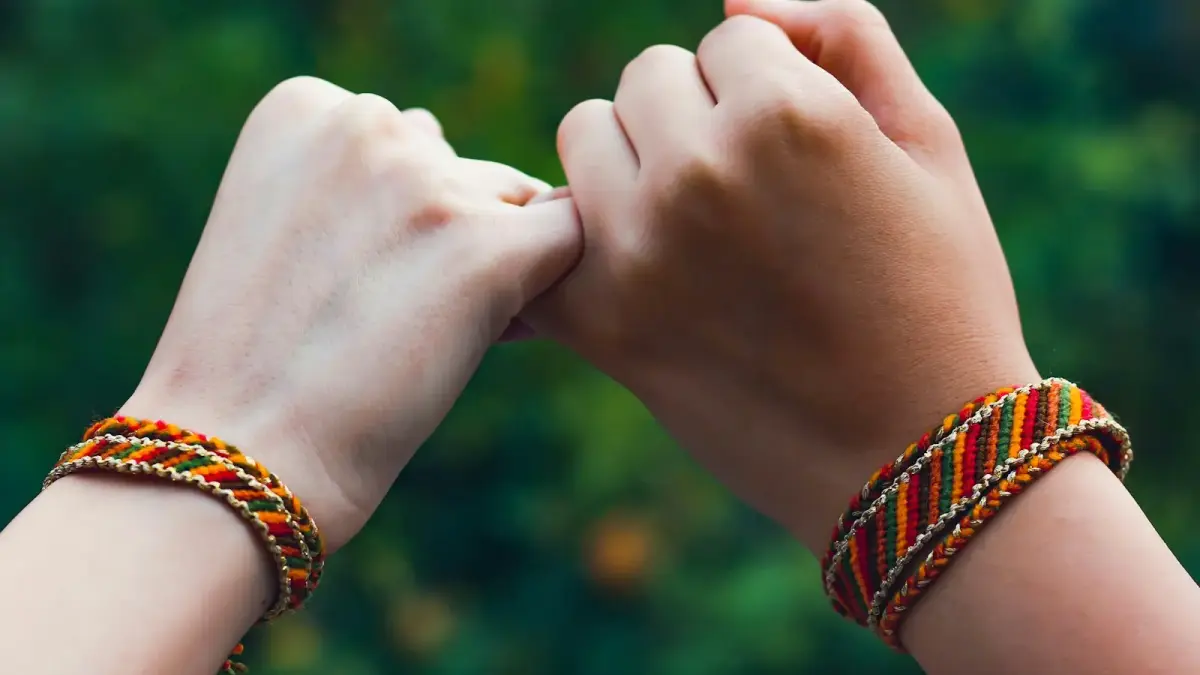
I remember sitting on my bedroom floor with a shoebox full of embroidery thread, sorting colors into piles like I was curating something sacred. Purple and gold for my best friend. Green and white for the girl who sat behind me in math. Red and blue for the boy I barely talked to but who seemed lonely at lunch.
I made one for every single person. Twenty-three bracelets. I counted them. I can still feel the ache in my fingers from pulling the knots tight.
I never made one for myself. And the strangest part is that I didn’t notice I hadn’t. Not until years later, when I was sitting in a therapist’s office at thirty-one, trying to explain why I felt so empty after spending an entire weekend helping my sister move, organizing a birthday dinner for a coworker, and driving forty minutes to drop off soup for a friend with the flu - all while my own apartment had no food in it and I hadn’t slept more than four hours in three days.
She asked me a question I still think about. “When was the last time you let someone do something for you - without immediately finding a way to pay it back?”
I couldn’t answer. And something about that silence reminded me of my bare wrist.
The child who counted every bracelet she gave away
If you were this child, you already know the feeling. You were the one with the craft supplies, the sticker collection you shared freely, the extra snack in your lunchbox that you always gave to whoever forgot theirs.
You were generous. Everyone said so. Teachers wrote it on your report cards. Your parents mentioned it to other adults at dinner parties as proof of your goodness.
But here is the part nobody talks about.
You weren’t just being generous. You were conducting an experiment. Every bracelet, every shared sticker, every offered snack was a quiet question you were too young to put into words: if I give you this, will you think of me?
And you watched. You watched to see if anyone noticed your wrist was bare. You watched to see if anyone made something for you without being asked. You were measuring something - not in a calculating way, but in the desperate, wordless way children measure whether they are safe.
A 2003 study published in the Journal of Personality and Social Psychology explored what researchers call “relational schemas” - the internal blueprints children develop about how relationships work. The researchers found that children as young as five begin forming stable expectations about whether they are the kind of person who receives care or the kind of person who provides it. These schemas, once formed, become remarkably resistant to change.
You formed yours on a bedroom floor, surrounded by thread.
How giving became your operating system
The thing about being the child who gives everything away is that it works. It works beautifully, in fact.
People like you. Teachers trust you. Friends come to you first. You become the reliable one, the thoughtful one, the person everyone describes as “so sweet” and “always thinking of others.”
And because it works, you keep doing it. You learn that your value lives in what you offer, not in who you are when your hands are empty.
This is what psychologist Dana Jack calls “self-silencing” - the process of suppressing your own needs and feelings to maintain relationships. Jack’s research, originally published in the early 1990s and expanded over decades, found that people who self-silence don’t do it because they don’t have needs. They do it because they learned, usually very early, that expressing those needs was either unsafe or simply ineffective.
The child who gave away every bracelet wasn’t born without desire. She wanted one too. She just learned that wanting things for herself wasn’t part of her role.
By middle school, the pattern was set. You were the friend who organized the birthday parties but deflected when anyone tried to plan one for you. You were the one who remembered everyone’s favorite candy but felt strange when someone asked about yours.
You weren’t selfless. You were afraid. And the fear was so old and so familiar that it felt like personality.
The bare wrist in adulthood
If you recognize yourself in this, I want to describe your adult life back to you, because I think you need to hear that someone sees it.
You are the person who texts first. Always. You check in on people. You remember the details - the job interview, the doctor’s appointment, the anniversary of the loss. You carry other people’s stories in your body like they are your own.
When someone asks how you are, you say “I’m good” and redirect. Not because you’re lying, exactly, but because the idea of someone actually sitting with your answer feels like too much to ask for. Like it would be greedy.
You organize. You show up early to help set up. You stay late to clean. You volunteer before anyone asks. And when someone does something kind for you - brings you flowers, writes you a note, shows up at your door just because - you feel a strange discomfort. Almost like you don’t deserve it. Almost like it’s a debt you now owe.
This is what attachment researchers describe as compulsive caregiving. It looks like love, and in many ways it is love. But it is love with a hollow center, because the person doing all the giving has quietly removed themselves from the equation.
A 2016 study in Frontiers in Psychology examined the tend-and-befriend stress response - the tendency, particularly common in women, to respond to threat by nurturing others and strengthening social bonds. The researchers found that while this response can be genuinely adaptive, in individuals with early attachment disruption it often becomes compulsive. The giving doesn’t stop when the threat is gone. It becomes the only way the person knows how to feel safe.
You are not giving because you are overflowing. You are giving because stopping feels like disappearing.
The experiment that never ended
Here is what I want you to understand about the bracelet.
The child who gave away every single one and kept her wrist bare was not just being generous. She was running a test. The test was: will anyone notice?
Will anyone look at my empty wrist and say, “Wait - where’s yours?”
Will anyone make one for me without me having to ask?
Will anyone see that I am giving and giving and giving, and think - maybe she needs something too?
And when nobody did - not because they were cruel, but because children are children and most people are simply not paying that kind of attention - she drew a conclusion. The conclusion was quiet and devastating and it went something like this:
Love is something I make. It is not something that comes to me.
That conclusion followed her everywhere. It followed her into friendships where she was always the listener and never the one who called at 2 a.m. It followed her into romantic relationships where she shaped herself around the other person’s needs like water filling a container. It followed her into parenthood, where she gave every drop of herself and then felt guilty for being tired.
The experiment never ended. She’s still watching. Still counting. Still looking at her bare wrist.
What nobody told you about over-giving
There is something important that gets lost in the way our culture talks about generosity.
We praise givers. We celebrate them. We share quotes about how the greatest joy is in giving, how love is an action, how the best relationships are the ones where you show up for the other person.
And all of that is true. But it is incomplete.
Because over-giving - the kind that leaves you empty, the kind that feels compulsive rather than free - is not actually about love. It is about survival. It is the strategy you developed when you were too young to have any other options, and it worked well enough that you never questioned it.
Psychologist Gabor Mate has written extensively about how children adapt to their environments in ways that ensure connection, even at the cost of their own authenticity. The child doesn’t decide to become an over-giver. She doesn’t sit down and calculate that generosity will earn her belonging. She simply notices what gets rewarded - what makes people smile, what keeps the peace, what prevents the kind of rejection that feels, to a child, like the end of the world.
And she becomes that. She becomes the giver. The maker. The knotter of thread. The one with the bare wrist and the full heart and the quiet question that never gets answered.
Learning to keep one
I am not going to tell you to stop giving. That advice misses the point entirely, and honestly, your generosity is one of the most beautiful things about you.
But I am going to ask you something, and I want you to sit with it.
When was the last time you kept one?
Not a bracelet - although if you want to make yourself one, I think that would be lovely. I mean: when was the last time you kept something for yourself? A Saturday morning with no obligations. A “no” that you didn’t apologize for. A moment where someone offered to help and you let them, fully, without rushing to return the favor.
A 2019 study in the Journal of Research in Personality found that individuals who struggle to receive care often score high on measures of empathy and emotional intelligence. They are not lacking in relational skill. They are lacking in what the researchers called “receptive capacity” - the ability to allow themselves to be on the receiving end of the very love they so freely give.
You have spent your whole life proving you are worth knowing by what you offer. But here is the thing the child on the bedroom floor never got to learn: you were worth knowing before you made a single bracelet. You were worth knowing with empty hands.
The bare wrist was never evidence that you didn’t deserve one. It was evidence that you were so busy taking care of everyone else that you forgot you were also someone who could be taken care of.
You are allowed to keep one. You are allowed to wear it. You are allowed to let your wrist not be bare.
And if nobody notices - if nobody asks where yours is - that doesn’t mean you don’t deserve it. It just means you might need to be the first person who gives one to yourself. Not because nobody else will. But because you have been waiting for permission that was always yours to grant.
The thread is still in the shoebox. You remember the colors. You remember how the knots go.
Make one more. And this time, keep it.