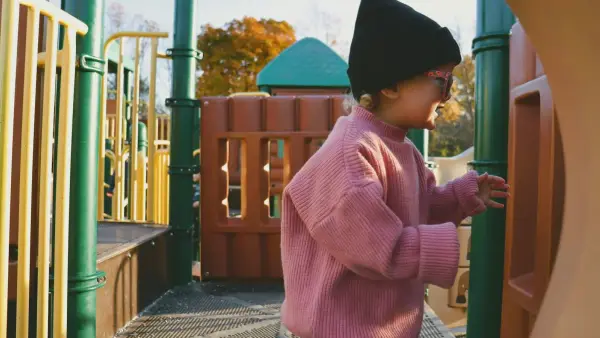
Children who always apologized after laughing too loudly - who covered their mouths, looked around the room, and immediately checked whether their joy had been too big for the space they were in - often become adults who cannot celebrate anything without the guilt arriving seconds later, because a child who learned that her happiness made other people uncomfortable never stopped rationing the one emotion that should have been free

I remember the exact moment I realized I was doing it.
I was thirty-one, sitting in a restaurant with friends after getting an unexpected promotion, and someone said something that made me laugh - a real laugh, the kind that comes from your stomach and takes over your whole face. And before the sound had even finished leaving my body, my hand was already over my mouth. My eyes had already darted sideways. I had already begun the silent calculation I had been running since I was seven years old: Was that too much? Did I just make this uncomfortable? Should I apologize?
I didn’t apologize. But I did something almost worse. I immediately started qualifying the promotion. “It’s not that big of a deal. I basically just got lucky. Someone else probably deserved it more.” My friends looked confused. They had been trying to celebrate me, and I had made that impossible in under ten seconds.
That night, lying in bed, I traced the feeling back to its source. And what I found there was a kitchen table, a child laughing at something on television, and a parent who said - without cruelty, without malice, almost casually - “Do you have to be so loud?”
That was all it took. One sentence, repeated in small variations across a childhood, and joy became the thing I learned to apologize for.
The child who monitors her own laughter
Not every child who grows up rationing happiness had a dramatic childhood. Some of them had parents who were simply tired, or overwhelmed, or carrying their own unprocessed grief. The household wasn’t abusive. It was just a place where big emotions were treated as a disruption rather than a sign of life.
These children learned something specific: that their joy had consequences for other people.
Not their anger - that was expected and managed. Not their sadness - that was comforted, at least sometimes. But their happiness, their unfiltered delight, their spontaneous laughter - that was the emotion that drew correction. A look. A sigh. A “Can you keep it down?” A parent’s visible irritation at the sound of a child simply enjoying herself.
A 2019 study published in the journal Emotion found that children who received consistent negative feedback during expressions of positive affect developed what researchers called “joy vigilance” - a heightened monitoring of their own happiness and its impact on others. These children didn’t stop feeling joy. They learned to feel it and immediately scan the room for permission to continue.
That scanning never stops. It just gets more sophisticated with age.
What joy vigilance looks like at forty
The adult version of covering your mouth after laughing is subtle enough that most people - including the person doing it - don’t recognize it as a pattern. It looks like modesty. It looks like humility. It sometimes even looks like emotional maturity.
But it isn’t any of those things.
It’s a child’s survival strategy wearing adult clothing.
Here is what it actually looks like in a grown person’s life:
1. You cannot receive a compliment without immediately deflecting it
Someone tells you that you did beautiful work, and before the words have landed, you are already explaining why it wasn’t that impressive. You credit the team. You mention the parts that didn’t go well. You do anything - anything at all - to keep the spotlight from resting on you for more than a breath.
This isn’t humility. This is a learned reflex: if I let myself feel this good thing fully, someone will be uncomfortable, and that discomfort will be my fault.
2. You qualify every accomplishment within seconds of sharing it
You got the job, but the market was weak. You finished the marathon, but your time wasn’t great. You raised kind children, but you made so many mistakes along the way. The qualification arrives so fast it’s almost part of the original sentence - as if celebrating and apologizing are the same action now.
3. Good news makes you anxious instead of happy
When something genuinely wonderful happens - a clean scan, a financial windfall, a relationship milestone - the first emotion isn’t relief or gratitude. It’s dread. A quiet voice that says this can’t last, or I don’t deserve this, or something bad is coming to balance this out. Psychologist Martin Seligman’s research on “foreboding joy” - the act of rehearsing tragedy in moments of happiness - describes this phenomenon precisely. The brain has been trained to treat joy as a precursor to loss.
4. You feel guilty for being happy when someone near you isn’t
Your friend is going through a divorce, so you hide your own relationship satisfaction. Your sibling lost a job, so you downplay your career success. You have internalized a zero-sum model of happiness: if you take too much, someone else gets less. This was the math of your childhood kitchen table, and you still run it automatically.
5. You apologize for enthusiasm
You catch yourself saying “Sorry, I’m just really excited about this” or “I know this is silly, but…” before sharing something that matters to you. The apology is preemptive. You are asking for permission to feel something before anyone has told you no.
6. You are more comfortable comforting others than being celebrated
Sitting with someone else’s pain feels natural. Having a room full of people focused on your accomplishment feels unbearable. You would rather be the support than the center. Not because you don’t want to be seen, but because being seen in your happiness triggers an old alarm that says you are taking up too much space.
7. You struggle to enjoy things without immediately thinking about what comes next
A beautiful vacation day gets interrupted by thoughts about the work waiting at home. A perfect meal is followed by guilt about the calories. A moment of peace is punctured by the question of whether you’ve earned it. Enjoyment never gets to just be enjoyment. It always has to justify itself.
The neuroscience of rationed happiness
What happens in the brain of a child who learns that joy is disruptive is more concrete than most people realize.
A 2021 study in Frontiers in Psychology found that children who grew up in emotionally suppressive environments showed altered activation patterns in the ventral striatum - the brain’s reward processing center. Specifically, these individuals showed normal activation when anticipating a reward but dampened activation when actually receiving it. Their brains had learned to enjoy the wanting but suppress the having.
This is not a personality trait. It is a neurological adaptation.
The child who covered her mouth after laughing wasn’t being polite. She was training her brain, hundreds of times across thousands of small moments, to treat the experience of happiness as a signal to activate self-monitoring rather than pleasure. By adulthood, this pattern is so deeply wired that it feels like identity. “I’m just not someone who gets excited about things.” “I’ve always been the calm one.” “I don’t really need recognition.”
These aren’t descriptions of a personality. They are descriptions of a coping strategy that became permanent.
The specific grief of rationed joy
There is a particular kind of sadness that belongs to people who learned to make their happiness small.
It is not the sadness of never having good things happen. Good things happen. Promotions come. Babies are born. Friendships deepen. The sadness is that none of it lands fully. Every wonderful moment arrives with a filter already in place - a slight dimming, a pulling back, an instinct to check whether it’s safe to feel this before actually feeling it.
Brene Brown has written extensively about this phenomenon, describing it as the most terrifying human emotion - not because joy itself is dangerous, but because somewhere along the way, we learned that it made us vulnerable. If you let yourself feel the full weight of how good this moment is, you have something to lose. And if you grew up in a household where your happiness seemed to cost someone else their comfort, you learned that having something to lose also means being something to blame.
That’s the specific wound: not that joy was forbidden, but that it was monitored. Not that you were punished for laughing, but that you learned your laughter had a weight that other people had to carry.
Unlearning the apology
The first step toward reclaiming unrationed joy isn’t dramatic. It doesn’t require confronting anyone or revisiting painful memories in detail. It starts with something much smaller: noticing.
Noticing the hand that moves toward your mouth when you laugh. Noticing the qualifier that follows the good news. Noticing the guilt that appears - like clockwork - forty-five seconds into any celebration. Noticing the impulse to shrink, to deflect, to make it smaller so it’s safer.
You don’t have to fight those impulses. You just have to see them for what they are: a child’s strategy, still running in an adult’s body, still trying to keep the room calm.
Developmental psychologist Edward Tronick’s research on emotional communication between parents and children shows that repair is always possible - not just in childhood, but throughout the lifespan. The brain that learned to suppress joy can learn to tolerate it again. Not all at once. Not without discomfort. But steadily, in the same way it was trained in the first place: one small moment at a time.
The next time something good happens and you feel the urge to make it smaller, try letting it stay its full size for just ten seconds longer than feels comfortable. That’s it. Ten seconds of unqualified, unapologetic, unmonitored happiness.
It will feel strange. It might feel dangerous. That’s the old alarm, and it’s lying to you.
Your joy was never too big for the room. The room was just too small for you.
You were never too much. You were a child, laughing, and that should have been the easiest thing in the world for the people around you to hold.
It still can be. Starting now. Starting with you deciding - quietly, privately, without anyone’s permission - that the one emotion you’ve been rationing your entire life is the one you’re finally allowed to have for free.