There is a morning after sixty when you catch your reflection in a store window and see your father looking back - not as a metaphor but as a genuine confusion, a half-second where the man in the glass is the man you watched shave at the bathroom sink when you were six years old - and the vertigo that follows is not grief exactly but the sudden understanding that the person you have been becoming your entire life was never a mystery to anyone who loved your father, because they have been watching his face arrive in yours for years and simply never told you
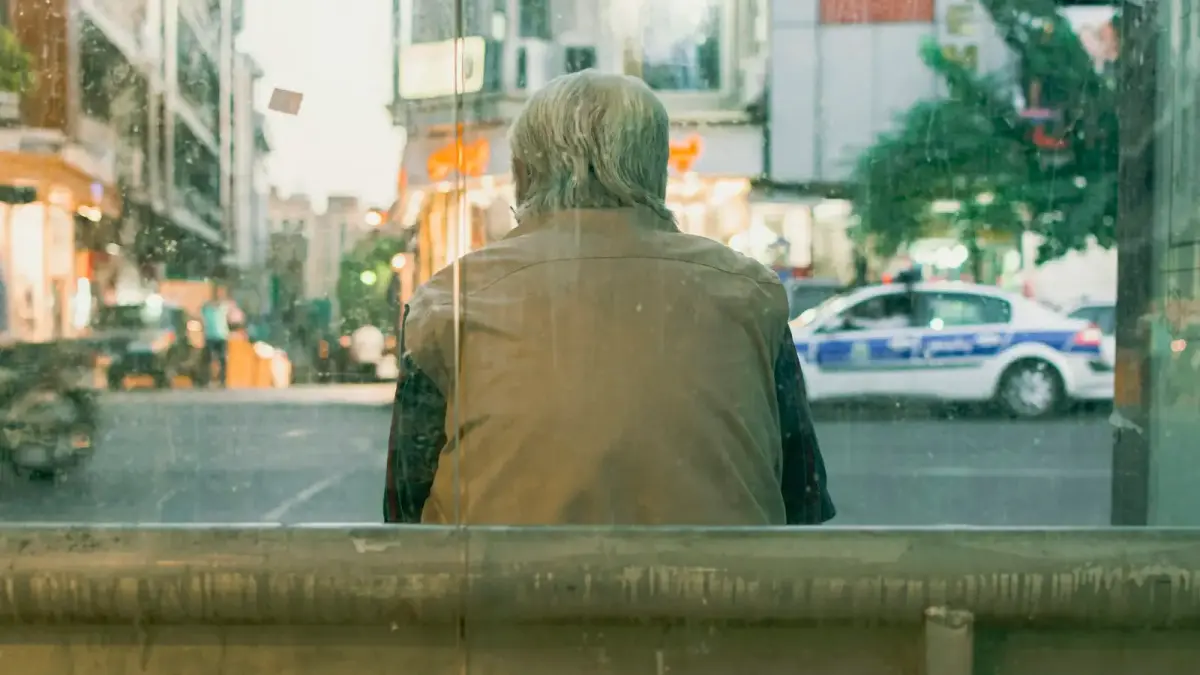
I was walking past a hardware store on a Tuesday morning - nothing remarkable about the day, nothing remarkable about the errand - when I stopped cold on the sidewalk. The man in the plate glass window was my father. Not reminded me of my father. Not looked a little like my father. Was my father. The same heavy brow, the same way the jaw softened at the edges, the same tired kindness around the eyes.
It lasted maybe half a second. Then the man in the glass moved when I moved, and the world corrected itself, and I understood that I was looking at my own face.
But for that half-second, I was six years old again, standing in the bathroom doorway, watching him drag a razor across his cheek with the quiet concentration of a man who has done the same thing ten thousand mornings in a row. I knew that face better than I knew my own. I had studied it the way children study everything - without knowing I was studying it at all.
And now, somehow, I was wearing it.
The face in the glass
You don’t notice it happening. That’s the part nobody warns you about. You spend decades looking in the mirror and seeing yourself - the version of yourself you’ve always been, the face you learned to shave, the face that aged so gradually it never seemed to age at all. You accommodate each change as it arrives. The gray at the temples. The deepening lines around the mouth. The way the skin under the chin stops holding itself taut.
None of it shocks you because none of it happens all at once.
But a store window is different from a mirror. A store window catches you unaware. You’re not looking for yourself. You’re looking at a display of socket wrenches or a sale sign or nothing at all, and then a figure appears in the periphery, and your brain does what brains do - it identifies the figure before it identifies you.
And sometimes, after sixty, the figure it identifies is your father.
I called my older brother that evening. I didn’t tell him what had happened, not exactly. I just asked him, as casually as I could manage, whether he ever looked in the mirror and saw Dad.
He was quiet for a long moment. Then he said, “Every morning for the last five years.”
He said it the way you’d say the sky is blue. Like it was the most obvious thing in the world. Like he’d been living with it so long it had stopped being strange.
The inheritance nobody names
We talk about inheriting our parents’ temperament, their values, their trauma, their patterns. There are entire shelves of books about the emotional legacy of fathers. But we almost never talk about the simplest, most visible inheritance of all - the face.
A 2019 study published in the journal Nature Genetics mapped the specific genetic variants responsible for facial morphology and found that the resemblance between parents and children is not general but architectural. It’s not that you vaguely look like your father. It’s that the specific proportions of your brow ridge, the angle of your nose, the distance between your eyes - these are inherited with startling precision. The blueprint was always there. It just takes decades to fully express itself.
Because here’s what no one tells you about resemblance: it’s a moving target. You might look nothing like your father at twenty-five. You might share his coloring but not his structure, or his jawline but not his expression. The resemblance is partial, scattered, incomplete.
Then time does its work. The soft tissue thins. The bone structure emerges. The expressions you’ve been making your entire life - his expressions, learned by watching him before you could walk - carve themselves into permanent lines. And one morning, the face finishes assembling itself.
You don’t grow into your father’s face. His face arrives in yours.
What they’ve been watching
The vertigo I felt on that sidewalk was not grief. It was not nostalgia. It was something I didn’t have a name for until weeks later, when my aunt - my father’s younger sister, eighty-one years old and sharp as a tack - said something to me at a family dinner that knocked the wind out of me.
She said, “You know, watching you get older has been like watching him come back.”
She said it gently. She said it with love. But the implications of it opened up beneath me like a trapdoor.
She had been watching. For years. She had been sitting across from me at Thanksgiving tables and birthday dinners and Sunday lunches, watching my father’s face slowly reassemble itself on my bones, and she had simply never mentioned it. Not because it was a secret. Because what would she have said?
I think about that now - all the people who loved my father, who knew his face the way I knew it, who have been watching that face migrate into mine with the slow patience of a season changing. My mother, before she passed. His friends. His brother. They watched the eyebrows thicken the same way. They watched the forehead crease in the same places. They watched and they recognized and they held it privately, this quiet recognition, because it belonged to a category of experience that doesn’t have a comfortable place in conversation.
You can’t walk up to a man at a barbecue and say, “You’re turning into your father.” Even when it’s true. Even when it’s beautiful.
The science of becoming
Psychologist Daniel Goleman has written about what he calls the “emotional inheritance” - the way we absorb not just our parents’ features but their characteristic expressions, their habitual ways of holding their faces. A furrowed brow isn’t just genetic. It’s also learned. You watched your father concentrate, worry, think, and your mirror neurons fired in sympathy, and your face practiced his expressions thousands of times before you were old enough to choose your own.
A 2021 study in Psychological Science examined what researchers called “facial echo” - the phenomenon where adult children increasingly resemble their same-sex parent as they age, not merely in structure but in expression and affect. The researchers found that this resemblance accelerated after the age of fifty, driven by the convergence of genetic facial architecture and decades of shared expressive habits.
In other words, you’ve been rehearsing your father’s face your entire life. You just didn’t know you were rehearsing.
This is why the store-window moment is so disorienting. It’s not just that you see your father. It’s that you realize you’ve been becoming your father - visibly, physically, in the most literal sense possible - and you were the last person to notice. Everyone else has been watching the dress rehearsal. You only showed up for the performance.
The ones who came before the mirror
I’ve been thinking about what it means to wear another person’s face. Not in the uncanny, horror-movie sense. In the sacred sense. In the sense that your face is a record of the people who made you, and that record becomes more legible as you age, and that legibility is not a loss of self but an expansion of it.
My father was not a complicated man, or maybe he was and I was too young to see the complications. He worked with his hands. He was quiet in crowds and loud in the kitchen. He loved baseball the way some men love religion - with devotion and occasional despair. He was tender with my mother in ways he never learned to be tender with himself.
And now his face looks back at me from store windows, car mirrors, the blank screen of my phone before it lights up. I see him in the way my eyes narrow when I’m listening carefully. I see him in the way my mouth sets when I’m trying not to say something I’ll regret. I see him in the heaviness of my brow when I’m tired, which is more often now than it used to be.
This is not haunting. This is inheritance working exactly as it’s supposed to. This is biology’s way of saying that the people we come from don’t disappear. They migrate. They take up residence in the architecture of our faces and wait for time to make the resemblance undeniable.
The face fits
There’s a moment - and I think every man who has lost his father and lived long enough arrives at this moment - when the resemblance stops being startling and starts being a comfort.
You stop flinching when you see him in the glass. You start greeting him.
Research from a 2023 study in Frontiers in Psychology found that adults who recognized strong physical resemblance to a deceased parent reported higher levels of what the researchers called “continuing bonds” - an ongoing sense of connection that supported rather than complicated their grief. The resemblance wasn’t a reminder of loss. It was evidence of continuity.
I think that’s the right word. Continuity. Not replacement, not reincarnation, not any of the dramatic words. Just the quiet fact that the face continues. That the jaw my grandfather gave my father, my father gave me. That the lines I’m earning now are the same lines he earned. That when my son - who is thirty-four and still looks mostly like himself - catches his reflection in a store window twenty-five years from now, he might see me looking back at him, and he might feel that same beautiful vertigo, and he might understand for the first time that he was never becoming a stranger.
He was becoming family.
If you’ve had that moment - the one where the face in the glass isn’t yours for just a half-second, where the man looking back at you is the man you come from - I want you to know something. That disorientation you felt is not confusion. It’s recognition. It’s the deepest kind of recognition there is.
You are not losing yourself. You are finding out how far back you go.
The face fits. It was always going to fit. And the people who loved the man who wore it first - they’ve known that longer than you have. They’ve been watching you arrive in his face for years, with a patience and a tenderness they never had the words for.
You are not your father. But you are not not your father, either.
You are what happens when love gets a second face to wear. And it looks good on you. It looks exactly right.