There is a particular kind of man who still checks the tide tables every morning even though he has not been fishing in twenty years, because a boy who sat on a dock beside his grandfather before sunrise learned that the ocean runs on a schedule and the men who loved it were expected to know it by heart, and somewhere in him there is still a boy who believes that knowing when the water rises is the closest a man can come to understanding something larger than himself
My grandfather had a tide chart tacked to the wall beside the kitchen phone. It was printed on thin newsprint, the kind that yellowed within a week, and every January he would take the old one down, fold it carefully into the junk drawer, and pin up the new one like a man hanging a calendar of holy days.
He never explained why it mattered. He never needed to.
I would sit at that kitchen table at five in the morning eating cereal I did not want, watching him run his finger down the columns of numbers while the coffee pot sputtered behind him. High tide at 6:14. Low at 12:37. He would nod at the paper like it had confirmed something he already suspected, then look at me and say, “We’ve got a window.”
That was thirty-five years ago. I live in Colorado now. The nearest ocean is a thousand miles in any direction. And this morning, before I did anything else, I opened an app on my phone and checked the tide report for a harbor I have not visited since his funeral.
The schedule nobody asked you to keep
There is a kind of knowledge that serves no practical purpose but refuses to leave you.
I could not tell you the tides for any particular reason. Nobody is waiting for me at a boat launch. Nobody needs me to know when the flats are exposed or when the channel is deep enough to clear the sandbar. The information has no utility in my life whatsoever.
But I check it the way some people check the weather for cities they used to live in. Not because they are going back. Because something in them never left.
A 2019 study published in the Journal of Environmental Psychology found that people who form strong place attachments in childhood often maintain what researchers call “phantom engagement” with those landscapes well into adulthood - monitoring weather patterns, following local news, tracking seasonal changes in places they no longer inhabit. The attachment is not to the information. It is to the version of themselves who needed it.
My grandfather needed it. Or at least, he lived as though he did. And because I loved him in that wordless way boys love the men who show up early and expect them to keep pace, I decided I needed it too.
What the ocean taught that fathers could not
Here is something I have come to understand about the men of my grandfather’s generation: the ocean was the one place they were allowed to be reverent.
They could not say “I love you” without coughing afterward. They could not sit with sadness without turning it into a task. They could not hold a grandchild’s face in their hands and say, “You are the best thing I have ever been part of,” because that would require a vocabulary they were never issued.
But they could stand at the edge of the water at dawn and fall silent in a way that looked like prayer.
They could study the tide tables with the same devotion other men brought to scripture. They could teach a boy how to read the current, how to tell from the color of the water whether the bottom was sand or mud, how to watch the birds to know where the fish were running. And in all of that teaching, there was a transmission happening that had nothing to do with fish.
They were saying: I am showing you how to pay attention. I am showing you that the world has a rhythm and that your job is to learn it. I am showing you that devotion looks like showing up early, keeping quiet, and knowing the schedule of something larger than yourself.
Research on intergenerational environmental behavior, published in a 2021 issue of Frontiers in Psychology, confirms what many of us feel instinctively - that environmental knowledge passed between generations carries emotional weight far beyond its practical content. Children who learn outdoor skills from grandparents report stronger nature connectedness decades later, not because the skills remain useful but because the learning itself becomes a container for the relationship.
The tide chart was never about tides. It was a love letter written in numbers.
A boy on a dock before the world wakes up
I want to tell you about one morning, though I suspect you have a morning like it somewhere in your own memory.
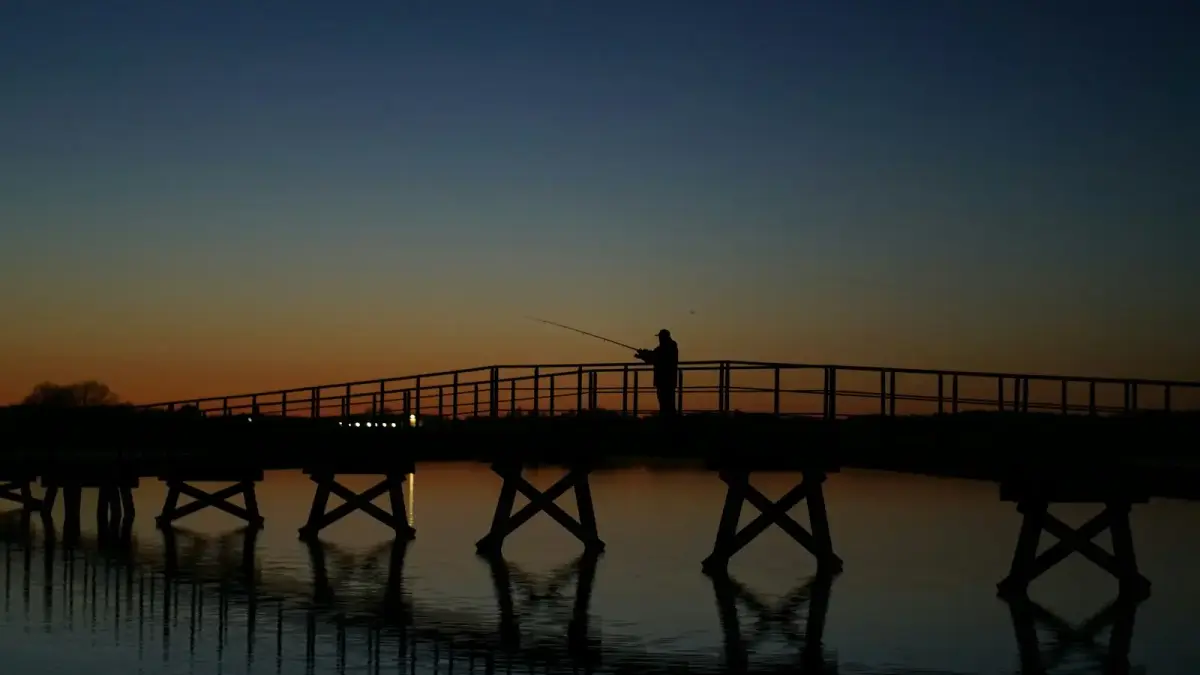
I was nine. It was August. We were on the dock by 5:30 and the sky was that impossible purple it turns before the sun commits to rising. The water was flat. I mean perfectly, almost unnervingly flat, like a sheet of dark glass laid over everything underneath.
My grandfather handed me a thermos cap full of coffee - mostly milk, a gesture of inclusion rather than caffeine - and we sat there without talking. A heron stood in the shallows about thirty yards out, absolutely still, as though it had been assigned to that spot by someone who understood the importance of composition.
Nothing happened. We did not catch anything remarkable. We did not have a conversation that changed my life. He did not deliver a speech about manhood or mortality or what it means to carry a family name.
He just sat beside me and watched the water come in.
And somehow, that was enough to build an entire identity around. That stillness. That willingness to be present for something that would happen whether we were there or not. The tide was coming in at 6:14 and my grandfather knew it and I knew it and we sat there together and waited for it like two people keeping an appointment with something honest.
The practical men and their hidden churches
Stephen Kaplan’s attention restoration theory suggests that natural environments replenish cognitive resources in ways that built environments cannot - that something about the rhythm of water, the movement of wind, the patterned chaos of a coastline allows the prefrontal cortex to rest in a way that feels, to the person experiencing it, like peace.
I think my grandfather knew this without having the language for it.
I think a lot of men of that era knew it. The ones who woke up early to fish were not always fishing. The ones who drove to the coast on weekday mornings were not always catching anything. They were going to the only church that never asked them to be vulnerable in front of other people.
The ocean does not require you to name your feelings. It does not ask you to share with the group. It does not need you to make eye contact while describing the thing that keeps you up at night. It just moves in and out, on a schedule you can memorize, and if you show up consistently enough, it starts to feel like the most reliable relationship you have ever had.
My grandfather was married for forty-seven years. He loved my grandmother. But I do not think she ever saw him the way the ocean did - which is to say, completely still, completely himself, unburdened by the expectation of being useful.
On the dock, he was not a provider. He was not a husband or a father or a veteran or a man who owed anyone anything. He was just a person sitting at the edge of something enormous, tracking its rhythms, and finding in that tracking a kind of faith he could not access anywhere else.
The men who carry water in their pockets
I know other men like this. You probably do too.
There is the man who still keeps a barometer in his hallway even though he works in an office park and has not needed to read the weather from an instrument since before smartphones existed. He taps the glass every morning the way his father did. He does not know why he does it. If you asked him, he would say it is habit. But habit is just the word we use when devotion has been doing its work so long we have forgotten it is devotion.
There is the man who can still tie a bowline in the dark, whose hands remember the motion the way a pianist’s hands remember a piece they learned at twelve. He has not been on a boat in a decade. The knot is useless. But his hands are not willing to let go of the conversation they were having with his uncle’s hands on a dock in 1978.
There is the man who watches the weather channel during hurricanes - not for the drama, not for the destruction, but because somewhere in his chest there is a boy who learned that men pay attention when the water rises. That vigilance is a form of love. That knowing what the sea is doing means you are still in the conversation.
Place attachment researchers at the University of Surrey have documented how environmental monitoring behaviors serve as what they call “identity anchors” - small daily rituals that connect individuals to meaningful places and relationships across time and distance. The act of checking is not informational. It is relational. You are not tracking the tide. You are tracking the person who taught you to care about it.
The inheritance nobody put in the will
My grandfather left behind a house, a truck, some tools, and a collection of fishing tackle that my uncle divided among the grandchildren with the solemnity of a man distributing sacred relics.
I got a tackle box, a filleting knife, and the final tide chart from his kitchen wall - the one that was up when he died, still showing the schedule for a month he did not finish.
I framed it. It hangs in my office in Colorado, a thousand miles from any tide it describes. Sometimes clients notice it and ask if I fish. I say I used to, which is true. What I do not say is that the chart is not about fishing. It is the last record of what my grandfather considered important enough to look at every single morning of his life.
He chose the ocean. He chose its schedule over his own comfort. He chose to know when the water would rise and when it would fall, every day, for decades, as though the information itself was a kind of prayer.
And I chose to keep choosing it after him. Not because I need to know the tides. Because he needed me to. Because somewhere in the quiet machinery of how men pass love to boys without saying the word, he installed in me a small, persistent engine that runs on saltwater and silence and the conviction that the ocean keeps its promises.
What the water knows
If you are a man who still tracks something you no longer need to track - the tides, the weather, the migration patterns of birds you will never see from where you live now - I want you to know something.
You are not being sentimental. You are not stuck in the past. You are not wasting your time.
You are keeping faith with someone who taught you that the world has a rhythm and that your job - your real job, beneath all the other jobs - is to pay attention to it.
That is not nostalgia. That is the quietest, most durable form of love I have ever seen.
This morning I checked the tides for a harbor in Maine. High water at 5:47. The sun will be just clearing the tree line on the eastern shore. The herons will be in the shallows. The dock will be empty.
But not really. Not to me.
There is a boy sitting there with a thermos cap full of mostly-milk coffee, learning something he will carry for the rest of his life about devotion and rhythm and the particular grace of men who loved the ocean because it was the one thing that never asked them to explain why they kept coming back.
He is still there. I check every morning to make sure.