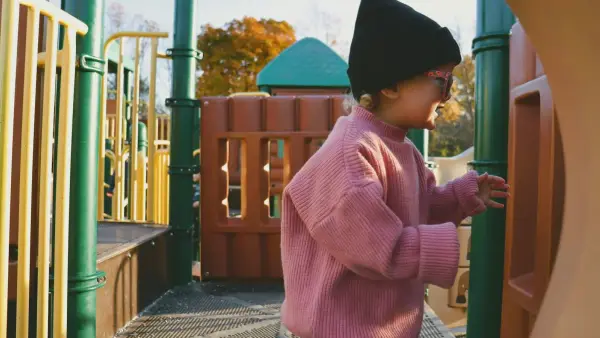
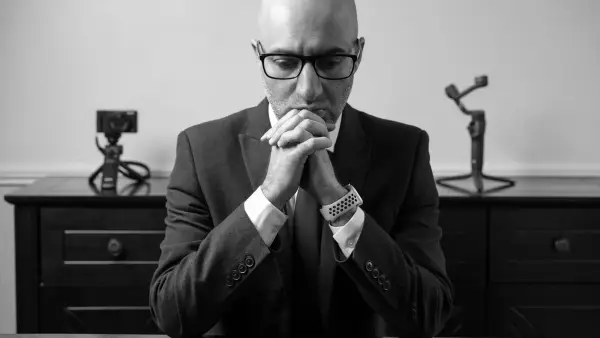
There is a particular kind of man who learned to say 'I'm fine' before he learned to say 'I'm hurt' - who could name every tool in his father's garage by age six but has never once in fifty years been able to name what he is feeling in the moment he is feeling it, because a boy who was told to shake it off ten thousand times eventually built a person who could not be shaken, and the wife who asks 'what's wrong' and hears 'nothing' is not being lied to but is hearing the only answer a boy was ever allowed to practice
The Vocabulary He Was Given
My father could tell you the difference between a Phillips head and a Robertson without looking. He knew which wrench fit which bolt on a ‘72 Chevy engine by feel alone, in the dark, with grease up to his elbows. He could identify a bird by its call from three rooms away, and he could read the weather by the way the wind moved through the maple tree in the backyard.
But if you asked him how he felt the day his own father died, he would pause. He would look at his hands. And then he would say something like, “Well, it was a tough one.”
That was the entire eulogy his grief ever received.
I grew up watching this man - this deeply good, quietly suffering man - navigate an entire inner life with roughly four words. Fine. Tired. Hungry. Busy. That was his emotional vocabulary. Not because he was shallow. Not because he didn’t feel things. But because the language of interior experience was never part of the curriculum he was handed as a boy growing up in a house where men fixed things and women felt things, and those two categories never overlapped.
I inherited that curriculum. And I suspect, if you’re reading this, you either inherited it too or you love someone who did.
The Ten Thousand Small Lessons
Nobody sits a boy down and says, “You are not allowed to have feelings.” That’s not how it works. It’s more like water shaping stone - slow, constant, and invisible to anyone standing too close.
It’s the coach who says “walk it off” when you’re nine and your ankle is screaming. It’s the uncle who squeezes your shoulder at Grandpa’s funeral and whispers, “Be strong for your mom.” It’s the other boys on the playground who learn the word “crybaby” before they learn the word “empathy.”
It’s your father, who loves you tremendously, telling you there’s nothing to cry about. Not because he wants to hurt you. But because this is the only parenting script he was ever given by his father, who received it from his father, who received it from a long line of men stretching back to some impossible beginning where someone decided that a man who weeps is a man who is failing.
A 2015 study published in the journal Psychology of Men and Masculinities found that boys receive significantly fewer emotional labels from parents than girls do - starting as early as infancy. By the time a boy is school-aged, he has heard hundreds fewer words for emotional states than his sister has. Not because his parents are cruel. Because the culture whispers in everyone’s ear at the same volume.
You can’t name what you were never given the name for. This is not a metaphor. This is literally how emotional development works.
The Architecture of “Nothing”
So the boy grows up. He becomes a teenager, then a young man, then a husband, then a father. And somewhere inside him lives a complete and complex emotional world - rich, nuanced, deep - that has no map, no legend, no street signs.
He feels a heaviness in his chest on Sunday evenings and calls it “tired.” He feels a sharp ache when his daughter leaves for college and calls it “hungry.” He feels a slow, creeping sadness that has been sitting on his sternum for three years and calls it “fine.”
He is not lying. He is doing the best translation he can with a dictionary that contains four entries.
Daniel Goleman, who brought the concept of emotional intelligence into the mainstream, has written extensively about what psychologists call alexithymia - not a disorder, exactly, but a difficulty in identifying and describing one’s own emotions. It exists on a spectrum. And research suggests men are significantly more likely to experience it, not because of biology, but because of the social training that begins before a boy can even walk.
His wife asks, “What’s wrong?”
He searches the inventory. He checks the shelves. He opens every drawer in the small room he was given.
“Nothing,” he says.
And he means it. Not because nothing is wrong. But because “nothing” is the closest word he has for the vast, unnamed thing sitting in his throat.
The Body Keeps What the Mouth Cannot Say
Here’s what happens to feelings that never get spoken: they don’t disappear. They relocate.
They move into the shoulders. The jaw. The lower back. The chest. They become the two beers every night that slowly became four. They become the long silence after dinner. They become the garage projects that never quite get finished because the garage is the only room in the house where nobody asks how he’s doing.
A 2019 study in Frontiers in Psychology found a significant correlation between emotional suppression and physical health outcomes in men over fifty - including higher rates of cardiovascular issues, chronic pain, and sleep disruption. The body, it turns out, is not fooled by “I’m fine.” The body has been listening the whole time.
I think about my father’s back, which went out every spring like clockwork. I think about the way he’d grip the steering wheel during long drives, white-knuckled, staring straight ahead, carrying something he could not name and therefore could not set down.
I think about all the men I’ve known who were hard on the outside and dissolving on the inside, and how every single one of them would have described themselves as “not really a feelings person.”
They were all feelings people. Every last one. They just never got the manual.
What the Women Around Him Learn
If you love this man - if you married him, if you raised him, if you are his daughter sitting across from him at Thanksgiving watching him deflect every meaningful question with a joke and a subject change - I want you to know something.
His silence is not indifference. It is the sound of a person trying to open a door that was welded shut before he was old enough to know doors existed.
The women who love these men often carry a particular kind of loneliness. They can feel the emotion in the room. They can see it in his face, in the way he goes quiet after a phone call with his brother, in the way he holds the dog a little tighter some nights. They know something is there. But every attempt to reach it is met with the same gentle wall.
“I’m fine.”
“It’s nothing.”
“I don’t want to talk about it.”
And over time, she might start to believe the wall is the man. That there is nothing behind it. That she married someone emotionally vacant.
But Gabor Mate, the physician and author who has written powerfully about the connection between emotional suppression and illness, describes it differently. He describes it as a survival adaptation. The boy learned that showing pain led to more pain - not physical pain, necessarily, but the pain of being dismissed, mocked, or made invisible. So he built a structure that could absorb anything without showing a crack.
That structure is not emptiness. It is architecture. It is engineering. It is a boy’s brilliant, desperate solution to an impossible problem: how do I keep the people I love close without ever letting them see the part of me that needs them most?
The Moment It Almost Breaks
There is almost always a moment. If you’ve lived with this man long enough, you’ve seen it.
It’s 11 p.m. and something on television makes his eyes glass over and he blinks it away before you can be sure you saw it. It’s the way his voice cracks - just barely, just for a syllable - when he talks about his mother. It’s the letter he wrote and never sent. The apology that came out as “I picked up dinner.”
A 2022 study in the Journal of Research in Personality found that men who struggle with emotional expression often develop what researchers call “instrumental intimacy” - they express love through acts of service rather than verbal disclosure. Fixing the leaky faucet is “I love you.” Checking the tire pressure is “I’m worried about you.” Working overtime is “I want to give you everything I never had the words for.”
This is not a lesser form of love. It’s love that was forced to find another way home.
But it is incomplete. And somewhere, in a room he built for himself a long time ago, he knows it. He knows there is a conversation he’s never been able to have. A sentence that begins with “I feel” and ends with something true and terrifying and real.
He’s just never been taught the next word.
The Inheritance He Didn’t Choose
Here is the part that undoes me every time.
He will, without intervention, pass this down. Not because he wants to. Not because he believes in it. But because the only way to teach emotional language is to speak it, and he was never given the words.
His son skins a knee and he says, “You’re okay, buddy.” His son’s heart gets broken in ninth grade and he says, “Plenty of fish in the sea.” His son stands at his wedding looking nervous and he claps him on the back and says, “You’ll be fine.”
And another generation learns to translate their interior life into four words. Fine. Tired. Hungry. Busy.
But this is not a tragedy without an exit. This is not destiny. Because the thing about language is that it can be learned at any age. Brene Brown’s research on vulnerability has shown, again and again, that men who begin to develop emotional vocabulary - even in their fifties, sixties, seventies - report profound shifts in their relationships, their health, and their sense of self.
It doesn’t have to be dramatic. It doesn’t have to be a breakdown. It can start as small as saying, “Actually, I’m not fine. I don’t know what I am. But it’s not fine.”
That one sentence. That tiny, terrifying correction. It is the first word in a new language.
What I’m Still Learning
I am forty-six years old, and I am still learning to say the true thing instead of the easy thing.
Last Tuesday my wife asked how my day was and I almost said “fine.” The word was right there, loaded and ready, the way it always is. But I caught it. I held it in my mouth for a second. And instead I said, “Honestly, I’ve been carrying something heavy all week and I don’t quite know what it is yet.”
She didn’t fix it. She didn’t need to. She just sat with me in the not-knowing, and for the first time in a long time, the heaviness didn’t feel like mine alone.
My father never had that moment. He carried his unnamed things all the way to the end. And I don’t say that with anger. I say it with the kind of grief that doesn’t have a clean edge - the grief of understanding that he did everything he knew how to do, and it still wasn’t enough, and that wasn’t his fault.
If you are this man - if you are sitting somewhere right now with a feeling you can’t name and a reflex that says don’t bother trying - I want you to know that the inability to name your pain is not a character trait. It is a wound. One that was given to you before you had any say in the matter.
And wounds, unlike character traits, can heal.
Not all at once. Not perfectly. But enough to let someone in. Enough to let yourself hear the question “what’s wrong” and, for once, try an answer longer than one word.
You learned “I’m fine” first because that’s what they taught you. But you are allowed to learn a second language. Even now. Especially now.