There is a particular kind of man who has been married for thirty years and still does not know how to tell his wife that he is lonely - not because the marriage is failing or the love has faded but because a boy who was taught that needing anything from anyone was the first sign of weakness never learned the words for 'I am standing right next to you and I still miss you,' and so he sits in the garage on Saturday afternoons, not fixing anything, just sitting, in the only room where silence does not require an explanation
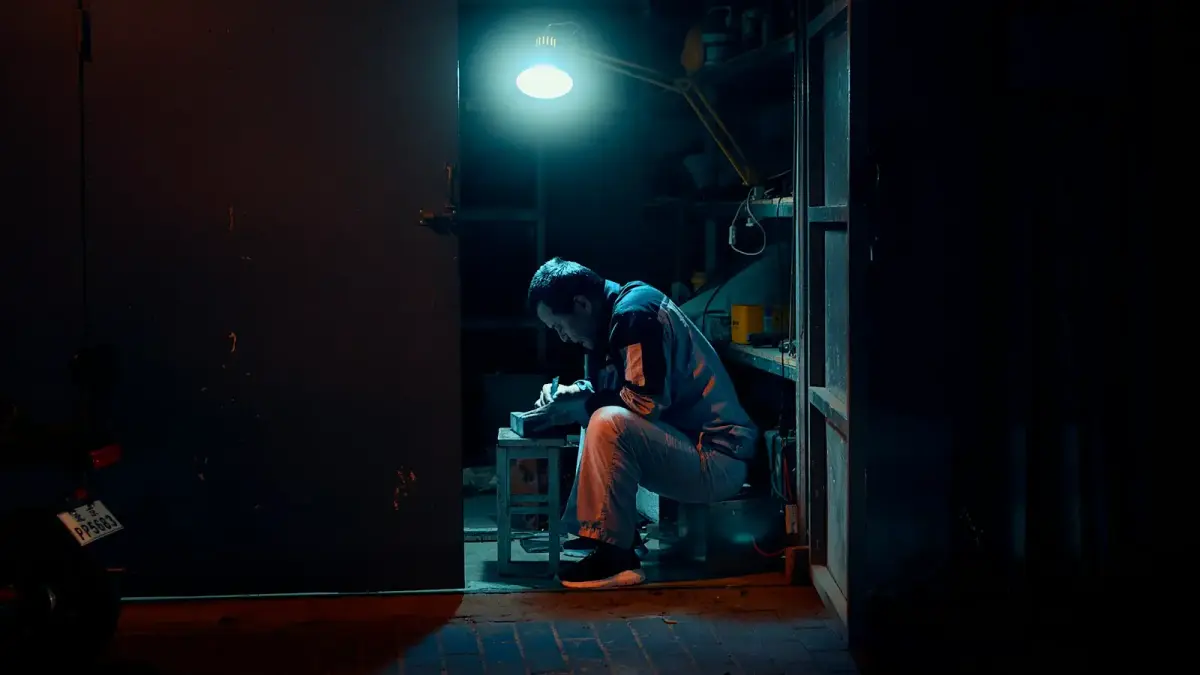
My father had a chair in the garage that didn’t match anything. It was an old dining chair with a cracked vinyl seat, pushed against the wall between his workbench and a shelf of coffee cans full of screws he’d never sort. He sat in that chair most Saturday afternoons, sometimes with a beer, sometimes without, and my mother would say he was “puttering” and leave it at that.
He wasn’t puttering. He wasn’t doing anything at all.
It took me thirty years and my own garage and my own chair and my own wife calling up the stairs to ask if I wanted lunch before I understood what that chair actually was. It was the one place in the house where a man could be lonely without anyone asking him what was wrong.
The room where nothing needs explaining
I want to be careful here, because this isn’t a story about bad marriages. This isn’t about men who fell out of love or women who stopped trying. This is about something much quieter and much harder to name - the loneliness that lives inside a good marriage, inside a house full of love, inside a man who would do anything for his wife and still cannot figure out how to say the words “I miss you” when she is sitting six feet away.
You know this man. You might be married to him. You might be him.
He is the one who answers “I’m fine” so automatically that the phrase has lost all meaning. It is not a lie, exactly. It is more like a reflex that hardened into bone decades ago, back when he was nine or ten and learned that the boys who said they were hurting got left behind.
A 2013 study published in the Journal of Personality and Social Psychology found that men in long-term relationships reported feeling significantly less emotionally known by their partners than women did - not because their partners were less attentive, but because the men disclosed less. The researchers called it “protective self-silencing.”
The men in the study weren’t hiding anything dramatic. They were hiding ordinary need. The need to be asked twice, to be held without a reason, to say “I am not okay” without it becoming a project.
He learned that need was a burden. So he stopped carrying it where anyone could see.
What the boy was given instead of words
There is a training that happens to boys, and it doesn’t always happen through cruelty. Sometimes it happens through love.
His father showed him how to change a tire, how to shake a hand, how to show up early and leave late. His mother praised him for being strong, for not crying at the dentist, for handling things on his own.
His coaches told him to push through. His friends communicated through shoulder punches and silence and showing up without being asked.
None of this was wrong. All of it was incomplete.
He was given every tool for competence and not a single tool for closeness. He learned that love was something you demonstrated through reliability - through showing up, providing, fixing, enduring. He never learned that love could also sound like “I don’t know what I need right now, but I know I need you closer.”
Psychologist Niobe Way spent years studying adolescent boys and found something that still stops me cold. At thirteen and fourteen, boys describe their friendships with the same emotional depth and intimacy as girls. They talk about needing their best friend, about feeling lost without them, about love.
By sixteen, that language is almost entirely gone. Not because the feelings disappeared. Because the boys learned that the feelings were not allowed to have names.
The man sitting in the garage at fifty-seven is the same boy who, at fifteen, quietly stopped telling anyone what he actually felt. He just got forty-two years of practice.
The architecture of a quiet house
Here is what Saturday looks like.
She is in the kitchen, or the living room, or on the phone with their daughter. He is in the garage. The door between them is not locked.
There is no fight. There is no distance you could point to and say “there - that’s the problem.” The house is warm.
The marriage is intact. If you asked either of them, they would tell you they love each other, and they would both be telling the truth.
But somewhere inside this ordinary Saturday is a gap that neither of them can name.
She might sense it. She might stand in the doorway and say “you’ve been out here a while” and he will say “just organizing some stuff” and she will nod and go back inside.
Neither of them is lying. Neither of them is saying what is actually true, which is that he doesn’t know how to be in a room with someone he loves and still feel reached, and she doesn’t know that the man she has slept beside for three decades is quietly aching for a kind of closeness he cannot describe, let alone request.
He is not angry. He is not resentful. He is something worse - he is resigned.
He decided somewhere around year eight or year twelve that this low hum of unmet longing was just what marriage felt like for men, and he stopped questioning it the way you stop noticing the sound of a refrigerator.
The difference between presence and closeness
I think this is the part that people misunderstand most.
He is present. He is there for every birthday and every holiday and every doctor’s appointment.
He drives her to the airport. He fixes the thing she mentioned was broken before she mentions it again. He is, by every external measure, a devoted husband.
But presence and closeness are not the same thing. You can be in the same room as someone for forty years and never once feel that they have seen the specific, private, slightly embarrassing shape of your interior life.
The part of you that gets sad for no reason on Sunday evenings. The part that still thinks about a friend you lost in your twenties. The part that sometimes wants to be held the way you were held when you were very small and the world hadn’t yet told you that wanting to be held was something to outgrow.
A 2021 study in Frontiers in Psychology found that men’s perceived emotional isolation within romantic relationships was one of the strongest predictors of depression in men over fifty - stronger than financial stress, stronger than physical health decline. The researchers noted that the isolation was not caused by an absence of love but by an absence of emotional language.
The men could not articulate what they needed. And the partners, in many cases, did not know there was something to ask about.
He doesn’t know the word for it. If you pressed him, he might say “disconnected” or “just tired.”
He would not say lonely, because lonely is what happens to people who are alone, and he is not alone. He is married, has a family, has a full life.
He just also has a chair in the garage where the quiet doesn’t ask anything of him.
The shed, the workshop, the truck
It is not always a garage. Sometimes it is a workshop, sometimes a fishing boat. Sometimes it is a truck parked at the edge of a field or a recliner in a basement or a walk that takes forty-five minutes longer than it needs to.
The common thread is this - it is a place where a man can be with himself without performing the version of himself that everyone around him seems to need. Not the provider, not the strong one, not the man who is fine.
Just the man. The one who is tired in a way that sleep does not fix.
I recognize this because I have been this man. I have sat in my own version of that garage and felt the specific ache of wanting my wife to walk in and not say “what’s wrong” but just sit next to me.
Not to fix it. Not to talk about it. Just to be there in a way that communicated “I know you are carrying something, and I am not going to make you name it, but I am here.”
She did, once. She came out and sat on an overturned bucket and didn’t say a word for twenty minutes, and I cried for the first time in a decade, and I still couldn’t tell you exactly why.
What nobody taught either of them
Here is the cruelest part - she is often lonely too.
She is lonely because she married a man she loves deeply and he will not let her in, and she has stopped knocking because every time she knocked he said “I’m fine” and after a while you start to believe it. She thinks he doesn’t need her the way she needs him.
She thinks the garage is proof that he is content with his own company. She has no idea that the garage is not contentment. It is the only fluency he has for sadness.
They are two people who love each other, standing on opposite sides of a wall that neither of them built, missing each other in a house they share.
Daniel Goleman writes about how emotional intelligence isn’t a fixed trait but a practice - one that can be developed at any age. I believe that.
But I also believe that developing it at sixty-two, after a lifetime of “I’m fine,” requires something more than practice. It requires grief. It requires a man to sit with the reality that he lost decades of closeness not because his wife was unavailable but because he was trained to never reach.
That grief is real. And it is not anyone’s fault.
The smallest possible beginning
I am not going to end this with five steps or a therapist’s phone number. That is not what this is.
This is just a recognition. A naming. A way of saying that if you are the man in the garage, or if you love the man in the garage, you are not imagining the distance.
It is real. And it is not evidence of failure.
It is evidence of a wound so old and so ordinary that most men don’t even recognize it as a wound. They think it is just who they are.
It’s not who you are. It is what you were given.
And the fact that you can feel the loneliness at all - that you can sit in that chair and know that something is missing, even if you cannot name it - means the part of you that wants closeness is still alive. It was never gone. It just went quiet.
You don’t have to find the perfect words. You don’t have to make a speech or have a breakthrough.
You just have to stay in the room a little longer. Let the silence be shared instead of private. Let someone sit on the overturned bucket.
The garage will still be there when you need it. But you might find that you need it a little less.