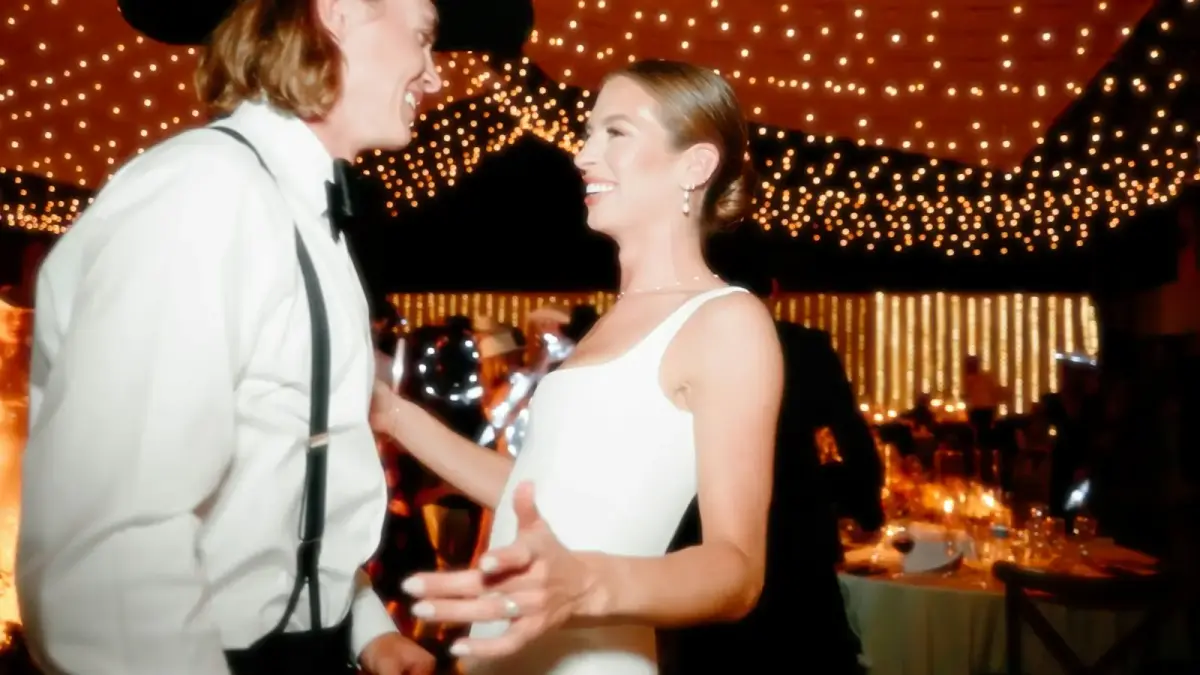
There is a particular kind of man who has never once danced with his wife at a wedding without first looking around to see who was watching - not because he was embarrassed by her but because a boy who was laughed at once for the way he moved his body learned that a man in motion is a man exposed, and he has spent thirty years standing at the edge of dance floors with his hands in his pockets, moving only when the lights go low enough that no one can see him clearly
The Boy Who Stopped Moving
I was twelve years old at a school dance when it happened. The gymnasium smelled like floor wax and cheap cologne, and for exactly one song - I think it was something by Boyz II Men - I forgot to be careful with my body. I moved the way the music told me to.
My arms did something my brain hadn’t approved. My hips found a rhythm that felt like it belonged to me.
Then someone laughed.
It wasn’t cruel laughter, not really. It was the casual, forgettable kind - a quick burst from a kid whose name I can’t even remember now. But I can tell you exactly what my body did in response.
It stopped. Not slowly, not gradually. It locked up like a door slamming shut, and everything that had been moving freely a moment before went rigid and still.
I walked to the bleachers and sat down. I didn’t dance again for six years.
What I didn’t understand then - what I couldn’t have understood at twelve - was that I wasn’t just walking away from a dance floor. I was walking away from a version of myself that had been willing to be seen in motion. And that version would become harder and harder to find with every year that passed.
The Architecture of Stillness
If you are the kind of man I’m talking about, you already know exactly what I mean. You know the geography of a wedding reception better than anyone. You know where the bar is, not because you drink too much, but because standing near the bar is the most socially acceptable way to not be on the dance floor.
You know where the tables are, because a seated man is an invisible man. You know the precise distance from the speakers where conversation becomes plausible enough to justify staying put.
You have built an entire architecture of stillness around your body, and you have maintained it so long that most people think it’s just who you are.
Your wife thinks you don’t like dancing. Your friends think you’re “not the dancing type.” Your kids have stopped asking.
And the truth - the truth that lives somewhere underneath all of that careful positioning - is that you love music more than almost anything. You hear a song and something inside you responds immediately, instinctively, the way it did before you learned to be afraid.
But the response stops at your shoulders. It reaches your chest and dies there. Because somewhere between the impulse and the movement, there is a checkpoint, and at that checkpoint stands a twelve-year-old boy who heard laughter and decided that being seen in motion was too dangerous to risk ever again.
What One Moment Can Steal
A 2019 study published in the Journal of Research in Personality found that single episodes of body-related shame in childhood can create lasting physical self-consciousness that persists well into adulthood - often decades after the original event. The researchers called it “somatic shame encoding,” and what struck me most was how specific their findings were.
It wasn’t general embarrassment that stuck. It was embarrassment about the body in motion - the way you ran, the way you threw a ball, the way you danced.
And here’s the part that gets me. The study found that men were significantly more likely than women to internalize a single body-shame event as a permanent identity marker.
Women who experienced the same kind of humiliation were more likely to process it socially - to talk about it, to reframe it, to eventually return to the activity. Men were more likely to simply stop doing the thing, quietly, without telling anyone why.
Because that’s how we were taught to handle pain. Not by processing it, but by building a wall around whatever caused it and pretending the wall was always there.
I think about all the dance floors since that gymnasium. Wedding receptions and holiday parties and backyard barbecues where someone turns the music up. Every time I stood at the perimeter, drink in hand, watching other people move freely, feeling something I couldn’t name pressing against the inside of my ribs.
It wasn’t jealousy. It was grief for the version of me who had been willing to move without checking the exits first.
The Scan
Every man who lives this way knows the scan. It’s the thing you do before you even consider stepping onto the floor, usually because your wife has taken your hand and is pulling you toward the music with a look on her face that is equal parts hope and resignation.
The scan goes like this: Who is watching? Who might record this on their phone? Is anyone here who knows me from work?
Are the lights bright enough that people can see clearly? How many other men are already out there, and are they worse at this than I would be?
You don’t think of it as a scan. You think of it as awareness, as being reasonable. But it is surveillance, and the target is yourself.
When you do finally step out there - because she asked, because the song is your song, because you’ve had just enough to drink to loosen the checkpoint - you don’t dance. You perform a version of dancing that has been carefully stripped of anything that might draw attention.
The shuffle. The slight sway. The arms-at-your-sides two-step that looks like a man waiting for a bus in mild wind.
It looks nothing like what you feel inside.
Inside, there is a whole symphony of movement that wants to happen. Inside, your body knows rhythms it has never been allowed to express. But between the knowing and the doing, there is a wall that was built in a single afternoon when you were twelve years old, and that wall has only gotten thicker with time.
The Places His Body Was Never Allowed to Be Free
Here is what nobody talks about when they talk about masculinity: the dance floor is just the most visible version of all the places a man’s body learns to be small.
It’s the way you hug - quickly, with maximum distance between your chest and theirs. It’s the way you sit - contained, compact, taking up only the space you can defend. It’s the way you walk through a room full of people - purposefully, never lingering where your body might be observed doing nothing useful.
Daniel Goleman’s work on emotional intelligence touched on this - the way boys learn early to associate physical expressiveness with vulnerability. A girl who spins in a dress is charming. A boy who moves freely is a target.
Not always, not everywhere. But often enough that most boys get the message by middle school: your body is not for joy, it is for function.
And so the man at the edge of the dance floor is not just a man who doesn’t dance. He’s a man whose body learned, in one sharp lesson, that freedom of movement is a luxury he cannot afford. He has carried that lesson into every room, every celebration, every moment where the music plays and something inside him wants to respond.
A 2022 study in Frontiers in Psychology examined what the researchers called “kinesthetic inhibition” in adult men - the suppression of natural movement impulses in social settings. They found it was strongly correlated with early experiences of physical mockery and almost entirely uncorrelated with actual motor ability.
In other words, these men weren’t bad dancers. They were frightened ones.
That finding broke something open in me when I read it. Because I had always assumed - had been told, had told myself - that I simply couldn’t dance, that I was built wrong for it, that some men have rhythm and some don’t.
But that was never true. The truth was that I had rhythm and fear in equal measure, and fear won every time.
What She Sees From the Dance Floor
I want to talk about the woman for a moment. The wife, the partner, the person who has spent years watching this man from the dance floor, swaying with her friends or her sister or sometimes alone, glancing back at the table where he sits with his beer and his careful smile.
She has tried everything. She has pulled his arm gently, told him nobody is watching, pointed out other men on the floor who are clearly worse. She has told him she doesn’t care how he looks, that she just wants to be close to him when the music plays.
None of it works, because the problem was never about her. It was about a twelve-year-old boy and a gymnasium and a laugh that lasted less than two seconds but echoed for thirty years.
What she might not know - what he has probably never told her - is that he watches her from the edge of the floor with something close to awe. She moves like someone whose body was never taken from her. And he loves that about her, even as it reminds him of everything he lost.
Sometimes, late at night, when they’re alone in the kitchen and a song comes on the radio, he lets himself sway. Just barely. Just enough that she notices and smiles but doesn’t say anything, because she has learned that saying something makes him stop.
Those kitchen moments are the closest he gets to the boy he used to be.
The Lights Go Low
At every wedding reception, there comes a moment when the lights dim. The DJ shifts to slower songs. The dance floor gets crowded enough that individual bodies disappear into the mass of moving shapes.
This is when he goes.
Not because he suddenly feels brave. But because the conditions have finally met his requirements - low visibility, collective movement, plausible deniability. He can hold his wife and move with her and nobody will notice, because everybody is doing the same thing.
And for those three or four minutes, something happens that he will never tell anyone about. His shoulders drop. His arms remember what they’re for.
His body presses against hers and finds a rhythm that isn’t the shuffle, isn’t the two-step, isn’t the careful performance he does when the lights are up.
It’s real. It’s him. It’s the twelve-year-old who forgot to be careful, except now he’s fifty-three and holding the person he loves most in the world, and the music is doing exactly what music has always wanted to do to his body.
He will not talk about this moment the next morning. He will not reference it or build on it. By the time the lights come back up, the checkpoint is back in place, and the wall is thick as ever.
But it happened. And if you are the man I’m talking about, you know exactly what I mean.
You know that those few minutes in the dark are the closest you come to being whole.
What the Boy Deserves to Hear
I’m not going to tell you to sign up for dance classes or that the cure is exposure or practice or the right playlist. I don’t think this is something you fix with action steps.
I think it’s something you fix by telling the truth.
Someone laughed at your body when you were young, and you made a decision about what that meant, and you have honored that decision with a faithfulness that borders on religious. You have been loyal to a lesson that was never true.
Brene Brown has written extensively about how shame needs secrecy to survive - how the things we never say out loud control us most completely. The dance floor version of this is one of the quietest examples of male shame there is.
Nobody writes about it. Nobody talks about it in therapy. It just lives in the bodies of millions of men who stand at the edges of celebrations, feeling the music but refusing to answer it.
You were not a bad dancer. You were a child, and someone laughed, and you did the only thing a child knows how to do with pain that big - you made it disappear by making part of yourself disappear along with it.
The boy who moved freely in that gymnasium, the one who existed for exactly one song before the world told him to stop - he’s still in there. He’s still hearing the music.
He’s still waiting for the lights to go low enough that it’s safe to come out.
And maybe the bravest thing you’ll ever do isn’t stepping onto the dance floor when everyone can see you. Maybe it’s just admitting, quietly, to yourself or to the person who loves you, that you wanted to - that you always wanted to.
The man at the edge of the floor with his hands in his pockets was never standing still by choice.
He was standing still because standing still was the only dance he was allowed.