There is a particular kind of man who still keeps a road atlas in the glove compartment of every car he has owned for the last thirty years, not because he does not trust the GPS but because a boy who watched his father unfold a map on the hood of the car at a gas station in the middle of nowhere and trace the route home with his index finger learned that knowing how to find your own way was not something you handed to a voice on a screen but something you solved with your own two eyes and a folded piece of paper
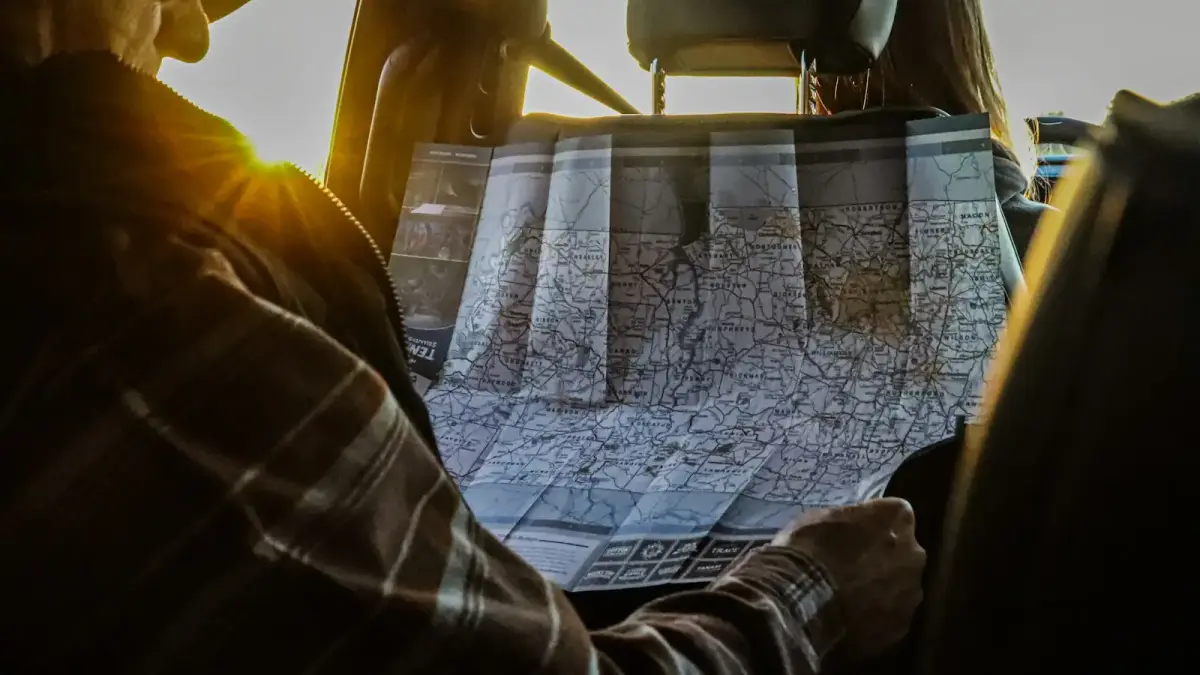
I found it last week when I was cleaning out the glove compartment. Wedged behind a stack of napkins and an expired proof of insurance, creased so many times the cover had gone soft as cloth. A Rand McNally road atlas, 2014 edition, pages yellowed at the edges and dog-eared at Pennsylvania, Ohio, and the whole stretch of I-40 through Tennessee.
My wife asked why I still had it. She meant the question gently. We have had GPS in every car we have owned since 2009. My phone can tell me where the nearest gas station is before I even realize I need one.
I did not have a good answer. Not the kind that fits into a sentence, anyway. The honest answer would have taken an hour and a couple of back roads and a story about my father standing in the gravel lot of a Texaco station in 1987 with a map spread across the hood like he was planning a campaign.
The Texaco Station
He drove a brown Oldsmobile with a cracked dashboard and a cassette deck that only worked when you hit it. We were somewhere in West Virginia, or maybe western Virginia - the distinction mattered to him, not to me. I was nine. We were lost.
I remember being afraid. Not of danger, but of the silence. My father had not spoken in twenty minutes, which meant he was working something out. He pulled into that gas station, killed the engine, and got out without a word.
Then he unfolded the map.
There is something about watching a man unfold a map on the hood of a car. It is an act of patience. The creases resist. The wind catches corners. You have to hold it down with your forearms while your eyes scan for the intersection of where you are and where you need to be.
He found it. He always found it. His index finger traced the route like he was reading braille, following thin red lines through towns I had never heard of toward a place that suddenly felt reachable again.
He folded the map back up - never quite the right way, never along the original creases - and said, “Okay. I know where we are.”
That was it. That was the whole lesson. I just did not know it yet.
What the Map Really Taught
My father never said the words “self-reliance.” He was not a man who named things. He demonstrated them and expected you to notice.
But what he showed me in that gravel lot, and in a hundred moments like it, was that being lost was not an emergency. It was a problem. And problems had solutions that you could find with your own hands and your own eyes if you were willing to pull over, spread the evidence out in front of you, and think.
A 2019 study published in the journal Nature Communications found that regular use of GPS navigation actually reduces activity in the hippocampus - the part of the brain responsible for spatial memory and cognitive mapping. People who relied on turn-by-turn directions showed less engagement in the neural systems associated with planning and decision-making than those who navigated on their own.
My father would not have known what a hippocampus was. But he knew something the researchers confirmed thirty years later: that finding your own way builds something inside you that being told the way does not.
He was not anti-technology. He was pro-competence. There is a difference, and it is one that his generation understood in their bones.
A Generation That Read the Road
My father’s generation did not just drive places. They navigated. They studied maps the night before a trip, tracing the route with a pencil, noting mile markers, memorizing the exits. They knew which highways ran north-south and which ran east-west. They could tell you, without looking anything up, that odd-numbered interstates go north and even ones go east.
This was not trivia to them. It was literacy. The road was a text, and they could read it.
They knew that if the sun was on your left in the morning, you were heading north. They knew that moss grew on the north side of trees, though they would admit it was not always reliable. They knew how to estimate distance by time and speed, how to find a town by following the power lines, how to tell from the grade of a hill whether a valley was coming.
None of this was romantic to them. It was ordinary. It was what it meant to be a grown man who could get himself and his family from one place to another without asking anyone for help.
And then, gradually, it was not needed anymore.
The Quiet Extinction
GPS arrived the way most revolutions do - not with a dramatic replacement but with a slow forgetting. First it was a novelty. Then a convenience. Then a default. And then, one day, the map stayed in the glove compartment for good.
Nobody mourned it. That is the thing about practical knowledge - when it becomes unnecessary, it does not get a funeral. It just stops being passed down.
My son is twenty-three. He is a capable, intelligent young man who can do things with a computer that would have seemed like sorcery to my father. But he has never unfolded a map. He has never had to. The thought of pulling over to figure out where you are, using paper and patience and the position of the sun, is as foreign to him as churning butter.
I do not blame him for this. You cannot miss a skill you were never taught. But I notice the absence the way you notice a word that has fallen out of common use - not with grief, exactly, but with the awareness that something specific and human-shaped has gone quiet.
Research from the University of London, published in 2017 in Nature Communications, found that London taxi drivers - who spend years memorizing the city’s labyrinthine streets - had measurably larger hippocampi than the general population. The knowledge was not just information. It had physically reshaped their brains. The act of learning to find your way had literally built more of them.
What happens to a generation that never has to find its own way? I do not know. But I keep the atlas.
It Was Never About the Map
Here is what I have come to understand, standing in my driveway at fifty-one with a creased atlas in my hands and a phone in my pocket that knows exactly where I am at all times:
The map was never about directions.
The map was about my father. It was about the quiet way he handled being lost - without panic, without blame, without asking someone else to solve it for him. It was about his hands on the hood of the car, his finger on the page, his voice when he said, “Okay. I know where we are.”
It was about what he was really saying, which was: I can figure this out. And so can you.
That is what I carry in the glove compartment. Not a navigation tool. A inheritance. A folded piece of paper that holds the shape of a man who believed that competence was something you owed yourself and your family, that being lost was not a crisis but a temporary condition, and that the route home was always there if you were patient enough to find it.
What We Carry Forward
I think about this sometimes when I watch my son tap an address into his phone and follow the blue line without ever looking up. He arrives where he is going. He is not lost. By every measurable standard, the system works.
But there is a kind of knowing that comes from having been lost and finding your own way back. A kind of confidence that does not come from being told where to turn but from figuring it out yourself. Adam Grant has written about how struggle and autonomy build what he calls “originals” - people who do not simply follow the established path but are willing to carve their own.
My father carved his own path with a folded map and a stubborn refusal to ask for directions. It was maddening sometimes. My mother would sit in the passenger seat with her arms crossed, suggesting that maybe, just maybe, we could stop and ask someone. He never did. He would pull over, open the map, and find it himself.
It was not pride. Or it was not only pride. It was something closer to faith - faith in his own ability to read the world and find his place in it without being led.
I cannot give my son that exact experience. The world has moved on, and there is no going back to gas station maps and penciled routes. But I can tell him what it meant. I can tell him about the Texaco station and the brown Oldsmobile and the man who spread a map on the hood and found his way home.
And I can keep the atlas.
Not because I need it. Because it is the last physical proof that someone taught me I was capable of finding my own way. Because every time I open the glove compartment and feel its soft, worn cover, I am nine years old again, watching my father’s finger trace a thin red line through the mountains, and I am learning something that no satellite can teach.
You do not hand the road to a voice. You read it yourself. You pull over. You unfold the paper. You find where you are.
And then you drive home.