Children who always drew themselves smaller than everyone else in family portraits - a tiny figure in the corner while their parents filled the page, stick arms tucked at their sides, a head half the size of their siblings' - often become adults who still make themselves small in every room they enter, because a child who learned that taking up space meant taking up too much drew themselves the size they believed they deserved to be
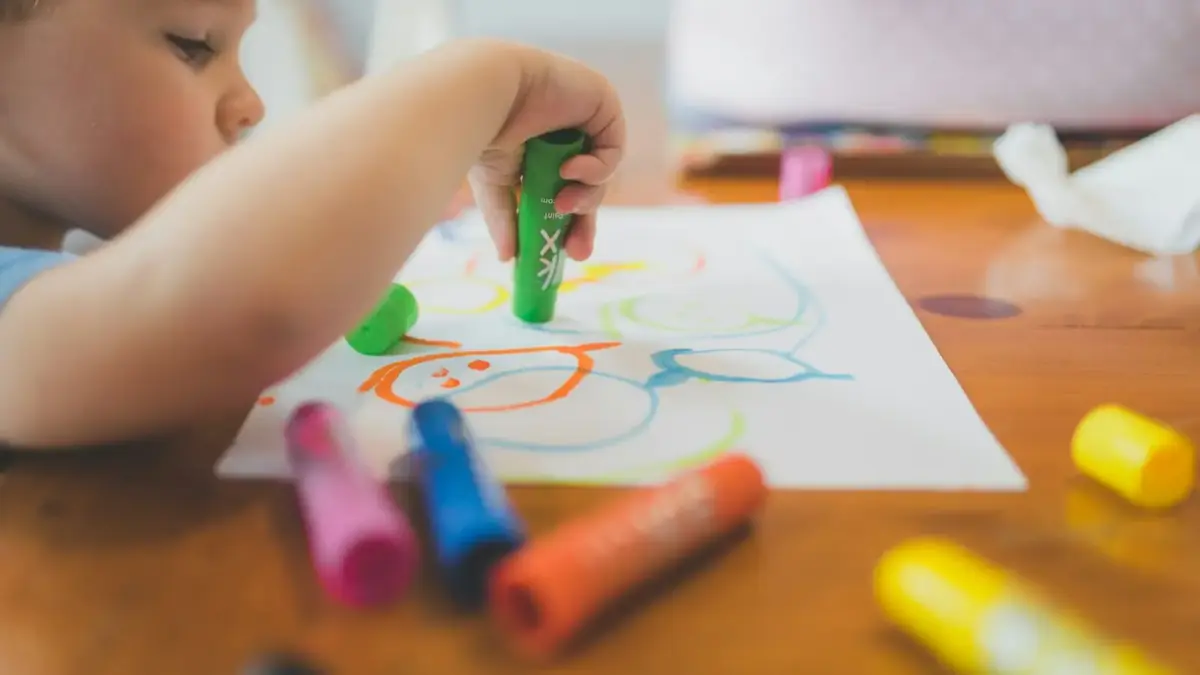
I found a box of my old drawings in my parents’ garage three years ago. Construction paper, crayon-smudged, curling at the edges. I sat on the concrete floor and spread them out, expecting nostalgia. What I got instead was a pattern I couldn’t unsee.
In every single family portrait I drew between the ages of five and nine, my mother was enormous. She filled the center of the page - bright dress, wide smile, arms that stretched nearly to both edges of the paper. My father stood beside her, almost as tall. My older brother floated somewhere near the top, his head bumping against the sky I’d scribbled in blue.
And then there was me. A stick figure in the bottom right corner. Arms pressed flat against my sides. A circle for a head that was maybe a third the size of my brother’s. No hands. Sometimes no feet. Always smiling, because I knew even then that the small one should at least be pleasant about it.
I wasn’t drawing what I saw. I was drawing what I felt. And what I felt was that I was the least important person in any room my family occupied.
The page as a psychological map
Child psychologists have understood for decades that children’s drawings are not just art - they are emotional blueprints. The size, placement, and detail a child gives each figure in a family portrait tells you something that the child may not have the words to say out loud.
A 2009 study published in the British Journal of Developmental Psychology found that children who felt emotionally secure in their family relationships drew themselves closer to other family members and at a comparable size. Children who felt anxious, overlooked, or emotionally unsafe consistently drew themselves smaller, farther away, or with fewer details than the people around them.
This wasn’t about artistic skill. A child who draws their mother with detailed fingers, earrings, and shoes, then draws themselves as a featureless oval with two lines for legs, is making an unconscious statement. They are saying: she matters more. She deserves detail. I deserve an outline.
The page becomes a map of belonging. And some children, without anyone teaching them to do it, place themselves at the very edge of the territory.
Where the shrinking starts
No child is born believing they deserve less space than the people around them. That belief gets installed, usually not through cruelty, but through a thousand small moments that accumulate like snow.
The parent who says “not now” every time the child begins a sentence. The dinner table where one sibling’s stories get follow-up questions and the other’s get a nod. The household where love is conditional on being easy - where the child learns that needing something is the fastest way to become inconvenient.
Sometimes the message is more direct. “Stop being so dramatic.” “Nobody wants to hear about that.” “Your sister is going through something right now, so just be good.”
The child hears: your feelings are a burden. Your presence is a favor I am granting you. Take up less room.
And so they do. They tuck their arms in their drawings because they’ve learned to tuck their arms in real life. They make their head small because their thoughts have been made small. They place themselves in the corner because the center of the page - the center of attention, the center of care - belongs to someone else.
The heartbreaking part is that the child usually isn’t angry about this. They’ve simply accepted it as accurate. Of course I’m smaller. Look at how much space everyone else needs.
The art teacher who noticed
I think about art teachers a lot. Not because they’re trained therapists, but because they’re sometimes the first adult outside the family to see the drawing and pause.
A friend of mine told me about her second-grade teacher who kept her after class one afternoon. She’d drawn another family portrait - her parents enormous, her two brothers medium-sized, herself a tiny smudge near the bottom of the page with no mouth.
The teacher knelt down and said, very gently, “Can you draw yourself a little bigger? You’re a big, important part of your family.”
My friend remembers staring at the teacher, confused. Not because the instruction was complicated, but because it contradicted everything she understood about herself. She was not big. She was not important. She was the quiet one who made things easier by needing nothing.
She drew herself slightly larger. It felt like lying.
That moment stayed with her for thirty years. Not because the teacher fixed anything - one afternoon can’t undo years of emotional positioning - but because it was the first time an adult suggested that her smallness wasn’t a fact. It was a choice someone had made for her.
The mother who said “draw yourself bigger”
There is a particular kind of pain in the parent who notices the small self-portrait and says “draw yourself bigger” without understanding that they are the reason the child drew small.
I say this without judgment, because most parents who minimize their children don’t do it on purpose. They do it because they were minimized themselves. They do it because they’re overwhelmed, or because they genuinely believe that teaching a child to need less is preparing them for a hard world. They do it because their own parents filled the page, and they never questioned the composition.
But the instruction - draw yourself bigger - lands differently when it comes from the person who taught you to be small. The child hears it as another demand. Another performance. Another way to be what someone else needs you to be. Even your smallness, it turns out, is inconvenient.
Research from developmental psychologist Edward Tronick, known for the Still Face Experiment, has shown that children are extraordinarily attuned to their caregivers’ emotional availability. A child doesn’t need to be told they’re unimportant. They read it in the microsecond delay before a parent looks up. They feel it in the quality of attention - the difference between being listened to and being waited out.
The drawing is just the evidence. The verdict was delivered long before the child picked up the crayon.
What the small child becomes
The adults who were small children - not physically small, but emotionally small, spatially small, allowed-to-exist small - carry that template into every room they enter for the rest of their lives.
You know this person. You might be this person.
They sit at the edge of group photos, angling their body slightly away, as if preparing to be cropped out. They introduce their accomplishments in half-sentences. “Oh, it’s just a small project.” “I mean, it’s not a big deal.” “I got lucky, honestly.”
They deflect compliments like they’re catching something too hot to hold. Someone says “that was brilliant” and they say “oh, it was nothing” and they mean it - not as false modesty but as a genuine belief that what they contributed was, in fact, nothing much.
A 2015 study in the Journal of Personality and Social Psychology found that individuals who reported feeling chronically unseen in childhood were significantly more likely to engage in what researchers called “preemptive self-diminishment” - minimizing their contributions, needs, or presence before anyone else could do it for them. The logic is devastating in its efficiency: if I make myself small before you make me small, at least I control the shrinking.
They sit in meetings with ideas burning in their chest and say nothing, or say it so quietly that someone else says it louder thirty seconds later and gets the credit. They don’t fight for the credit. They don’t even feel robbed. They feel relieved. Someone else took the space, which means they don’t have to.
They apologize for existing in ways so subtle they don’t even register as apologies. “Sorry, just a quick question.” “I don’t want to take up too much of your time.” “You’re probably busy, but…”
Every sentence has a built-in exit. Every presence has a built-in retraction. They are still drawing themselves in the corner of the page, just with words now instead of crayons.
The full chair
A therapist once told me something I think about almost every day. She said, “I want you to sit in the full chair.”
I didn’t understand. I was sitting in a chair. What did she mean, the full chair?
She pointed out that I was perched on the front edge of the seat, legs tucked under, shoulders rounded forward, taking up maybe a third of the available space. I’d been sitting that way for our entire session. I’d been sitting that way, she suspected, for most of my life.
“The chair is yours,” she said. “Use the back of it. Use the armrests. Let it hold you.”
I leaned back. It felt enormous. It felt like I was being greedy with furniture.
That is what chronic self-minimization does. It makes normal space feel like too much space. It makes your own chair feel like someone else’s. It makes the center of your own life feel like an imposition.
Learning to fill the page
I want to be honest with you: I don’t have a five-step fix for this. You don’t unlearn decades of spatial contraction in an afternoon. You don’t suddenly start drawing yourself the size you actually are just because someone tells you that you’re allowed to.
But I do know that the first step is seeing the pattern. Noticing the moments when you tuck your arms. When you sit at the edge. When you say “it’s nothing” about something that cost you real effort, real thought, real courage.
Gabor Mate writes about how the adaptations we make in childhood to survive our emotional environments become the constraints that limit us in adulthood. The smallness that once kept you safe - that kept the peace, that kept you from being too much - is now keeping you from being enough. Not enough for other people. Enough for yourself.
You were never actually small. You were a full-sized person drawing yourself with half a crayon because you believed that was all you were worth.
The page is bigger than you think. It always was.
And you are allowed to fill it. Not because someone gave you permission. But because the space was yours the whole time, and the child who drew herself in the corner deserves to finally stand in the center - fully detailed, fully visible, arms wide open, taking up every inch she needs.