She's 59 and just realized she always puts the cheapest thing in her own cart but buys the brand name for everyone else in the family - the generic cereal for herself, the name-brand for the kids, the good coffee for her husband - because a girl whose mother always ate last and ate least learned that love was measured by what you were willing to go without, and going without became so reflexive that she never noticed she had been placing herself at the bottom of her own grocery list for thirty-five years
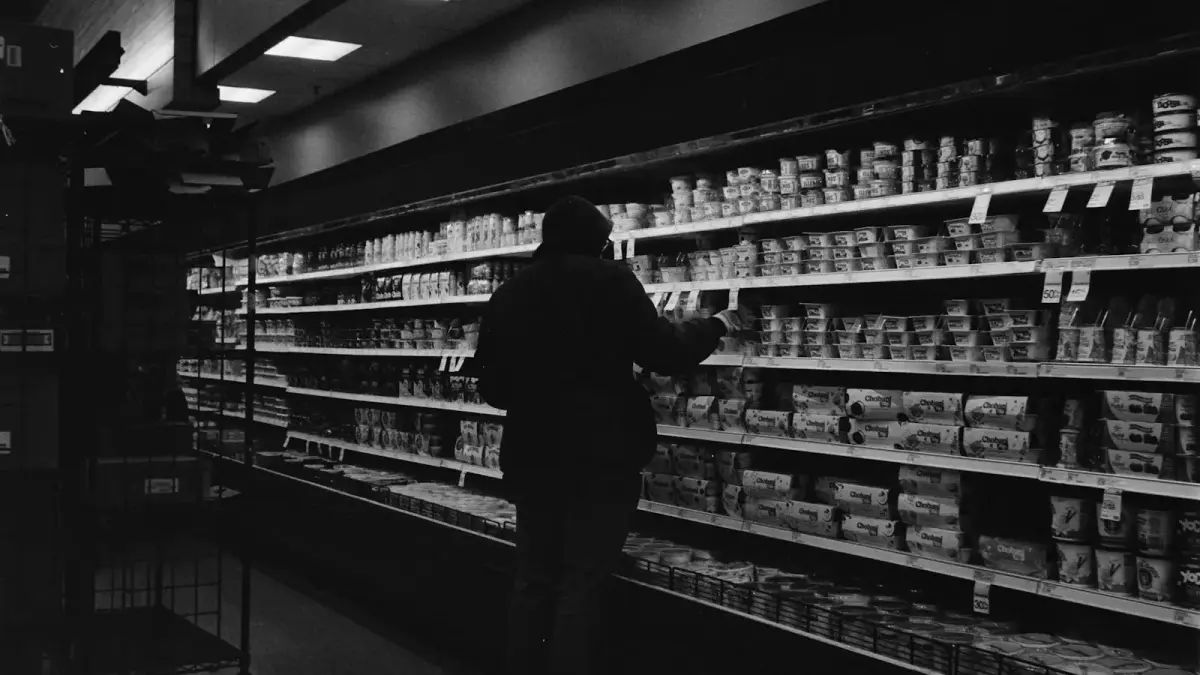
The cart that told the truth
I was standing in the cereal aisle last Tuesday when I saw something I had been doing my entire adult life without once registering it.
My hand reached for the store-brand corn flakes and placed them in the cart. Then, without pausing, I grabbed the name-brand version - the one in the brighter box, the one that costs two dollars more - and set it right next to the generic. The generic was for me. The name-brand was for my daughter.
I had done this a thousand times. Maybe ten thousand. And I had never once thought about it as a choice. It was just what I did - like brushing my teeth or locking the front door. Automatic. Invisible. As natural as breathing.
But something about that Tuesday made me stop. Maybe it was the fluorescent lighting. Maybe it was the fact that I had just turned fifty-nine and my knees ached from standing too long. I looked down at my cart and I saw it - really saw it - for the first time.
Every single item that was for me was the cheapest option on the shelf. And every single item for someone else in my family was the version I would never allow myself to buy.
The cart was a portrait. And I did not like what it was showing me.
The woman who always ate last
My mother was a woman who moved through kitchens like she was visiting someone else’s house.
She cooked beautiful meals. Roast chicken on Sundays. Homemade soup that filled the whole apartment with warmth. Bread she baked from scratch because she said the store-bought kind tasted like cardboard. But when everyone sat down to eat, she would hover. She would serve my father first, then me, then my brother. She would make sure everyone had enough before she would even pick up her own fork.
And when she finally sat down, she took the smallest portion. The piece of chicken closest to the bone. The heel of the bread. The bruised apple.
Every single time.
I never questioned it as a child. I thought that was just what mothers did. I thought love looked like going without. I thought the measure of a good woman was the distance between what she gave others and what she kept for herself.
A 2019 study published in the Journal of Family Psychology found that self-sacrificing behaviors in mothers are frequently transmitted to daughters not through explicit teaching, but through daily modeling. Daughters don’t learn the lesson from a speech. They learn it from watching who eats last and who eats least.
My mother never once told me I should put myself at the bottom of every list. She didn’t have to. She showed me every single day at the dinner table.
The invisible accounting
Here is what I discovered when I finally started paying attention to my own habits.
I drink instant coffee. My husband drinks the good beans - the ones I grind fresh for him every morning. I have been doing this for twenty-six years. He has never once asked me to. He doesn’t even know I drink something different when he leaves for work.
I wear the same three t-shirts in rotation. Two of them have small holes near the hem. Meanwhile, I buy my kids new clothes at the start of every season without flinching. I’ll spend eighty dollars on a sweater for my son and then talk myself out of a twelve-dollar top for myself because I “don’t really need it.”
I use the shampoo that comes in the big economy bottle. My daughter uses the salon brand that smells like eucalyptus. I bought it for her birthday last year and she loved it so much I quietly kept restocking it. She probably thinks it just appears.
I order the cheapest thing on the menu when we eat out. Every time. I tell myself I just prefer simpler food. But the truth is I scan the prices first and work backward to whatever I can justify spending on myself.
This is not frugality. Frugal people buy the cheaper version for everyone. This is something else entirely. This is a woman who believes, in a place deeper than logic can reach, that she does not deserve the better thing.
Where the pattern starts
Psychologist Harriet Lerner has written extensively about the way women are socialized to confuse self-sacrifice with love. She describes it as a kind of disappearing act - a woman who slowly edits herself out of her own life while making sure everyone around her has everything they need.
But it goes deeper than socialization. For many of us, this pattern started before we had language for it. It started in the body, in the gut, in the quiet watching we did as little girls.
If your mother always gave you the bigger piece, you learned something. You learned that love flows in one direction - outward. You learned that the person doing the loving is the person doing the giving up. And you learned, without anyone ever saying it aloud, that needing something for yourself was a kind of selfishness.
A 2021 study in Frontiers in Psychology found that children who grew up watching a primary caregiver consistently self-deprive were significantly more likely to develop what researchers call “low personal entitlement” - a chronic, often unconscious belief that their own needs are less valid than the needs of others.
Low personal entitlement doesn’t look like low self-esteem on the surface. It doesn’t look like sadness. It looks like generosity. It looks like thoughtfulness. It looks like a woman who always remembers what everyone else likes and never once mentions what she wants for her own birthday.
It looks, from the outside, like the best kind of person. And that is exactly why it is so hard to see.
The grocery list as a map of worth
Your grocery cart is more honest than your journal.
You can tell yourself you value yourself. You can read the self-help books and nod along to the podcasts about boundaries and self-compassion. But then you walk into a store and your hands tell a different story.
The cart doesn’t lie. It shows you, item by item, who you believe deserves quality and who you believe should make do. And if you have been placing yourself at the bottom of that list for decades, the cart knows it even when you don’t.
I started keeping track. Not obsessively - just noticing. Every time I reached for the cheaper version of something for myself while buying the better version for someone else, I made a small mental note.
The number was staggering.
It wasn’t just groceries. It was everything. The dentist appointments I postponed while making sure everyone else went on schedule. The shoes I kept wearing past the point of comfort because they were “still fine.” The doctor visit I canceled twice because something always came up for someone else.
Brene Brown talks about the difference between fitting in and belonging. I think there is a version of this that plays out in the grocery aisle. Some of us have spent our whole lives trying to earn our place in our own families by being the person who needs the least. We fit in by disappearing. We belong by costing nothing.
And the cruel part is that it works. Nobody complains about the woman who never asks for anything. Nobody notices the woman who always makes do. The system runs smoothly when someone is willing to be the margin.
The moment it cracks
The thing about invisible patterns is that they stay invisible until something breaks them open.
For me, it was my daughter. She was visiting last month and she opened my closet to borrow a jacket. She stood there for a moment, looking at the sparse rack of faded clothes, and then she looked at me with this expression I will never forget.
“Mom,” she said. “When is the last time you bought yourself something nice?”
I opened my mouth to answer and nothing came out. Because I genuinely could not remember.
She sat on the edge of my bed and she said something that hollowed me out. She said, “I don’t want to grow up and treat myself the way you treat yourself.”
That sentence landed like a stone in still water. Because I realized in that moment that the pattern I had inherited from my mother - the one I thought I was keeping private, the one I thought was just my quiet habit - was already being watched by the next pair of eyes. My daughter had been learning from my cart the same way I learned from my mother’s plate.
The self-deprivation I thought was invisible had been teaching a lesson I never intended to give.
What going without really costs
A 2018 study published in the Journal of Personality and Social Psychology found that chronic self-neglect in caregivers is associated not just with burnout, but with a gradual erosion of identity. When you consistently deprioritize your own needs, the study found, you begin to lose contact with what those needs even are.
This is the part that frightened me most. It wasn’t that I was choosing the cheaper thing. It was that I had lost the ability to want the better one.
Somewhere along the way, I had stopped having preferences. I didn’t know what kind of coffee I actually liked because I had never let myself find out. I didn’t know what clothes made me feel good because I had never given myself permission to care. I had become so practiced at going without that I had forgotten what I was going without.
The wanting itself had gone quiet. And when you stop wanting things for yourself - not extravagant things, not selfish things, just the ordinary daily things that make a life feel like yours - something essential dims.
You become the background of your own life. The person who maintains everything for everyone else but is somehow not quite there. Present but unclaimed. Generous but hollow.
Picking up the better thing
I want to be careful here, because I am not going to tell you the answer is to suddenly start buying expensive things for yourself. That is not what this is about.
This is about the moment you reach for the generic box and you pause. You notice. You ask yourself - not with judgment, but with genuine curiosity - why you believe you deserve less than the people you love.
That pause is the entire revolution.
I bought myself the good coffee last week. It sounds ridiculous to say that out loud. A bag of coffee beans should not feel like an act of rebellion. But it did. My hand actually hesitated on the shelf.
I brewed a cup the next morning and I sat at the kitchen table and drank it slowly. It was better. Not life-changing. Just better. And I was allowed to have it.
I keep thinking about my mother. She would be eighty-seven now if she were still alive. I wonder if she ever wanted the bigger piece. I wonder if she ever stood in a grocery aisle and wished she could put the nicer thing in her own cart. I wonder if she thought she was teaching me love when she was really teaching me that I shouldn’t take up too much room.
She did the best she could with what she was handed. I believe that completely. But I also believe that the kindest thing I can do for my daughter - the most radical, countercultural, quietly powerful thing - is to let her see me reach for the better thing and put it in my own cart without apologizing.
Not because I deserve it more than anyone else. But because I deserve it exactly the same amount.
The grocery list is just a grocery list. But the woman who writes it is telling herself a story about who matters. And after thirty-five years of writing myself into the margins, I am finally picking up the pen and changing the draft.
You are allowed to want the good coffee. You are allowed to take the bigger piece. You always were.