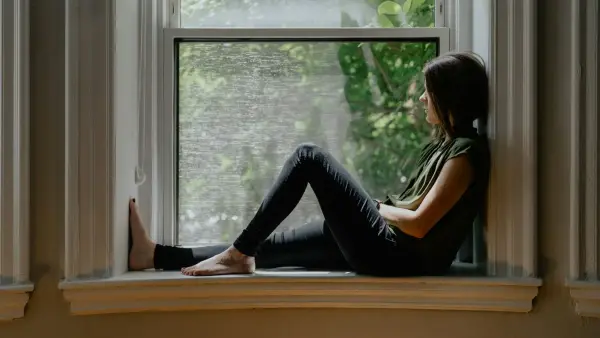
She's 60 and just realized she's been saying 'it's fine' to every doctor who asks about her pain level - rating a seven as a four, describing a migraine as 'just a headache,' telling the surgeon 'it's not that bad' while her hands grip the sides of the examination table - because a girl who watched her mother describe a broken arm as 'just a little sore' and refuse the wheelchair at the emergency room because she didn't want to make a fuss learned that a woman's pain is always an overstatement until proven otherwise

I went to the dentist last year for a root canal, and when they asked me to rate my pain on a scale of one to ten, I said three.
It was not a three. My jaw had been throbbing for two weeks. I had been sleeping on my left side to keep pressure off the right, chewing only with my front teeth, and taking ibuprofen every four hours like clockwork. If I had been honest, I would have said seven. Maybe eight on the mornings when the pain woke me before the alarm.
But I said three, and I said it with a small smile, and the dental assistant wrote it down without questioning it, and we moved on.
I did not think about this moment until months later when my sister called to tell me she had been walking on a fractured foot for six days before going to the emergency room. “It wasn’t that bad,” she said. “I thought it was just a sprain.” And I heard it - that same voice. Not hers. Our mother’s.
The scene that wrote the script
I was nine years old when my mother fell on the ice in the driveway and broke her arm.
I remember the sound first - not a crack, but a gasp she swallowed before it could become a cry. She stood up holding her left arm against her body like she was cradling something fragile. Her face was white. I could see the shape of the bone pressing against the skin in a way that bones should not press.
“It’s just a little sore,” she said. To me, standing in the doorway in my socks. To my father, who came out asking what happened. To the neighbor who saw her fall from across the street.
At the emergency room, they brought a wheelchair and she waved it away. She walked to the intake desk carrying her own broken arm like it was an inconvenience she was embarrassed about. When the nurse asked her pain level, she said four.
I did not know then what I was learning. I did not know I was watching a master class in how to be a woman in pain - how to fold it down, translate it into something quieter, tuck it into a version of yourself that takes up less space in the room.
But my body learned it. My voice learned it. And forty years later, I am still performing the same act on every examination table I sit on.
The language we inherited
There is a specific vocabulary that women of my generation - and my mother’s generation, and her mother’s before that - were taught to use when describing their own suffering.
“It’s not that bad.” “I’m probably overreacting.” “It’s just a headache.” “I don’t want to bother you with this.” “I’m sure it’s nothing.”
These are not descriptions of pain. They are apologies for having it.
A 2021 study published in the Journal of Pain found that women consistently rate their pain lower than men do for equivalent conditions, not because they experience less pain, but because they have been socialized to minimize reports of their own discomfort. The researchers called it “pain stoicism,” but I think that word is too generous. Stoicism implies a philosophical choice. This is not a choice. This is a script that was handed to us before we were old enough to know we were memorizing lines.
My mother learned it from her mother, who had migraines so severe she would vomit in the bathroom with the door closed and then come out and start dinner. She learned it from a generation of women who gave birth without pain relief and were praised for their silence, not because silence was strength but because a woman’s screaming made everyone else uncomfortable.
The inheritance is not toughness. The inheritance is translation - the automatic, unconscious conversion of a seven into a four, because somewhere deep in our nervous system lives the belief that our real number will not be taken seriously anyway.
What the doctor’s office teaches us about ourselves
Here is what happens when you minimize your pain at the doctor’s office often enough: the doctor believes you.
They believe the four. They believe “it’s not that bad.” They prescribe the lower dose, schedule the follow-up for six weeks instead of two, tell you to try rest and over-the-counter medication for something that has been keeping you up at night for a month.
And here is the devastating part - you feel grateful. Not frustrated. Grateful. Because the doctor did not make you feel like you were making a fuss. The interaction confirmed what you already believed: that your pain was manageable, that you were handling it, that you were not one of those women who exaggerates.
A 2018 study in Academic Emergency Medicine found that women who presented to the emergency department with acute abdominal pain waited an average of 33 percent longer than men to receive pain medication. Not because their pain was less severe, but because the medical system itself has internalized the same script we have - the assumption that when a woman says it hurts, the real number is probably lower than what she is reporting. Which means we are minimizing our pain to a system that is already minimizing it for us.
The math is brutal. If you are experiencing an eight and you report a five, and the system discounts that five to a three, you are being treated for a pain level that is less than half of what you actually feel.
And you leave the appointment thinking you handled it well.
The six-month gap
I have a name for it now, the thing that women my age do. I call it the six-month gap.
It is the distance between when something starts hurting and when we finally mention it to a doctor. Six months of “it’ll probably go away on its own.” Six months of adjusting how we sit, how we sleep, which shoes we wear, which activities we quietly stop doing. Six months of the body sending urgent messages and the mind calmly filing them under “not important enough to mention.”
My friend Carol discovered she had been living with a torn rotator cuff for almost a year. She had stopped reaching for things on high shelves. She had switched to a lighter purse. She had rearranged her kitchen so everything she needed was below shoulder height. She had rebuilt her entire physical world around the pain rather than reporting it.
When I asked her why she waited so long, she looked at me like the question made no sense. “I didn’t want to be dramatic,” she said.
Dramatic. That word. The word that has kept more women from emergency rooms than any other word in the English language. The word our mothers used to describe women who cried at the doctor, who asked for more medication, who insisted something was wrong when the tests came back normal.
We would rather restructure our entire lives around an injury than risk being called dramatic.
The performance nobody asked for
Here is what I have come to understand at sixty: the pain minimization is not about toughness. It is a performance.
It is the performance of a woman who has learned that her suffering is only legitimate if it can be verified by someone else’s eyes. That her body is not a reliable narrator of its own experience. That the appropriate response to pain is not to feel it fully but to present it in a form that is palatable - small enough to fit inside a fifteen-minute appointment, quiet enough that it does not make the doctor uncomfortable, reasonable enough that it cannot be dismissed as hysteria.
Because that word, too, lives in the inheritance. Hysteria. From the Greek hystera, meaning uterus. The original medical term for “a woman who insists that something hurts.”
Brene Brown has written extensively about how vulnerability requires a sense of worthiness - the belief that you deserve to be seen and heard even in your messiest, most unfiltered state. And I think this is exactly what the pain performance takes from us. Not just accurate medical care, though it takes that too. It takes the fundamental experience of being believed without having to earn it first.
My mother, gripping her broken arm in that emergency room, was not being brave. She was performing the one act she had been taught was required of women in pain: making it smaller so it fits inside the room without inconveniencing anyone.
Learning a new language at sixty
I am sixty years old, and I am trying to unlearn the translation.
It is harder than I expected. Last month I went in for a follow-up on a knee that has been bothering me for - you guessed it - about six months. The nurse asked me to rate the pain. My mouth opened and “about a three” came out before my brain could intervene.
I stopped. I actually closed my mouth, took a breath, and said, “Actually, can I try that again? It’s more like a six. Some mornings it’s a seven. I’ve been limping when nobody’s watching.”
The nurse looked up from her clipboard. Not with suspicion. Not with the dismissal I had been bracing for my entire life. Just with attention. She wrote down the six.
That was it. No drama. No fuss. No one accused me of exaggerating. The world did not collapse because a woman told the truth about her own body.
A 2022 study published in Psychological Science found that people who practice what researchers call “emotional accuracy” - the ability to name what they are actually feeling rather than a softened version of it - experience better health outcomes, stronger relationships, and lower levels of chronic stress. They are not more dramatic. They are more precise.
I am trying to be more precise.
I am trying to let my pain be its actual size - not the version I was taught to present, not the version that makes everyone else comfortable, but the real number. The one that lives in my body and not in my mother’s voice.
What I want you to know
If you are a woman who has ever gripped the sides of an examination table while telling the doctor it’s not that bad, I want you to know something.
You are not being stoic. You are not being strong. You are speaking a language you did not choose to learn, one that was passed to you in emergency rooms and kitchens and sick beds by women who loved you and did not know they were teaching you to betray your own body.
The woman at sixty who minimizes every symptom is not performing strength. She is performing the only version of pain that the women before her were allowed to have - the kind that asks for nothing, that takes up no space, that waits until it is undeniable before it speaks.
You have already earned the right to hurt. You earned it by being a person with a body. That is the only qualification there has ever been.
The next time someone asks you to rate your pain, give them the real number. Not your mother’s number. Yours.
It will feel like too much. It will feel dramatic. It will feel like you are taking up too much space in the room.
Give the number anyway. Your body has been telling the truth this whole time. It is just waiting for your voice to catch up.