There is a specific grief nobody warns you about - the afternoon you finally open your father's closet six months after the funeral and find his shirts still hanging in the order he left them, still holding the shape of his shoulders, still carrying the cologne he wore to church on Sundays, and you realize that fabric remembers a man's body longer than your own memory can hold his voice
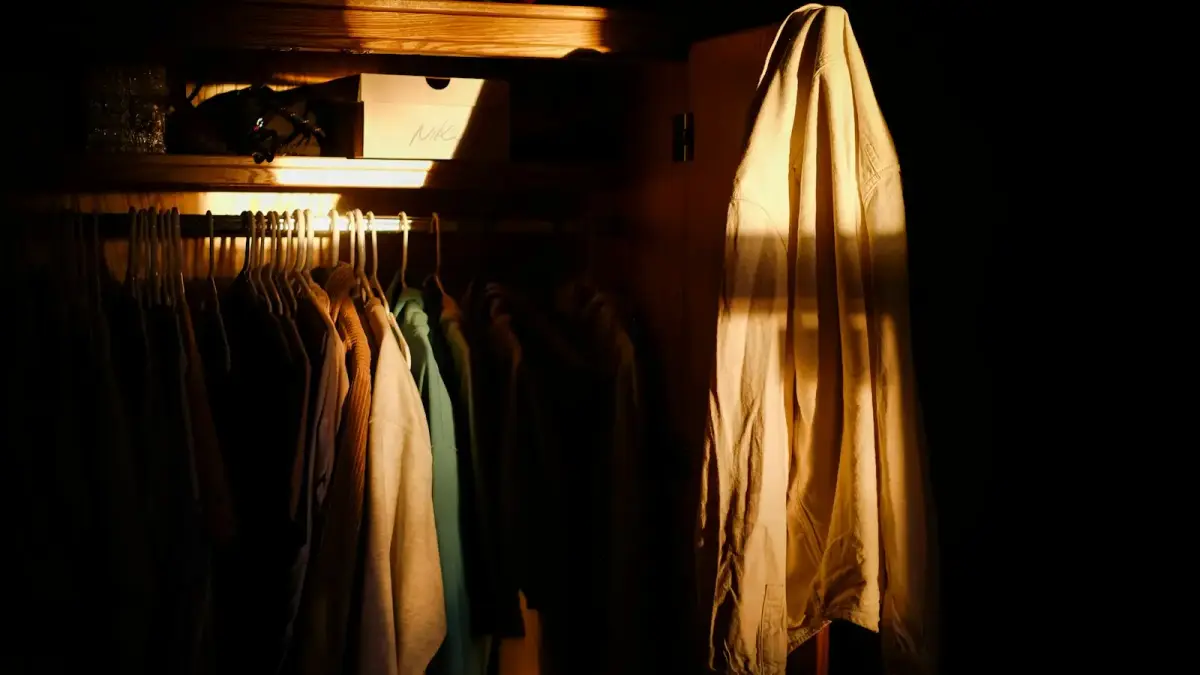
I opened my father’s closet on a Tuesday in March, six months and eleven days after we buried him.
I hadn’t planned to. I was looking for a box of old tax documents my mother asked me to find. Something practical. Something small. I pulled the bifold doors apart the way I had a thousand times growing up, reaching for board games on the top shelf or sneaking his oversized flannel to wear around the house as a teenager.
But this time the closet exhaled.
That is the only word I have for it. A breath of cedar and Old Spice and something underneath both of those things that was just him - the specific chemistry of a man’s skin after seventy-two years of living in it. And before I could find the box, before I could do the practical thing I came for, I was on my knees on the carpet, holding a sleeve.
Nobody warns you about this. They warn you about the funeral. They warn you about the first Thanksgiving with an empty chair. They warn you about his birthday, about Father’s Day, about the moment you reach for the phone to call him and remember there is no one on the other end.
But nobody tells you about the closet.
The clothes remember what you are already forgetting
His shirts were still hanging in the order he placed them. Dress shirts on the left, grouped loosely by color. Flannels in the middle. The two sport coats he wore to weddings and funerals on the far right, still in their dry cleaning bags from the last time my mother sent them out.
And the shoulders of those shirts still held the shape of his shoulders.
Not perfectly. Not the way they looked when he wore them. But the fabric had settled into a memory of him - a slight curve where his frame had pressed outward, a gentle slope that mirrored the posture he carried for decades. The hangers weren’t doing that. The wire and plastic couldn’t produce that specific architecture. His body had taught the cotton how to hold itself, and the cotton hadn’t forgotten yet.
I stood there realizing something that knocked the air out of me. I was already losing his voice. Six months out, and when I tried to summon the sound of him calling my name from the bottom of the stairs, it came back muffled. Approximate. Like hearing someone speak through a wall.
But this shirt still knew the exact width of his chest.
A 2015 study published in the journal Emotion found that bereaved individuals begin losing precise sensory memories of the deceased - the sound of their voice, the exact feeling of their touch - within the first year after loss, even while emotional memories remain vivid. The researchers described it as a separation between what we feel about someone and what we can physically reconstruct of them in our minds.
The closet doesn’t have that problem. The closet is a sensory archive that holds what our brains are already releasing.
The ambush of scent
Grief counselors talk about triggers. They use that word carefully, clinically, as if grief is a mechanism that fires when the right stimulus arrives.
But what happened to me in that closet was not a trigger. It was an ambush.
The scent hit first. Before my eyes adjusted, before I registered the row of shirts, the folded sweaters on the shelf above, the pair of brown loafers tucked beneath the hanging hems. Smell is the oldest sense we have, wired directly into the limbic system with almost no cognitive processing in between. There is no intellectual buffer. No chance to brace yourself.
Research from the Monell Chemical Senses Center has shown that olfactory memory is among the most emotionally potent forms of recall. A scent associated with a person can trigger a grief response years or even decades after loss, long after visual and auditory memories have softened.
My father’s cologne was not expensive. It was the same brand he had worn since the early 1980s, bought at the drugstore in a bottle that hadn’t changed its packaging in forty years. He put it on every Sunday morning before church, and sometimes on Saturdays if he and my mother were going to dinner.
Standing in that closet, I could have told you the exact morning he last sprayed it. I could have placed myself in the hallway outside the bathroom, hearing the glass bottle tap against the counter. I could have told you what he was wearing.
I couldn’t tell you the last thing he said to me the night before he died.
Scent remembers what the mind protects us from remembering.
The archaeology of a person’s daily life
Here is what else I found in that closet, and here is why it wrecked me.
A plastic bag from the hardware store, folded neatly and tucked into the pocket of a jacket. My father saved plastic bags. He grew up during a time when you didn’t throw things away, when a bag was a useful object that deserved a second life.
A receipt from a diner, dated three weeks before he went to the hospital. Two coffees, one short stack, one side of bacon. He and my mother went to that diner every Saturday. The receipt had been left in his shirt pocket the way men of his generation leave things in pockets - not forgotten, just parked.
A handkerchief. Actual cloth. Ironed. Folded into a square and placed in the breast pocket of a sport coat he probably hadn’t worn in two years.
These are not artifacts you find in an obituary. No one mentions the hardware store bag or the diner receipt at the memorial service. But they are the truest record of who a person was on any given ordinary day. And the closet holds them without judgment, without narrative, without trying to make them mean something.
They just sit there, evidence that he was here. That he had pockets and filled them. That he had mornings and spent them at diners. That he had a body and dressed it every day for seven decades with the kind of quiet routine that nobody thinks to grieve until the routine stops.
Why we delay opening the door
I asked my mother once why she hadn’t gone through his clothes yet, months after the funeral.
She looked at me like I had asked why she hadn’t dismantled his skeleton.
Psychologist William Worden, whose work on the tasks of mourning has shaped bereavement practice for decades, has written about the function of what he calls “linking objects” - physical items that serve as a bridge between the bereaved and the deceased. Worden noted that these objects are not signs of denial or complicated grief. They are instruments of continued connection, and the decision of when to release them belongs entirely to the person doing the grieving.
My mother knew exactly what was in that closet. She knew the shirts were still hanging in order. She knew the cologne was still there. She hadn’t avoided the closet out of weakness or fear. She was protecting something.
Because as long as the closet stays closed, the clothes stay shaped like him. As long as nobody folds the shirts, the shoulders remain. As long as the door stays shut, the scent has nowhere to go.
Opening the closet isn’t organizing. It’s a second burial.
And nobody tells you that either.
Fabric holds what the living cannot
I have since learned that I am not the only one who had this experience. In fact, when I mention it to friends who have lost parents, the response is almost universal. A sharp intake of breath. A nod. Sometimes tears that arrive without warning, years after the loss.
A friend told me she kept her mother’s bathrobe on the back of the bathroom door for two years. Not because she was in denial. Because the terry cloth still held the impression of her mother’s frame, and every morning when she walked past it, her mother was the right height, the right width, the right shape. The robe was more accurate than any photograph.
Another friend told me he found his father’s work gloves in the garage, still curled into the shape of his father’s hands. The leather had dried into fists. He couldn’t unfold them. He put them on a shelf where they remain today, a pair of empty hands still gripping something invisible.
These are not stories of people who can’t let go. These are stories of people who understand something that grief books rarely say plainly - that the physical world is the last place a person exists after they stop existing everywhere else.
The voice fades. The face softens in memory, becomes a composite of photographs rather than a living image. Even the feeling of their hug grows abstract, more concept than sensation.
But the shirt in the closet still smells like Sunday.
The tenderness of ordinary things
What I want you to know - if you are in this place, if you have a closet you haven’t opened, if you have a drawer you’ve been walking past, if there is a jacket hanging on a hook by the back door that belongs to someone who will never reach for it again - is that there is nothing wrong with you.
There is nothing disordered about finding more of your parent in their clothing than in their eulogy.
There is nothing pathological about pressing your face into a collar and breathing in a person who is gone.
The people who study grief will tell you that mourning is not a straight line with stages that resolve into acceptance. Bereavement researchers like George Bonanno at Columbia University have found that grief is more accurately described as an oscillation, a movement back and forth between loss and restoration that continues, in some form, for the rest of a person’s life.
The closet is part of that oscillation. The afternoon you open it is not a setback. It is not a sign that you are stuck. It is the moment you allow the physical world to tell you what your heart already knows.
He was here. He was real. He had shoulders that stretched cotton and a cologne that clung to wool and a pocket full of receipts from a life lived in ordinary, unremarkable, sacred routine.
And now the shirts are the last things still holding him.
You are allowed to hold them too. For as long as you need. There is no deadline for this. There is no correct month to bag them up and drive them to the donation center. There is no grief milestone that says you should be past this by now.
Fabric is patient. It will hold the shape of the person you loved for as long as you let it.
And that is not weakness. That is the quietest, most private form of love I know.